
Dirgayuza: Free Nutritious Meal Programme Can Shape Domestic Food Consumption Choices
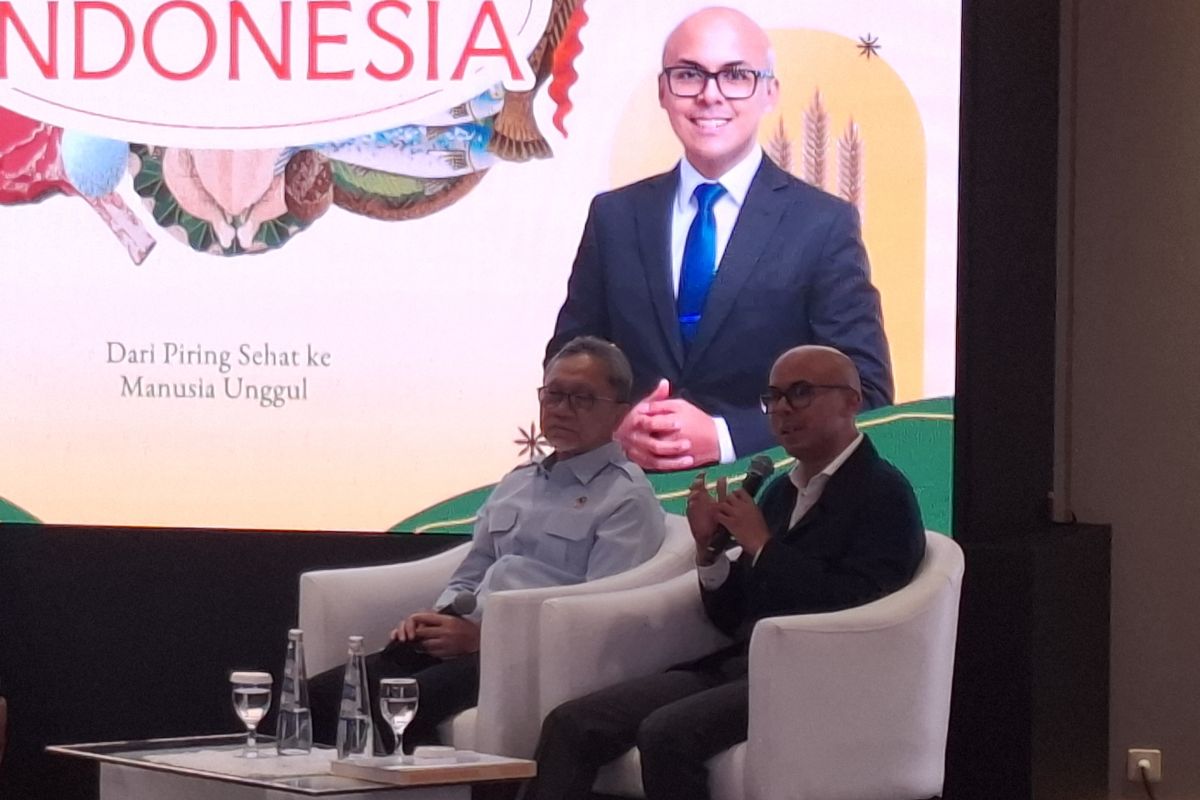
We need to make our people fall in love with our own food products.
Jakarta (ANTARA) - The Special Assistant to the President for Communication and Policy Analysis, Dirgayuza Setiawan, believes that the Free Nutritious Meal (MBG) programme can shape public consumption choices towards food that can be produced domestically.
Dirgayuza stated that strengthening food independence must be pursued not only through production and cost efficiency but also by considering the types of food that become popular among the public.
“That is why we need to make our people fall in love with our own food,” said Dirgayuza during the launch of the book ‘Indonesian Food: From Healthy Plates to Superior Humans’ at IdeaFest 2026 in Jakarta on Friday.
According to him, the MBG programme can serve two functions simultaneously: assisting in the absorption of produce from farmers and fishermen in the short term, and shaping public consumption preferences in the long term.
“The MBG is a mechanism not only to act as a short-term off-taker for our farmers and fishermen in every region, but also a way for us to determine consumer preference in the long run, so that our people prefer eating food that we can produce domestically,” he said.
Dirgayuza noted that consumer choice is linked to production, as public demand for certain types of food ultimately influences which commodities need to be provided and developed.
Therefore, he believes that strengthening food independence requires aligning the production side with the consumption side, including expanding public acceptance of food that is available and can be developed within the country.
This approach, according to Dirgayuza, is also crucial when certain commodities are difficult to produce competitively in Indonesia due to differences in resource conditions and production characteristics.
He assessed that public consumption patterns can evolve alongside the availability and introduction of certain food products.
Building consumer preference is seen as an aspect that must be addressed alongside increasing production capacity.
“We need to look at how we choose as consumers, because what we choose ultimately determines the outcome,” he added.
On the supply side, Presidential Regulation Number 115 of 2025 regarding the Management of the Free Nutritious Meal Programme mandates that the implementation of MBG prioritises the use of domestic products and the involvement of micro-enterprises, small businesses, cooperatives, Red and White Village/Sub-district Cooperatives, and village-owned enterprises.
In July 2026, the Coordinating Minister for Food, Zulkifli Hasan (Zulhas), mentioned that the MBG programme has already involved approximately 148,000 local food suppliers, consisting of village-owned enterprises (BUMDes), Red and White Village/Sub-district Cooperatives, farmer groups, livestock groups, and micro, small, and medium enterprises (MSMEs).
The government has directed the Nutrition Fulfilment Service Units (SPPG) to empower farmer groups, livestock breeders, fishermen, cooperatives, and MSMEs around the MBG kitchens to act as food suppliers, ensuring that supply does not rely on only one or two providers.
The National Nutrition Agency (BGN) previously emphasised that SPPG must prioritise local products, including absorbing supplies from breeders and businesses in each respective region.
In the same forum, Zulhas stated that strengthening domestic food production is also linked to efforts to reduce dependence on foreign supplies.
“If we are not self-sufficient in the food sector, our food will depend on imports,” said Zulting.
According to the Coordinating Minister for Food, food security and self-sufficiency are also related to the economic sustainability of communities that depend on the agriculture, fisheries, and livestock sectors.
“No country can advance without self-sufficiency. Therefore, President Prabowo says that self-sufficiency is an honour,” he said.
During the discussion, Zulhas and Dirgayuza positioned food not merely as a matter of production volume, but as an issue involving consumption patterns, producer welfare, nutrition, and food independence.
Dirgayuza assessed that the connection between production and consumption choices is vital so that the increase in domestic food capacity is accompanied by the formation of sustainable demand for national production results.