
Dire Straits for Mobile Phone Traders at ITC as Sales Plummet Severely in 2026
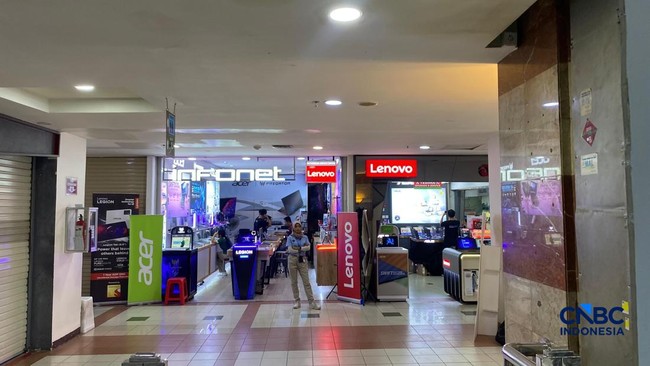
Jakarta, CNBC Indonesia - Mobile phone traders at ITC Kuningan are complaining about the difficulty of making sales since the beginning of 2026. This situation is partly caused by a global memory chip shortage, resulting from a sharp surge in demand for AI chips.
The disruption in memory chip supply has caused prices of mobile phone components to rise, forcing manufacturers to adjust selling prices. As a result, mobile phone prices have become more expensive worldwide, including in Indonesia. Mobile phone traders at ITC report that they have already felt a significant impact from this situation.
Several mobile phone traders at ITC Kuningan interviewed by CNBC Indonesia admitted that their sales have continuously declined in recent months. Some even said their sales have dropped by up to 50% since the beginning of 2026.
“It affects me a lot; my sales have been disastrous for two months,” said a mobile phone trader at ITC Kuningan, Jakarta, to CNBC Indonesia on Tuesday (7/4/2026).
He also said there was no significant change during the Lebaran period, which is usually a time of increased mobile phone sales. At that time, he only sold fewer than 30 units, down from 40 units compared to the previous year.
CNBC Indonesia observations show that price increases have occurred across almost all mobile phone brands. From the Samsung A07, which has risen by Rp 100-200 thousand, to the Oppo A6 at around Rp 900 thousand.
Increases have also occurred on phones with 4/64 GB memory configurations, which were usually priced around Rp 1.4 million, now exceeding Rp 2 million.
However, this price increase has not driven all customers away. A shop employee said some people still buy the phones they want despite knowing about the price rise.
“We just give them the knowledge; all prices are going up. Prices are up everywhere. If you wait, they’ll go up again because some shops have had two price increases,” explained the seller.
Chinese Mobile Phone Kings Begin to Surrender
Price increases for devices, including mobiles and laptops, have occurred since the chip shortage at the end of last year. Research firm IDC had predicted it, with the impact also felt in Indonesia.
Price adjustments have occurred in the low-price segment. For the middle and upper segments, it is still controlled because some costs are passed on to selling prices.
Not only in Indonesia, China is also affected by this chip shortage. Many mobile phone producers have rearranged shipments at the beginning of this year.
For example, Xiaomi and Oppo have reduced production by more than 20%. Meanwhile, vivo has reduced by nearly 15%, and Transsion, which oversees Tecno, Infinix, and Itel, recorded shipments down by up to 70%.
Declines in Chinese mobile phone giants are also recorded by Counterpoint. The research firm has cut its global mobile phone shipment projection for 2026 to minus 2.1%, including for Chinese manufacturers like Honor, Oppo, and vivo at minus 1% to less than 4%.
A Techwire Asia report states that the chip shortage is impacting low-end devices. That segment is not getting enough DRAM and NAND, so manufacturers have raised prices or cut standard features.
This memory chip shortage is hitting the Asia-Pacific market, which contains many cheap mobiles.
Cheap-priced mobiles usually take thin margins, making it unlikely they can handle chip price increases.
Counterpoint notes that the component cost for such phones is around US$200, jumping 25% from the beginning of the year. Meanwhile, mid-range and upper classes are 15% and 10% respectively.
This phenomenon also seems unlikely to stop in the near future. Because it is estimated that memory chip prices will continue to rise by up to 40% during Q2-2026, causing production costs to rise 8%-15%.