
Diplomacy from the Mihrab
There is a great paradox in today’s world. Humans find it increasingly easy to communicate, yet harder to trust one another. Technology shortens distances, while conflict widens the gap. Diplomacy arrives with increasingly sophisticated tools, alongside war, hate speech, disinformation, and identity politics finding new spaces to grow.
Data from the Uppsala Conflict Data Program (UCDP) shows that in 2025, 65 conflicts involving states on one or both sides were recorded, the highest figure since records began in 1946. Thirteen of these are categorised as wars. Approximately 244,600 people died due to organised violence. This figure indicates that the architecture of world peace requires much broader social energy.
As conflicts become more complex, efforts to build peace need to reach more actors. War has a geopolitical dimension, while peace requires social work at the community level. Conflict often begins with prejudice, exclusion, mistrust, and the manipulation of identity. It is at this point that religious leaders possess a strategic space.
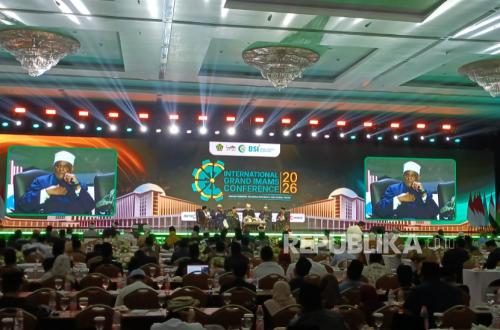
This idea finds its momentum in the International Grand Imams Conference (IGIC) 2026, which will take place from 25–28 September 2026 in Jakarta. This forum will bring together grand imams from various countries to discuss mosque harmony, religious diplomacy, and global peace. Istiqlal Mosque will serve as the centre of the event, with the ‘Istiqlal Understanding’ being prepared as one of the conference’s key outputs.
The question then arises: can religious moral authority be developed into a social force for peace?
Agents of Peace
For a long time, imams have been known as leaders of worship, religious guides, and guardians of the spiritual lives of their congregations. These functions remain fundamental. However, societal changes have expanded the field of social responsibility. Political polarisation, identity conflicts, extremism, and digital disinformation have entered the lives of the faithful, including the space of the mosque.
Therefore, the perspective on imams needs to be expanded: from religious authority towards peace agency. The concept of agency refers to the ability to act and influence social relations. An imam can serve as a spiritual leader, community leader, peace builder, and bridge builder.
The advantage of an imam lies in a capital that is often difficult for formal diplomacy to obtain: trust.
Diplomats work with state mandates, whereas imams interact through moral proximity to the community. In many communities, the voice of the imam is heard when the public faces social, humanitarian, or even inter-community tensions.
The United Nations has recognised the strategic position of religious actors in conflict prevention and resolution. Religious leaders possess moral authority and convening power, presence among conflict-affected populations, and the ability to reach groups that formal actors cannot always touch. The UNDP also places religious leaders and organisations as sources of information, trust, and influence in building social resilience and preventing violence.
Religious authority itself requires adequate capacity to become an energy for peace. Popularity and the number of congregants are not the sole measures. What is needed is peace capacity.
The 21st-century imam requires deep mastery of religious sciences alongside peace literacy, interfaith literacy, conflict mediation, and digital literacy. Imams need to understand how conflicts form, how social prejudice works, how propaganda and disinformation circulate, and how religious language can maintain social tranquility.
This need is becoming increasingly evident in the digital space. Sermons no longer stop at the pulpit; they move to the screen. Future imams must be able to build congregations in the mosque while presenting narratives of peace in the digital space.
Indonesia possesses significant social capital to develop this idea. The Ministry of Religious Affairs’ Mosque Information System (SIMAS) records hundreds of thousands of mosques and prayer rooms registered nationally. This figure illustrates the vast social infrastructure spread down to the community level.
Mosques can be developed as spaces for peace education, interfaith dialogue, humanitarian solidarity, community conflict mediation, and digital literacy. This perspective positions the mosque as a house of worship as well as peace infrastructure.