
Dinosaur Fossils Deepen Scientific Exchange Between China and Indonesia
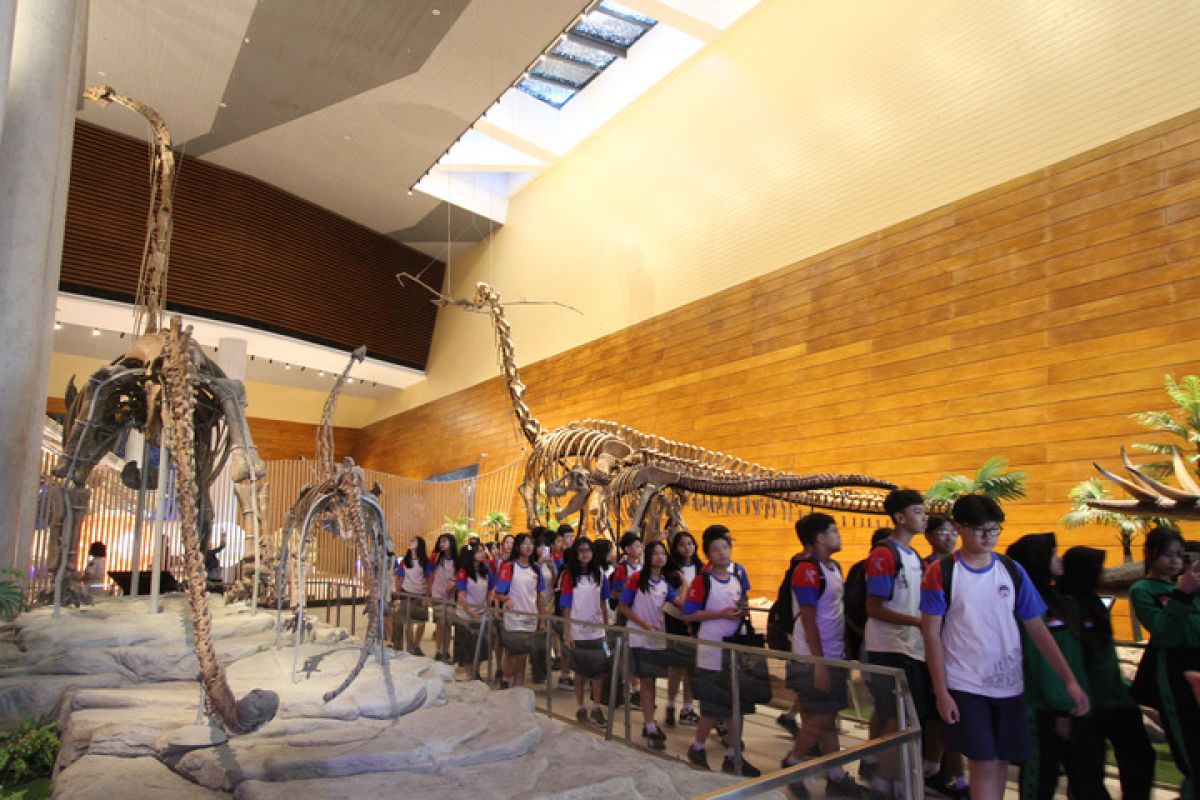
Under the towering skeleton of a long-necked dinosaur, student visitors crane their necks, their eyes tracing the fossil upwards as mobile phones capture the moment. “This dinosaur fossil is truly spectacular,” one visitor remarked in awe. The centrepiece of the exhibition is an adult Omeisaurus tianfuensis fossil from Sichuan Province in southwestern China. Measuring over 20 metres in length, the giant specimen dominates the exhibition hall of the newly opened Tahir Solo Museum. Around it, children and adults pause in amazement, many seeing genuine dinosaur fossils up close for the first time. The special exhibition, which opened on Saturday, marks the first time Chinese dinosaur fossils have been displayed in Indonesia, a country that has yet to discover any scientifically verified dinosaur fossils. This absence is closely linked to the geological history of the Indonesian archipelago. During the Mesozoic Era, when dinosaurs roamed the Earth, most of what is now Indonesia was still submerged under the sea. The Indonesian archipelago had not yet formed in its present shape, leaving few geological formations capable of preserving the remains of large land dinosaurs. This history makes the arrival of the fossils from China all the more significant. Alongside the adult Omeisaurus, there is a six-metre-long juvenile of the same species and a fossil of Huayangosaurus taibaii, considered one of the early ancestors of the stegosaurus group. All three fossils are classified as nationally valuable specimens in China. For local visitors, the fossils offer not only a glimpse of prehistoric giants but also a window into the evolution of life and the Earth itself. “Using dinosaur fossils as a cultural symbol with global appeal, this exhibition demonstrates the shared commitment of China and Indonesia to the preservation of natural heritage and science education,” said Luo Yingying, the museum’s director. She added that the specimens would provide valuable physical material for Indonesian academics studying Mesozoic Era dinosaur fossils in China. The thrill of discovery is not confined to the fossil hall. Life-sized animatronic dinosaurs roar, nod, and blink, delighting visitors and drawing families to pose for photographs. “All the models in the exhibition were produced in China and shipped to Indonesia,” Luo said. “We customised the accompanying descriptions so that the Indonesian public can better understand China’s achievements in science and technology.” The exhibition in Surakarta features 569 collections, including 106 first-level cultural heritage objects, and will run for approximately 180 days. A broader cooperation programme will continue until December 2026. At the opening ceremony, Wang Siping, cultural counsellor at the Chinese Embassy in Indonesia, stated that the completion of the museum was an important cultural event for Indonesia and Surakarta, adding that its presence would further enrich the cultural life of the local community. He also praised the museum’s founder, Tahir, and his foundation for their support of cultural facility development in Indonesia. Dato’ Sri Tahir, a prominent Indonesian entrepreneur, noted that many of the collections and models displayed in the museum originated from China. He said the dinosaur exhibition, the first of its kind in Indonesia, would provide a rare opportunity for the public to learn about dinosaurs and palaeontology. Noting the large ethnic Chinese community in Indonesia, Tahir, a leading figure in the Indonesian Chinese community, expressed his hope that the exhibition would help strengthen cooperation in science and education between the two countries. This cooperation is expected to extend far beyond the exhibition hall. Zeng Xiaoyun, director of the Zigong Dinosaur Museum, said both parties plan to establish long-term cooperation in joint scientific expeditions, fossil restoration, research sharing, and museum exhibitions. The exhibition also carries the hallmark of Zigong’s modern dinosaur industry. The city in Sichuan Province has grown into the world’s largest production centre for animatronic dinosaurs, hosting over 200 companies. According to a representative from Zigong Hualong Science and Technology Co., Ltd., products made in the city are exported to more than 80 countries and regions, commanding a 90 per cent share of the overseas market. For the dinosaurs from Zigong, the journey to Surakarta has connected fossils and technology, science and imagination, and two nations seeking new ways to learn from the past and explore the future.