
Digital Piracy Threatens Revenue in Indonesia’s Film and Streaming Industries
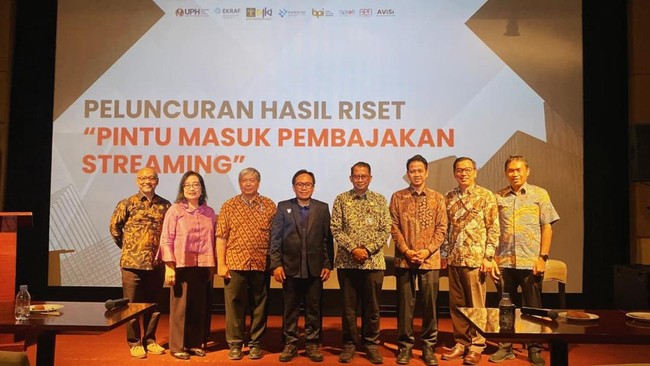
Jakarta, CNBC Indonesia — The Indonesian Film Board (BPI), the Indonesian Film Producers Association (APROFI) and the Indonesian Video Streaming Association (AVISI), together with Pelita Harapan University (UPH), launched the report “Digital Piracy in Indonesia 2026: Discovery Pathways, Consumer-Reported Risks and Verification of Access Facilitation” at the XXI cinema in Plaza Indonesia, Jakarta, on Thursday (5 November 2026). Its message was: “Protect creative works and consumers at piracy’s entry points”.
The October 2026 report, based on a non-probability online survey of 1,001 respondents across 32 provinces, recorded four key findings:
• Consumption of pirated content: 69.63% of respondents reported accessing pirated content in the previous three months.
• Promotion of piracy: 61.14% had encountered piracy promotions at least two to three times a week during the previous three months.
• Clicking advertisements leading to piracy: 54.65% had clicked an advert leading to pirated content, a website, an app or an offer for pirated devices.
• Piracy-related losses: one in five respondents reported financial losses that they associated with accessing pirated content.
As for promotional channels, TikTok was cited most often by respondents in the survey results (38.26%), followed by Facebook (32.97%) and Instagram (32.67%), as places where they encountered promotions for access to pirated content.
Speaking on behalf of BPI, APROFI and AVISI, BPI chairman Fauzan Zidni said: “A total of 61.14% of respondents encounter piracy promotions at least two to three times a week. We urge platforms to prevent such promotions in order to protect creative workers’ livelihoods, producers’ investment and the sustainability of legal streaming. We are ready to support this effort with evidence from rights holders and coordination on reporting.”
The research proposes government facilitation in line with each agency’s authority. The Directorate General of Intellectual Property (DJKI) at the Ministry of Law can provide guidance on copyright and evidence of ownership or authorisation. The Ministry of Communication and Digital Affairs (Komdigi) can facilitate dialogue with platforms and reporting channels.
The Ministry of Creative Economy (EKRAF) is proposed as a facilitator of industry participation and education on legal consumption. Contributions and follow-up measures should be agreed jointly.
Agung Damarsasongko, Director of Copyright and Industrial Designs at DJKI, said: “These findings are a reminder of the need to strengthen copyright education so that the public can better recognise piracy promotions and choose legal viewing options. We urge industry players and digital platforms to educate the public together that watching through legal services is a way of respecting creators and supporting the sustainability of Indonesian works.”
Cecep Rukendi, EKRAF’s Deputy for Media Creativity, said: “The fact that 69.63% of respondents reported accessing pirated content in the past three months is a reminder of the importance of protecting Indonesian works. Such protection supports the financing of future productions and the continuity of creative-sector jobs, alongside education that helps viewers find legal services.”
The study’s main recommendation is for platforms to reject advertisements promoting access to pirated content. For paid advertisements, checks should cover both the advert’s material and the destination of its link before publication. For organic promotions, platforms are expected to remove material verified as infringing copyright and prevent it from reappearing. Reporting channels and status updates, together with mechanisms for appeals and corrections, would help ensure accurate handling.
BPI can establish a joint point of contact and collect evidence from rights holders, including the work’s identity, proof of rights or authorisation, URL, suspected infringing material, time of discovery, screenshots and the access chain where relevant.
UPH Faculty of Economics and Business dean Gracia Ugut concluded: “In the sample, 91.31% of respondents agreed or strongly agreed that platforms should remove or restrict advertisements promoting access to pirated content. This support provides a basis for dialogue. UPH calls on the government, industry and platforms to strengthen prevention in order to protect creative works and consumers at piracy’s entry points.”
Source: jawawa.id (https://jawawa.id/newsitem/digital-piracy-threatens-revenue-in-indonesias-film-and-streaming-industries-1794199824)
Originally published by CNBC Indonesia (https://www.cnbcindonesia.com/lifestyle/20261109103339-33-783444/pembajakan-digital-mengancam-cuan-industri-film-dan-streaming-ri), translated from Indonesian