
Digital Economy Grows More Complex, Supreme Court Justice Candidate Urges Tax Court Reform
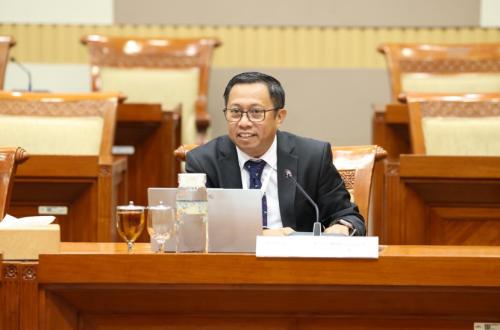
The development of the digital economy is considered to have further complicated taxation matters because cross-border transactions can generate economic value in Indonesia without the physical presence of business actors. This condition is deemed to require reform of the Tax Court so that it is able to handle disputes arising from digital business models.
Candidate for Supreme Court Justice for the Administrative Chamber (Tax), Yeheskiel Minggus Tiranda, said that cross-border transactions based on digital platforms allow global business actors to obtain economic benefits from the Indonesian market without a permanent physical presence.
“The digital economy has fundamentally changed the structure of national economic transactions. Cross-border transactions based on digital platforms are growing rapidly so that global business models have now obtained significant economic benefits from the Indonesian market without a permanent physical presence,” said Yeheskiel in a statement on Saturday (15/8/2026).
According to him, this condition raises issues of fiscal justice because domestic business entities remain subject to the conventional tax regime. Meanwhile, some digital business actors operating across jurisdictions can minimise their tax obligations through international legal loopholes.
The government has responded to these developments through a number of regulations, including the VAT collection scheme on Trade Through Electronic Systems (PPN PMSE). By mid-2025, the scheme had contributed approximately Rp40 trillion in state revenue.
“However, the acceleration of substantive regulation has not been matched equally by updates on the adjudicative side, namely the tax court as a dispute resolution forum,” said the Professor of Law at Sultan Agung Islamic University (Unissula) Semarang.
Yeheskiel assessed that the principle of permanent establishment, which has been one of the bases for cross-border taxation, is no longer fully adequate to reach digital business models that can create economic value without physical presence.
At the international level, this issue has been addressed through the two-pillar solution framework of the OECD/G20 Inclusive Framework on BEPS, which was agreed upon by more than 135 jurisdictions in October 2021.
“Pillar One regulates the reallocation of a portion of taxing rights over large multinational companies to market jurisdictions, while Pillar Two establishes a global minimum tax rate through the Global Anti-Base Erosion Rules,” he added.
In addition to digital economy issues, Yeheskiel highlighted the position of the Tax Court, which has been under a dual supervision pattern. Technical judicial supervision lies with the Supreme Court, while organisational, administrative, and financial supervision lies with the Ministry of Finance, which also oversees the Directorate General of Taxes, one of the parties in tax disputes.
“This configuration raises conceptual issues regarding the independence of judicial power as guaranteed by Article 24 of the 1945 Constitution of the Republic of Indonesia,” he explained.
According to Yeheskiel, this issue has become even more relevant following Constitutional Court Decision Number 26/PUU-XXI/2023. The decision mandates the full transfer of organisational, administrative, and financial supervision of the Tax Court to the Supreme Court no later than 31 December 2026.
“This decision confirms that the Tax Court is an inseparable part of judicial power, and is therefore subject to the one roof system principle that has been the foundation of post-1998 judicial reform,” he said.
On the other hand, developments in tax administration through Coretax are considered to have the potential to increase the volume of disputes. The system integrates taxpayer data more strictly and expands the basis for compliance monitoring.
“Without strengthening institutional capacity, adding an adequate number of tax judges, and utilising judicial technology, the increasing caseload risks slowing dispute resolution and ultimately reducing legal certainty for taxpayers,” he asserted.
Yeheskiel also assessed that harmonisation between the procedural law regime of the Tax Court and the procedural law of administrative courts needs to be studied after the transfer of supervision to the Supreme Court, especially regarding further legal remedies.
Another matter that needs attention, according to him, is the standard of proof for digital transactions and crypto assets that are cross-jurisdictional in nature, as well as dispute resolution mechanisms that support tax certainty.
Commission III of the House of Representatives previously approved 11 candidates for Supreme Court justices and three candidates for ad hoc judges at the Supreme Court after they underwent fit and proper tests. The approval was taken at a plenary meeting of Commission III of the House of Representatives on Thursday (13/8/2026).
For the Administrative Chamber (Tax), the approved candidates for Supreme Court justice include Yeheskiel Minggus Tiranda, Maftuh Effendi, and L.Y. Hari Sih Advianto.
Meanwhile, Sobandi and Nurmaningsih were approved as candidates for Supreme Court Justices for the Civil Chamber. For the Criminal Chamber, the approved candidates are Syamsul Arief, Sugiyanto, Sudharmawatiningsih, and Dhifla Wiyani.
Source: jawawa.id (https://jawawa.id/newsitem/digital-economy-grows-more-complex-supreme-court-justice-candidate-urges-tax-court-reform-1786787517)
Originally published by Republika (https://ekonomi.republika.co.id/berita/tjsppf416/ekonomi-digital-makin-kompleks-calon-hakim-agung-dorong-reformasi-pengadilan-pajak), translated from Indonesian