
Digital Economy Grows, but Funding for Indonesian Start-ups Remains Limited
Indonesia’s digital economy growth has not been matched by adequate investment in start-ups. Innovation, digital infrastructure and regulatory certainty need to be strengthened.
JAKARTA — Indonesia’s large digital economy market has not been matched by sufficient funding for start-ups. In 2025, Indonesian start-ups secured US$340 million, or 6.3 per cent of total start-up funding in Southeast Asia.
As global investors change their strategies, Indonesia’s challenge is to widen access to capital while encouraging technology companies to build sustainable businesses.
Minister of Communication and Digital Meutya Hafid said the sizeable value of national digital transactions gave Indonesia a foundation for economic growth.
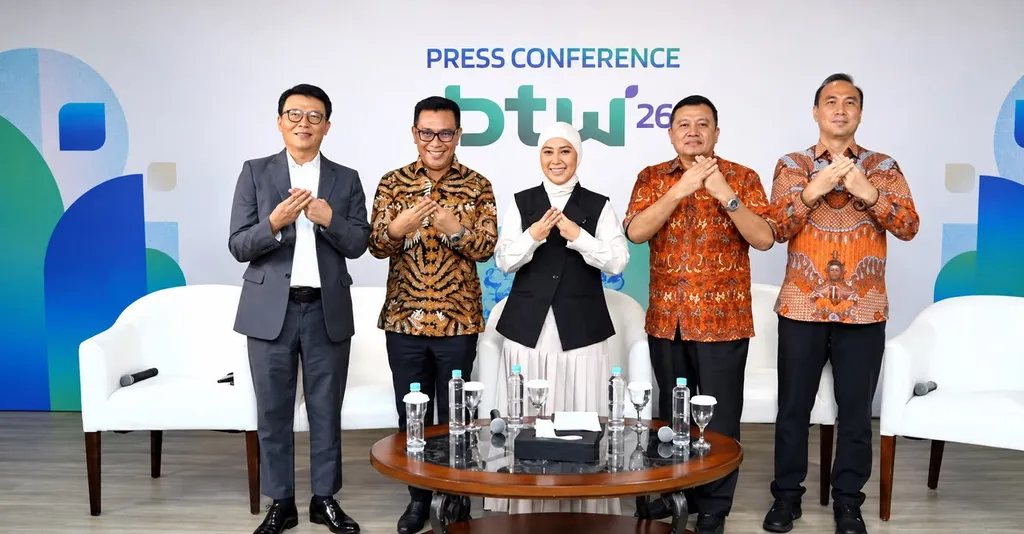
“Indonesia already has a substantial foundation. Our digital economy was worth US$99 billion in 2025, growing 14 per cent from the previous year. This is a major asset as we seek to lead the way towards 8 per cent growth,” Meutya said at a press conference for the 2026 Road to Bali Tech Week (BTW) in Jakarta on Tuesday (13 October 2026).
To connect investors with technology industry players, the Ministry of Communication and Digital Affairs is encouraging cross-sector collaboration through BTW 2026. The event, scheduled to take place in Sanur, Bali, from 19 to 23 October 2026, will feature several forums, including the HUB.ID Summit, Endeavor Global Forum and Bali Capital Circle.
The forums are designed to bring international delegates from 31 countries together with participants in the start-up, gaming, artificial intelligence (AI) and cyber security ecosystems. The government hopes the meetings will create opportunities for collaboration and investment in the technology sector.
A large digital economy market does not guarantee that funding will be distributed evenly among start-ups. Across the region, start-ups in Southeast Asia raised US$5.37 billion through 461 equity transactions in 2025.
The Southeast Asia Startup Funding Report 2025, published by DealStreetAsia, found that Indonesian start-ups raised US$340 million during 2025, equivalent to 6.3 per cent of total start-up funding in Southeast Asia.
This picture is consistent with a shift in investor priorities towards the quality of growth, capital efficiency and clear routes to profitability. The e-Conomy SEA 2025 report by Google, Temasek and Bain & Company showed that private funding for the region’s digital economy sector rose 15 per cent to US$8 billion.
Meanwhile, a DS Group compilation as of 5 October 2026 put announced funding for Indonesian start-ups at US$392 million. That exceeds the US$358 million recorded for all of 2025 in the same data series. Even so, the figure is not enough to demonstrate a broad-based recovery in funding.
As of 5 October 2026, 24 transactions had been recorded, compared with 97 during 2025. Because the observation periods differ, the two figures cannot be directly compared. However, the funding total may indicate that capital is still flowing into the start-up ecosystem.
The data suggest that technology funding is not entirely in decline, with some indicators pointing to stabilisation. However, capital is becoming more concentrated in companies with more mature business models and clearer profit prospects.
For Indonesian start-ups, the challenge is not only to attract investors, but also to demonstrate their ability to develop technology, maintain operational efficiency and build sustainable businesses.
GoTo chief executive Hans Patuwo said tighter global funding conditions should not stop digital industry players from innovating. Funding opportunities remain available to start-ups capable of producing innovative and distinctive products.
“Admittedly, compared with 2018–2019, the bar is higher. But funding is still available for start-ups that are genuinely innovative and create something unique. In recent months, we have also seen new investment entering Indonesia’s start-up ecosystem,” Hans said.
Telkom Indonesia Network director Budi Satria Dharma Purba said better connectivity required more than expanding internet access. Digital infrastructure must also support innovation and improve the competitiveness of national companies in the region.
The necessary infrastructure includes submarine cables, fibre-optic networks, data centres, cloud computing services and cyber security. “That is why we need collaboration, and we hope for regulations that create a favourable climate for long-term investment,” Budi said.
For technology companies, developing the digital ecosystem is also tied to their ability to provide services that meet people’s needs. Hans added that GoTo began developing its products by addressing problems faced by consumers, driver-partners and businesses.
“We start with customers’ pain points, whether they are consumers, driver-partners or businesses. If the entire technology ecosystem develops, we and other start-ups will benefit too,” Hans said.
The government hopes BTW 2026 will provide a forum for gathering feedback from investors and industry players on developing the national digital ecosystem. Alongside investment opportunities, policy certainty is among the issues highlighted by the government and industry.
Meutya said the government wanted to ensure that regulations were predictable, giving investors certainty when making business decisions. It also emphasised the importance of fair competition for foreign investors, start-ups and local entrepreneurs alike.
“The regulations we issue will not come as a shock; they will be predictable, so investors feel comfortable. The government is here to ensure fair competition not only for foreign investors, but also for start-ups and local entrepreneurs seeking to build Indonesia’s digital transformation,” Meutya said.
Indonesia’s digital market offers opportunities to develop the technology industry. To turn those opportunities into investment and stronger national companies, market growth needs to be accompanied by innovation, adequate infrastructure and policies that provide certainty for start-up businesses.
Source: jawawa.id (https://jawawa.id/newsitem/digital-economy-grows-but-funding-for-indonesian-start-ups-remains-limited-1791910236)
Originally published by kompas.id (https://www.kompas.id/artikel/ekonomi-digital-tumbuh-pendanaan-startup-indonesia-masih-terbatas?open_from=Jawa_Page), translated from Indonesian