
Digital Assets Begin to Enter Indonesia's Investment and Financial Sector Agenda
Digital assets are increasingly becoming a central part of discussions regarding investment and the financial sector in Indonesia. This aligns with the efforts of Indonesian regulators to prepare regulations for stablecoins and asset tokenisation, while simultaneously exploring blockchain technology as a new pathway to expand access to capital.
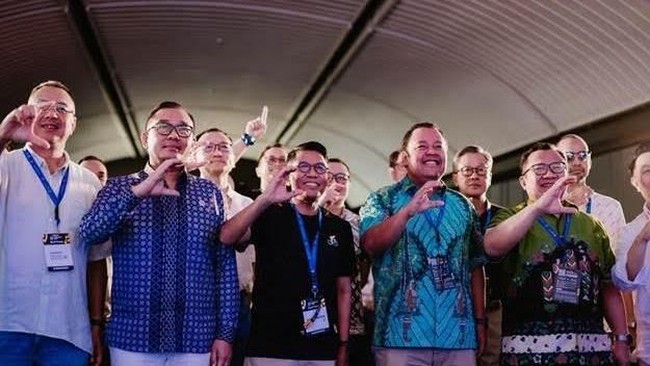
This direction was a key theme at Coinfest Asia, The World’s Crypto Festival, held in Bali on 20-21 August. Attended by approximately 10,000 participants from over 90 countries, the forum brought together regulators, policymakers, investors, financial institutions, technology companies, and global industry players to discuss the development of digital assets and the future of finance.
Amidst broader industry discussions in Asia, Indonesian officials brought several domestic agendas, ranging from changes in crypto asset regulations to the investment requirements needed to pursue economic growth targets.
OJK Brings Crypto Closer to the Financial Sector
Adi Budiar Malaysia, the Executive Head of Financial Sector Technology Innovation, Digital Financial Assets, and Crypto Assets at the Financial Services Authority (OJK), stated that the regulator is finalising several agendas following the amendments to the Law on the Development and Strengthening of the Financial Sector (P2SK).
One of these is the recognition of crypto asset providers as financial service institutions. OJK is also preparing a Single Investor Identification (SID) to align the identification of crypto investors with the capital market system.
Regarding stablecoins, Adi stated that OJK regulates them as transaction instruments rather than payment tools, in coordination with Bank Indonesia. Several stablecoins pegged to the rupiah have already undergone a regulatory sandbox.
OJK is also drafting regulations for the tokenisation of real-world assets (RWA) after testing several models, including Government Securities (SBN) and property economic rights.
“Today, at this Coinfest Asia forum, I want to declare that Indonesia’s on-chain economy is coming soon,” said Adi on Thursday (20/8/2026).
He linked this development to the deepening of financial markets and the 8% economic growth target for 2029. According to Adi, tokenisation can be used to expand access to funding, including for small and medium enterprises.
DPR: The Fundamental Regulations are Already in Place
On the regulatory side, the Chairman of Commission XI of the Indonesian House of Representatives (DPR RI), Mukhamim Misbakhun, emphasised that digital financial assets have a legal basis through the P2SK framework.
Other changes have been underway since January 2025, when the supervision of crypto assets began transitioning from a commodity regime under the Commodity Futures Trading Regulatory Agency (Bappebti) towards the OJK and the financial services sector framework.
“In Indonesia, this is already established by law. Its position is very high in the regulatory hierarchy,” said Misbakhun.
Misbakhun also stated that regulation is necessary so that Indonesia possesses a strong domestic market and that the activities of Indonesian citizens do not take place outside national jurisdiction.
“Therefore, I always convey that we must be the hosts and the strength for our national assets. We must not allow transactions to occur abroad, performed by our own people,” he said.
However, he assessed that regulations must still allow room for technological development.
“Supervision must not hinder. Regulation must not kill or obstruct innovation,” he added.
One area he highlighted was tokenisation. Misbakhun mentioned SBN, mining assets, property, and infrastructure such as toll roads and ports as assets with the potential to utilise such schemes.
“If we turn them into real-world assets and then perform tokenisation, it would be extraordinary,” he remarked.
Government Seeks New Investment Sources
Discussions on tokenisation also emerged from investment needs. The Deputy Minister of Investment and Downstreaming/Deputy Head of BKPM, Todotua Pasaribu, stated that Indonesia requires approximately US$789 billion in investment throughout 2025-2029 to support the 8 per cent economic growth target by 2029.
This requirement necessitates that the government expands investment sources and methods for connecting capital with economic opportunities.
“We need new technologies and new ways to connect capital with economic opportunities. This is where digital assets and blockchain become increasingly relevant,” said Todotua.
He noted that Indonesia already has over 22 million crypto users, but this scale should not stop at mere adoption.
Todotua explained that one possible use is tokenisation to link funding with investment realisation. He cited assets such as villas and hotels, as well as industrialisation activities, as sectors that can be explored.
“Tokenisation is actually a very easy way to release existing funding to become realised investment,” said Todotua.
According to him, the government’s interest remains on investment realisation and the actual inflow of capital into Indonesia.
Digital Assets Enter Financial Hub Discussions
Discussions regarding capital sources were also brought forward by the Executive Director of the National Economic Council (DEN), Pantro Pander Silitonga. Pantro stated that Indonesia is developing the concept of an international financial centre by studying models such as Dubai, Abu Dhabi, and Singapore.
He noted that the concept cannot rely solely on a single instrument like a family office, but requires an environment that provides certainty for global capital.
“We need a conducive environment so that global capital can enter,” he said.
Pantro stated that legal certainty, financial market depth, and regulation are several issues that frequently arise in discussions with international investors.
In the draft presented, the financial centre would accommodate various services and instruments, ranging from banking, insurance, and private equity to SPVs, trusts, and alternative investment funds.