
Difficulty Finding Work: Sent 5,000 Applications but Still Unemployed
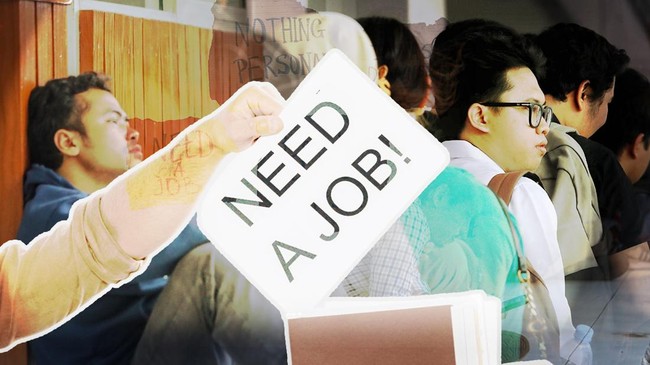
The difficulty of finding employment remains a common struggle for many job seekers in Indonesia. Some have even admitted to sending thousands of job applications without securing employment after several years.
These stories have been widely shared by netizens on the social media platform Threads, where they recount their experiences of unemployment. One user, @hand***, claimed to have been searching for a job for nearly three years, applying to more than 5,000 companies. “It has been 3 years (unemployed), I have applied to over 5,000++ companies; only about 100 were called for interviews, the rest ghosted me,” the account wrote.
Of the approximately 100 interview calls received, the user claimed only about 10 proceeded to the stage of interviewing with the end-user or potential supervisor, while other recruitment processes stopped at the HR interview stage. The individual even admitted to participating in paid sessions regarding job application techniques, yet has still not achieved the desired results.
Similar stories have emerged from other netizens. The account @ifarina**** admitted to sending around 1,000 applications during the first four months of unemployment. However, after a year without finding work, they admitted to no longer actively sending applications.
Another user, @nengresahera, shared that they have been unemployed for about 1.5 years. Amidst the job search, they chose to sell ‘seblak’ and assist with their parents’ business. Meanwhile, the account @ixxo briefly described their experience, stating they have been searching for work for two years since graduating.
These stories from job seekers emerge amidst the large number of higher education graduates who have yet to be absorbed by the labour market. Data from the Indonesian Central Statistics Agency (BPS), cited by Universitas Airlangga (UNAIR), shows that approximately one million university graduates in Indonesia are still looking for work.
Professor Bagong Suyanto, a Professor at the Faculty of Social and Political Sciences (FISCS) at UNAIR and an educational sociologist, assesses that one of the problems faced by university graduates is the mismatch between the competencies they possess and the needs of the labour market. As the industrial world evolves rapidly, many university graduates are deemed to lack the skills relevant to corporate requirements.
“A bachelor’s degree is no longer a guarantee for someone to obtain a job and improve their standard of living,” said Bagong, as cited from the official UNAIR website.
Bagong believes the issue is not solely related to the abilities of graduates. The direction of economic development also determines the extent of available employment opportunities. He noted that industrial development in Indonesia tends to prioritise capital-intensive industries that rely on technology, machinery, and capital, resulting in relatively lower labour requirements.
The issue for university graduates does not end with those who are unemployed. A recent report by the Institute for Economic and Social Research of the Faculty of Economics and Business, University of Indonesia (LPEM FEB UI), titled “When Access to Higher Education Increases, Is the Labour Market Ready?”, found that approximately 8 million bachelor’s graduates are working in jobs that require a lower level of education than the qualification they hold.
This phenomenon is known as overeducation. This condition indicates that the growth in the number of highly educated workers is occurring faster than the creation of professional jobs that require high-level skills.
Based on an analysis of the National Labour Force Survey (Sakernas) for August 2025, LPEM FEB UI also found that five fields of study account for approximately 40% of the total unemployment among those with at least a bachelor’s degree. Management holds the largest share at 10.3%, followed by law at 9%, economics at 8.7%, education at 7.1%, and accounting at 5.1%. Computer science or informatics also accounts for about 4.6% of unemployment among those with at least a bachelor’s degree.
However, LPEM FEB UI emphasised that these figures do not represent the unemployment rate for each specific major. The data shows the composition of study fields within the group of unemployed individuals with at least a bachelor’s degree, and therefore cannot be used to conclude that certain majors have the worst job prospects. The findings suggest that the challenge in the labour market for university graduates is not merely about finding a job, but whether the available opportunities can absorb the increasing number of educated workers and provide roles that match their level of education and competence.