
Difficulty Finding Office Jobs Leads Gen Z to Pursue Skilled Trades for High Salaries
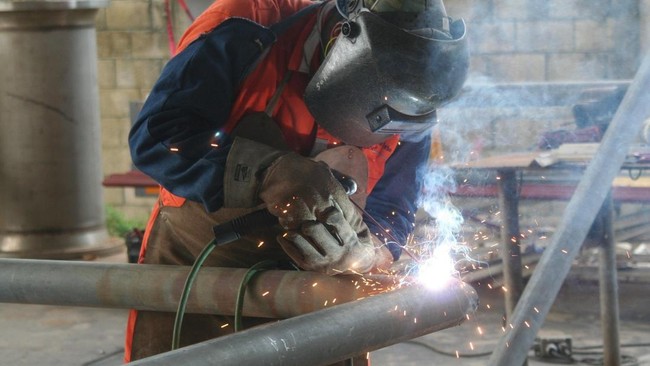
Many assume that the future lies behind office desks and computer screens. However, reality is now moving in the opposite direction. Amidst the wave of Artificial Intelligence (AI) that is beginning to take over administrative tasks, the younger generation is ceasing to pursue office jobs and is instead turning to professions that rely on manual skills. Surprisingly, the income offered can be far greater than that of most university graduates, even reaching billions of rupiah per year.
This phenomenon is most visible in the United States. Vocational schools are being flooded with applicants for classes in carpentry, welding, manufacturing, and electrical engineering. Once considered a second-choice option, these career paths are now highly sought after because they are deemed more secure against technological changes.
A high school in Middleton has even injected US$90 million (approximately Rp 1.5 trillion) to equip its manufacturing laboratory with advanced robotic arms and computerised equipment, attracting more than 2,300 students in a short period.
Today’s blue-collar jobs are no longer just about holding a hammer or welding. Factories and project sites are now filled with sophisticated machinery, automation systems, and devices that require high technical expertise to operate. This is what makes skilled labour increasingly sought after—abilities that cannot simply be replaced by computer code.
One of the most striking examples comes from AI data centres. The construction of thousands of data centres supporting AI systems worldwide is creating massive demand for field technicians, particularly electrical technicians.
Television presenter Mike Rowe shared an extraordinary account while visiting a large data centre in Texas. The technicians working there are under the age of 30, do not hold university degrees, and earn between US$240,000 and US$280,000 per year—equivalent to approximately Rp 4.3 billion to Rp 5 billion per year. They can take as much overtime as they desire, are free from student debt, and are constantly being headhunted by other companies.
Quincy Millerjohn, a welding instructor, confirms a similar trend. Workers in steel mills are now earning between US$41 and US$52 per hour, or roughly Rp 727,000 to Rp 922,000 per hour.
“There is a change in perspective. Manual labour is now becoming a high-skill, high-pay profession. Young people like it because they can see the tangible results of their work,” said John Mihm, a government education consultant in Wisconsin.
Professions Predicted to be Replaced by AI
This shift is occurring because more desk-based jobs are threatened by replacement by AI systems. A report from the World Economic Forum estimates that approximately 83 million jobs could change or disappear between 2023 and 2027.
About 23% of job types will undergo significant changes, particularly in administration, record-keeping, customer service, and finance. The following 15 professions are projected to experience the most significant decline in demand:
Bank tellers
Postal workers
Cashiers and ticket agents
Data entry staff
Secretaries and administrative staff
Stock clerks
Accounting, bookkeeping, and payroll staff
Legislators and government officials
Statistical, insurance, and finance staff
Street vendors and direct sellers
Security guards
Credit and loan managers
Insurance investigators and claims examiners
Software testers
Customer relationship managers
Meanwhile, in Indonesia, a similar trend is beginning to emerge. The development of data centres and the rapid need for digital infrastructure are creating opportunities for technical personnel who were previously overlooked.
Jobs that require a physical presence, practical skills, and on-site problem-solving are becoming increasingly valuable because they are difficult to replace remotely or by automated systems. Electrical technicians, air conditioning technicians, construction workers, and welders are increasingly in demand alongside the construction of data centres and communication networks across various regions.
Source: jawawa.id (https://jawawa.id/newsitem/difficulty-finding-office-jobs-leads-gen-z-to-pursue-skilled-trades-for-high-salaries-1791359618)
Originally published by CNBC Indonesia (https://www.cnbcindonesia.com/tech/20261007130156-37-774058/susah-cari-kerja-kantoran-gen-z-pilih-belajar-tukang-demi-gaji-tinggi), translated from Indonesian