
Didik J. Rachbini: Rp360 Trillion Data Centre Investment Opportunity Must Not Repeat Past Mistakes
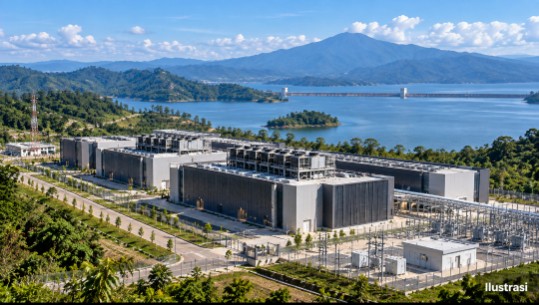
JAKARTA – INDEF economist and Rector of Paramadina University, Didik J. Rachbini, has addressed the controversy surrounding the suspension of data centre construction in Jatiluhur, West Java. He warned the government not to repeat the policy blunders of the 1980s, which caused Indonesia to miss a golden opportunity for semiconductor investment.
Didik noted that Indonesia is currently viewed as a viable investment destination, with no less than investments worth an equivalent of Rp360 trillion competing to enter the country. Target areas for these data centres include Batam, West Java, Madura, and Bali.
“This development is a golden opportunity that must not fall into the same pit as the 1980s, where we lost the golden opportunity for semiconductor investment,” Didik stated in a briefing on Sunday (4/10/2026).
According to him, investor interest and enthusiasm are already significant, and the government must be prepared given the sheer scale of this investment. This opportunity could help bridge Indonesia’s investment gap compared to neighbouring countries. The government has set a target for AI data centre investments worth Rp360 trillion to enter Indonesia. Indonesia’s recent track record is a key consideration for investors, as at least 182 data centres are already operational in the country. This indicates that Indonesia is capable of managing advanced data centre technology, with the majority located in Jakarta (94 units) and Batumn (16 units).
Specifically in Batam, Didik noted that planned data centre investments are estimated to be worth US$15-20 billion, with a national capacity target of approximately 1.3 gigawatts. Batam, with a regional economic growth rate of 7 per cent, is poised to become a new growth hub driven by this data centre investment pillar.
Jatiluhur Dispute Damages Investment Climate
Didik expressed regret that in West Java, a dispute has arisen where data centre construction was unilaterally halted by the Governor, citing environmental concerns, water supply, and various other reasons.
“Policy practices that damage the investment climate like this are a major obstacle to the future of an economy that is currently struggling to maintain moderate 5 per cent growth,” he asserted. He emphasised that Indonesia requires large-scale investment, and the current golden opportunity lies in maintaining investor confidence. The obstacles in West Java could potentially ruin the investment climate.
“We could become as foolish as a mouse falling into the same hole twice, precisely what the Governor of West Java is doing right now,” Didik criticised. He reminded the public of the 1980s policy blunder when the government indirectly drove away semiconductor investment opportunities due to being anti-automation, under the pretext of protecting manual labour.
“That 1980s blunder occurred when global tech giants such as Fairchild Semiconductor, National Semiconductor, and Monsanto had established large chip assembly bases in Jakarta and Bandung, but were indirectly suppressed by the government,” he explained. In 1985, a policy conflict regarding production automation occurred, which was won by an orthodox faction that limited automation to force the use of manual labour by investors.
“Naturally, such archaic policies were unsuitable for their advanced investments, and they eventually moved to Penang, Malaysia,” said Didting. This mirrors the current situation in West Java, where investments have been initiated only to be unilaterally halted. This serves as a heavy blow to investors and acts as a fatal blow to investment by failing to provide a comfortable and certain investment climate.
Learning from Malaysia
Didik reminded that in the 1970s and early 1980s, Indonesia led the semiconductor industry in Southeast Asia. However, due to poor policies, its position was overtaken by Malaysia.
“Past improper policy practices and failure to market investments against neighbouring countries caused that opportunity to fly away. Today, Malaysia controls about 13% of the global market share for chip testing, assembly, and packaging activities,” he explained.
Therefore, the central government must immediately anticipate obstacles from regional governments that damage the investment climate.
“On the ground, programmes must start with investment-friendly regional governments. Batam can become a primary regional data centre hub because Singapore is beginning to limit new developments due to land and energy constraints,” said Didik. Batam can seize this opportunity, supported by three main factors, including the fact that Indonesia is the largest digital economy hub in ASEAN with over 200 million internet users.
Didik added that major tech investors have already announced investments of US$1.7 billion for the expansion of cloud and AI infrastructure in Indonesia, while AWS has committed US$5 billion.
“Firmus is even building a data centre campus in Batam with a target of 170,000 AI accelerators. National data centre capacity is projected to exceed 2,000 MW by 2030, with demand growing at 16.8% per year according to World Bank projections,” he concluded.
Source: jawawa.id (https://jawawa.id/newsitem/didik-j-rachbini-rp360-trillion-data-centre-investment-opportunity-must-not-repeat-past-mistakes-1791107459)
Originally published by mediakarya.id (https://www.mediakarya.id/didik-j-rachbini-peluang-investasi-data-center-rp360-triliun-jangan-sampai-seperti-pelanduk-terperosok-dua-kali/), translated from Indonesian