
Did Trump have a stroke because he lost the war with Iran?
DW Indonesia Fact Check conducted verification regarding this claim.
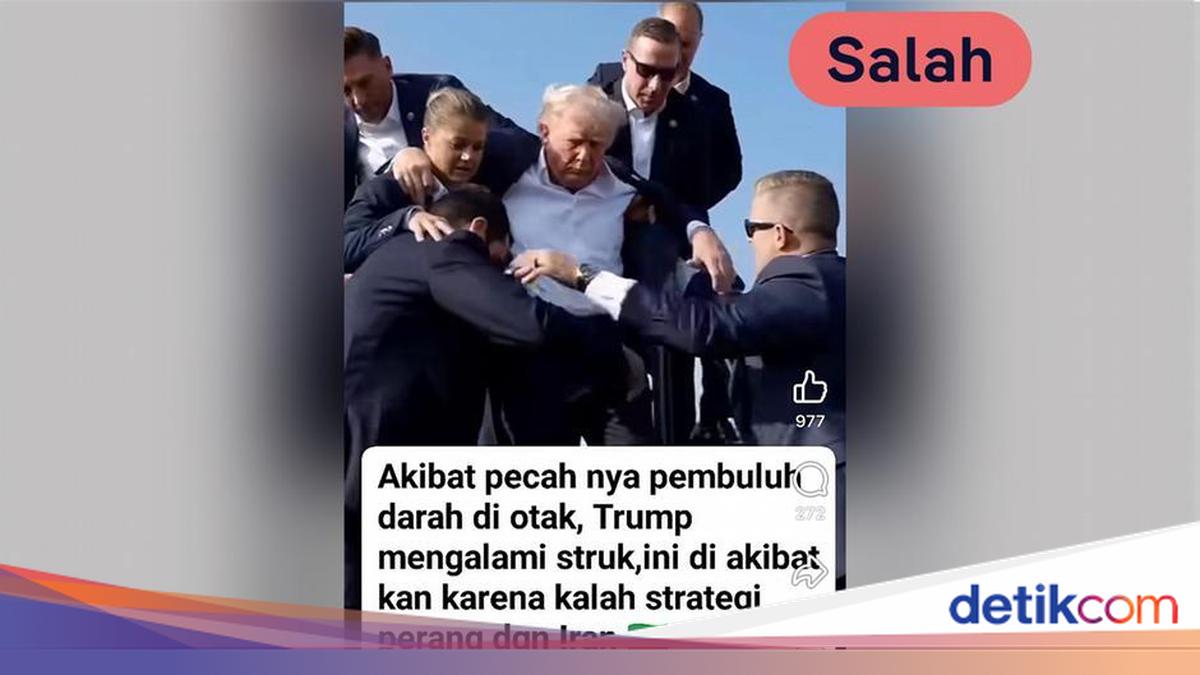
Claim: “As a result of a burst blood vessel in the brain, Trump suffered a stroke; this was caused by losing the war strategy with Iran.”
DW Fact Check: False.
On examination through Hive Moderation, the video is not AI-generated. Additionally, based on results from Google Reverse Image search, the video did not originate from a recent event but is an older recording from an incident during a Donald Trump campaign rally in Pennsylvania, United States, in 2024. In that incident, Trump was indeed seen being assisted by the US Secret Service, but the context was security procedures after the incident, not due to a medical condition such as a stroke.
Furthermore, searches using the keyword “Shooting at Trump Rally Pennsylvania” show another recording from a different angle that reinforces the chronology.
To date, there have been no official reports from the White House, the presidential medical team, or credible media naming Trump as having suffered a stroke, let alone linking it to a conflict or strategy with Iran.
What about the pattern of “recycled” hoax videos?
This phenomenon illustrates a pattern that frequently appears in the spread of disinformation, namely the reuse of old videos with new hoaxes. Fact-check Analyst Mafindo, Aribowo Sasmito, explains that hoaxes typically “piggyback” on issues that are widely discussed to attract attention and spread widely.
“Why bother making hoaxes if people are not paying attention? In other words, the debate isn’t as lively as when there is something the public is paying attention to,” Aribowo told DW Indonesia.
He also added that in such situations, emotion often dominates verification, so social media users tend to share information, including viral videos, without verifying its truth.
“Even if people know that the source is unclear, we don’t know whether Trump is truly stroked or not. So it ultimately goes back to the basic fact that people are often misled by their emotions,” he continued.
Is technology a challenge in an era of widespread misinformation?
In a broader context, Drone Emprit analyst Rizal Nova Mujahid assesses that technological developments actually add to the challenge of distinguishing authentic content from AI manipulation.
“Actually, that is a challenge for technology, even to this day. Because images or videos produced by AI are becoming better and more secure, at a glance it becomes harder to recognise,” Nova told DW Indonesia.
Nova adds that this condition makes the public increasingly dependent on the transparency of content creators and digital platforms. He notes that content labelling is crucial so people can immediately recognise whether content is potentially misleading or not. He also emphasises the need for active government and platform involvement in verifying circulating content.
“We depend on the willingness of content creators to label this as AI-generated or not AI, so we can immediately recognise whether it is a hoax or not. The next strategy is to urge the government to push for verification by platforms,” Nova said.
This viral Trump video demonstrates how context can be stripped away to construct a false narrative. Not only that, videos related to the Iran conflict and even a meeting between President Prabowo and President Putin have repeatedly been used to spread hoaxes due to the large public attention on global issues.
In the flood of information, the public is reminded not to react hastily, but to critically check sources and context before believing and sharing.