
Developing LIVE, Majenang Regional Hospital Strengthens Its Digital Patient-Service Ecosystem
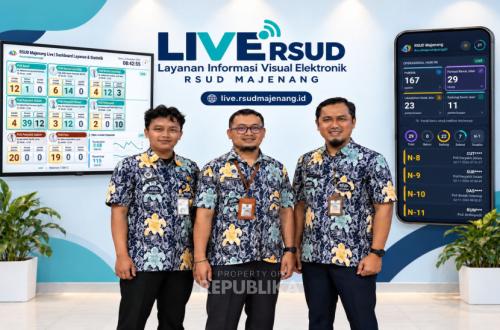
MAJENANG — For hospital patients, waiting is often about more than how long it takes. The uncertainty is what they feel most: How far has my queue progressed? Has the doctor started seeing patients? Will there still be a queue at the laboratory after my outpatient appointment? How far along is the process for my medicine?
These questions may sound simple. But for patients and their families navigating several stages of care in a single day, certainty matters. It was from these everyday concerns that Majenang Regional Hospital developed LIVE RSUD Majenang, short for Layanan Informasi Visual Elektronik (Electronic Visual Information Service).
The web-based platform, accessible at live.rsudmajenang.id, is designed to help the public monitor queues and hospital service information more easily.
LIVE was initiated by Dr Indra Setya Permana, SpPD, FINASIM, MMR, and developed with the hospital’s IT team as part of efforts to strengthen its digital ecosystem.
“Technology in hospitals should start with problems that patients and staff genuinely experience. We saw that one straightforward need was certainty about information. Patients should be able to follow the progress of their care without having to ask staff repeatedly,” Dr Indra said.
From data to information
Hospitals generate large amounts of data every day. Hospital information systems and electronic medical records have become an important part of healthcare delivery. But having data does not necessarily mean patients receive the information they need. LIVE aims to bridge that gap by presenting operational information that is appropriate for public access in a format that is easy to view on a mobile phone.
Patients and their families can open a single page to see the available service information. LIVE is being developed to cover outpatient clinic, laboratory, radiology and pharmacy queues, as well as other relevant service information. Patients have a reference point before asking staff, while family members can obtain information from the same source.
Connected to Majenang Hospital’s digital ecosystem
LIVE does not operate in isolation. The platform is integrated with SIMPONITARI PLUS, Majenang Regional Hospital’s registration and digital-services application. The integration links the process before a patient arrives at the hospital with the service information they need during their visit.
SIMPONITARI PLUS is available on Android and iOS devices. Its presence on the Google Play Store and Apple App Store extends access to the hospital’s digital services across the two main mobile platforms.
This integration means the hospital’s digitalisation is not confined to a single app. Patients can plan their visit and register through SIMPONITARI PLUS, then use LIVE to follow queue progress and service information.
The approach reflects a broader vision for a digital service ecosystem. Rather than developing each application as a separate service, the hospital aims for them to support one another throughout the patient journey — before arrival, during the hospital visit and when accessing subsequent service information.
Open information, protected patient data
Making service information public does not mean exposing patients’ medical data. This principle is central to the development of LIVE. Information displayed publicly must be clearly distinguished from medical records and individual health information. Health data is personal data that must be protected, so the public dashboard is intended to show only the minimum information the public needs.
LIVE is not designed as a gateway to patients’ medical records. Any personal information that may be made available in future would require separate authentication and authorisation mechanisms.
Helping patients plan their time
The intended benefits of LIVE are practical. Patients can check queue progress, families can anticipate the next stages of care, and staff can draw on a shared source of information when explaining queues to the public. For patients travelling from relatively distant areas, this certainty can help them plan their time at the hospital. Queue information, however, should not be treated as a guarantee of an exact examination time.
Patients’ clinical conditions, emergencies, examination requirements and case complexity can affect the order and duration of care. One of LIVE’s guiding principles is therefore to make information more transparent without restricting clinical flexibility.
Developed within the hospital
Another notable feature of LIVE is the involvement of Majenang Regional Hospital’s in-house IT team. The hospital’s programmers work closely with doctors, nurses, registration staff, laboratory and radiology teams, pharmacy staff, public-relations personnel and managers who deal with service issues every day.
“Our IT team has considerable potential. The challenge is translating needs from the front line into a simple system that people will genuinely use. That is why development does not stop when an application is completed. Feedback from patients and staff is an important part of what comes next,” Indra said.
For Majenang Regional Hospital, digital transformation does not always have to begin with a complex system. A problem can be selected, a solution developed and tested, and then improved based on users’ experiences. Applications should become part of service improvement, rather than simply a technology project.
Towards a more transparent hospital
LIVE also creates opportunities to use information for the hospital’s internal operations. If operational data is presented effectively, department heads and management can identify service bottlenecks, changes in patient numbers, unit workloads and where resources may need to be adjusted.
At a later stage, an internal dashboard could be developed to help leaders monitor service trends and quality indicators more quickly. Timely updates, system integration, security, network reliability, ease of use and the long-term capacity of the IT team will all be important to further development.
LIVE’s impact will also need to be measured. Evaluation could cover waiting times, complaints about information, the number of repeated administrative enquiries, patients’ understanding of service pathways, and system reliability before and after implementation.
Regional areas are no barrier to innovation
Digital transformation in healthcare does not have to come only from large hospitals in metropolitan cities. Regional hospitals have distinct advantages: service problems are directly visible, system users are close to developers, and improvements can be designed around local needs.
LIVE and SIMPONITARI PLUS show the direction Majenang Regional Hospital is taking. The aim is to make services easier to access, provide information, monitor queues and plan visits. At the same time, operational data can help staff and management improve services. Technology is not the ultimate goal; success is measured by the changes people experience. From a regional hospital in Cilacap Regency, Majenang Regional Hospital is seeking to show that innovation can start with a simple problem and grow into an interconnected digital service ecosystem.
Source: jawawa.id (https://jawawa.id/newsitem/developing-live-majenang-regional-hospital-strengthens-its-digital-patient-service-ecosystem-1793587916)
Originally published by Republika (https://rejogja.republika.co.id/berita/tnusa2291/kembangkan-live-rsud-majenang-kuatkan-ekosistem-digital-pelayanan-pasien), translated from Indonesian