
Destry’s Art of Supporting the Rupiah: More Than Just Market Intervention
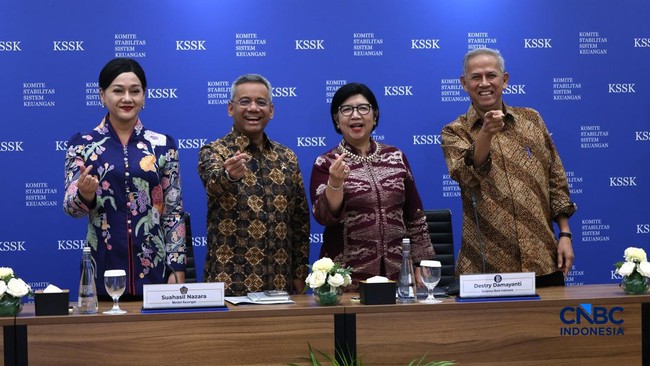
Bank Indonesia (BI) Governor Destry Damayanti said the central bank has a wide range of policies to maintain the rupiah’s exchange-rate stability against the US dollar, rather than relying solely on intervention, which can often drain Indonesia’s foreign exchange reserves.
“I always say that Bank Indonesia’s policies to maintain rupiah stability are a kind of art,” Destry said at a press conference following the Financial System Stability Committee’s (KSSK) regular meeting in Jakarta on Tuesday (3 November 2026).
Destry acknowledged that the rupiah remains under pressure, driven by a range of factors, including global and domestic economic volatility as well as sentiment. As of 2 November 2026, the rupiah stood at Rp18,145 per US dollar, weakening from Rp17,870 per US dollar at the end of September 2026, when it had strengthened.
She said intervention remains a policy that should continue to be optimised to stabilise the rupiah, particularly through Non-Deliverable Forward (NDF) transactions in offshore markets, and spot and Domestic Non-Deliverable Forward (DNDF) transactions in the domestic market.
However, BI has also developed other policies, including expanding incentives that reduce premiums to encourage foreign portfolio inflows into various instruments.
First, for DNDF hedging transactions with BI backed by foreign funding, covering portfolio inflows, banks’ offshore borrowing and foreign direct investment, the premium reduction has been set at 40% for a six-month tenor and 45% for a 12-month tenor.
Second, under the conventional hedging buy-swap mechanism with BI for transactions backed by foreign funding—including portfolio inflows, banks’ offshore borrowing and foreign direct investment—the premium is reduced by 15% for three months, 20% for six months and 25% for 12 months.
Third, BI is continuing incentives for Local Currency Transactions (LCT) with partner countries to diversify foreign-exchange transactions. These include a 10% increase in the premium for conventional hedging sell-swaps with BI for international trade and investment, as well as a 10% reduction in the premium for DNDF hedging with BI for international trade and investment.
In addition to these measures, Destry said BI could use monetary policy, including setting its benchmark BI Rate to maintain exchange-rate stability, or adjusting the issuance of Bank Indonesia Rupiah Securities (SRBI).
She nevertheless stressed that intervention in financial markets remains a strategic and effective option for keeping the rupiah stable in line with its fundamentals.
“Intervention is needed when sentiment suddenly disrupts the pattern or the true value of the rupiah,” Destry said.
“So, if asked whether BI will continue to intervene, we will certainly remain present to maintain market stability, whether through spot, DNDF or NDF transactions. So far, we still consider the results quite effective,” she said.
Source: jawawa.id (https://jawawa.id/newsitem/destrys-art-of-supporting-the-rupiah-more-than-just-market-intervention-1793706758)
Originally published by CNBC Indonesia (https://www.cnbcindonesia.com/market/20261103180951-17-782014/seni-destry-jaga-rupiah-bukan-cuma-intervensi-pasar), translated from Indonesian