
Destry Speaks Candidly: Rupiah Does Not Always Need to Be Rescued with the BI Rate
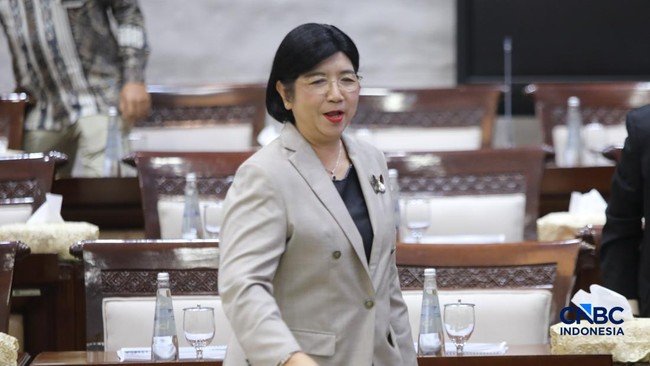
Jakarta, CNBC Indonesia - Bank Indonesia (BI) governor candidate Destry Damayanti has stressed that the central bank cannot rely solely on interest rate instruments to maintain economic stability.
Amid global uncertainty that is increasingly seen as unusual, BI must rely on a broader policy mix to safeguard the rupiah while supporting economic growth.
Destry made the remarks while undergoing a fit and proper test at the House of Representatives (DPR RI) on Wednesday (26/8/2026).
According to Destry, the challenges facing central banks today differ from conventional economic theory. In many advanced economies, an economic slowdown has occurred alongside high inflation due to supply chain disruptions and surging commodity prices.
This unusual situation is also visible in the United States. In theory, when demand for dollars rises and investors buy US government bonds, the yield on government debt should fall. Instead, the opposite has happened.
“This is an unusual situation. That is why we cannot rely on just one particular policy,” Destry said.
As a result of these conditions, Destry explained why BI does not always respond to rupiah exchange rate pressure by raising the BI Rate.
She said interest rate decisions must consider the balance between maintaining stability and encouraging economic growth. For that reason, on several occasions BI has chosen to use other instruments to support the rupiah.
“At the last Board of Governors meeting we could not raise interest rates to support the rupiah because we also saw that there is still homework on economic growth,” she said.
“We used our supporting policies, providing incentives and hedging because we need inflows to come in,” she added.
Instead, BI has relied on various supporting instruments such as liquidity incentives, hedging policies, and efforts to attract foreign capital inflows into the domestic financial market.
Destry stressed that this strategy is possible because Indonesia’s financial market is now much deeper than it was several years ago.
She revealed that domestic money market transaction volumes have increased around sixfold over the past six years. Meanwhile, foreign exchange market transactions have jumped up to threefold, with daily transaction values reaching around US$12 billion, far higher than in the 2020 period.
“A deeper market makes stability better maintained while also becoming a source of development financing,” she said.
Although emphasising the importance of synergy with the government, Destry assured that BI’s independence remains the main principle in carrying out monetary policy.
According to her, synergy does not mean sacrificing the central bank’s independence. On the contrary, coordination is needed because current economic challenges cannot be solved by a single institution or a single policy instrument alone.
For that reason, BI will continue to carry out its mandate of maintaining rupiah stability while supporting sustainable economic growth through a combination of monetary policy, macroprudential policy, and financial market deepening.
In her presentation, Destry also stressed that controlling inflation is not entirely in BI’s hands.
According to her, core inflation, which is influenced by the demand side, is indeed the main domain of monetary policy. However, other inflation components such as food prices and administered prices require government involvement.
Destry explained that core inflation contributes around 65% to overall inflation. Meanwhile, food inflation accounts for around 19%. Therefore, if food prices are not controlled, pressure on national inflation will remain significant even if BI runs a tight monetary policy.
“Inflation certainly cannot be handled by BI alone because of the demand side, since core inflation is 65% of headline inflation,” she said.
Besides food factors, inflation is also influenced by administered prices such as fuel prices. According to Destry, fuel price increases usually have an impact on inflation for one to two months before adjusting again.
Destry’s statement signals that under her leadership, BI is likely to continue prioritising a more flexible approach in determining the direction of the BI Rate. The focus is not only on maintaining rupiah stability, but also on ensuring that economic growth momentum is not disrupted by overly tight monetary policy.