
Destry Pledges to Execute New Mandate under P2SK Law: BI to Drive Indonesian Economic Growth
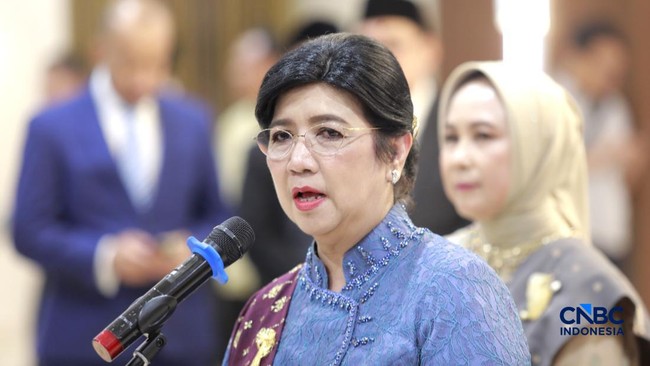
Jakarta, CNBC Indonesia - The Governor of Bank Indonesia (BI), Destry Damayanti, has reaffirmed her commitment to executing the new mandates provided through the Financial Sector Development and Strengthening Law (UU P2SK).
According to Destry, this mandate will serve as a foundation for the Board of Governors of Bank Indonesia for the 2026-2031 period in formulating future policies.
“We also have a mandate to drive sustainable economic growth while simultaneously creating a conducive economic climate to encourage growth in the real sector and job creation,” Destry stated during a press conference following her inauguration at the Supreme Court Building on Wednesday (2/9/2026).
She noted that the implementation of this mandate cannot be achieved by Bank Indonesia alone. Synergy with the government, as well as relevant ministries and agencies, is key to achieving these shared objectives.
This aligns with the policy principles that the Bank Indonesia leadership will uphold moving forward. Destry mentioned that BI will prioritise the ‘3I plus S’ principle, which involves policies that are impactful, inclusive, and integrative through strengthened synergy.
“All of this can be achieved through ‘Red and White’ synergy, which will continue to be our guide towards a more advanced Indonesia,” she said.
Despite receiving the additional mandate to help drive sustainable economic growth, Destry emphasised that maintaining stability remains Bank Indonesia’s primary focus.
She noted that global economic uncertainty remains high. This condition is reflected in the ‘higher for longer’ era of high interest rates, accompanied by high global bond yields and inflation in several developed nations.
“Our first priority must be stability. Stability is crucial for us because by having a stable economy, the opportunities for economic growth will naturally expand,” said Destress.
She added that these global developments will be a primary consideration for BI when formulating domestic policies.
“Those global factors will significantly influence the background of our domestic policy-making,” she remarked.
To balance the need for maintaining stability with driving growth, Destry stated that Bank Indonesia will continue to rely on a policy mix.
BI possesses three main policy pillars: monetary policy, macroprudential policy, and payment systems. Additionally, BI has other policies related to the development of MSMEs, Islamic economy and finance, and the deepening of financial markets.
“We will certainly navigate these policies—determining which will be more pro-stability and which will be more pro-growth,” said Destry.
Macroprudential policy, for instance, can be directed to support growth by providing incentives to the banking sector to increase credit distribution to specific sectors.
“This combination, or what we call the policy mix, will remain our primary tool in formulating policy,” she concluded.
Source: jawawa.id (https://jawawa.id/newsitem/destry-pledges-to-execute-new-mandate-under-p2sk-law-bi-to-drive-indonesian-economic-growth-1788353987)
Originally published by CNBC Indonesia (https://www.cnbcindonesia.com/market/20260902182430-17-764466/destry-janji-jalankan-mandat-baru-uu-p2sk-bi-dorong-ekonomi-ri-tumbuh), translated from Indonesian