
Destry Officially Becomes BI Governor, Five Heavy Tasks Await
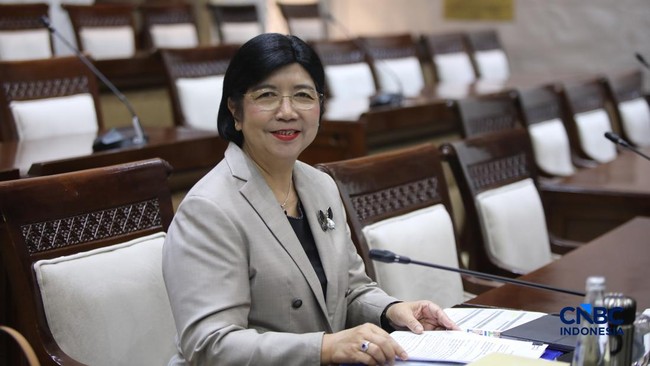
Destry Damayanti has been officially appointed as Governor of Bank Indonesia (BI) by Commission XI of the House of Representatives (DPR) on Thursday (27/8/2026). Destry was the sole candidate proposed by President Prabowo Subianto to replace Perry Warjiyo, who resigned from the position of BI Governor on 25 July 2026. “Commission XI of the DPR RI, based on deliberation to reach consensus, approves and appoints Destry Damayanti as the candidate for Governor of Bank Indonesia for the 2026-2031 period,” said Chairman of Commission XI Mukhamad Misbakhun on Thursday (27/8/2026).
The leadership transition at Indonesia’s central bank comes at a time when the central bank’s tasks are becoming increasingly complex. BI is not only facing issues of inflation and interest rates, but also pressure on the rupiah exchange rate, changes in global capital flows, uneven credit transmission, the need for coordination with the government, and the shift in transactions towards a digital financial system.
Here are five major challenges that the next BI Governor will face.
- Maintaining the Rupiah Amid Global Turmoil
The rupiah is likely to remain the biggest test for the next BI Governor. BI can determine domestic interest rates, but cannot control US interest rates, US Treasury yields, oil prices, the strength of the US dollar, or changes in global investor risk appetite.
Such pressures were already visible throughout 2026. According to Refinitiv, on 8 June 2026 the rupiah briefly closed at Rp18,170/US, itsweakestpositionever.TheGarudacurrencythengraduallyrecoveredandmovedbacktoaroundRp17, 700/US. However, on an annual basis the rupiah is still down about 6.3% against the US dollar.
Pressure came from the conflict in the Middle East, rising energy prices, high yields on US government bonds, and expectations of interest rate hikes by the US central bank (The Federal Reserve/The Fed). High yields on US assets mean developing countries must offer greater compensation to retain investors.
Indonesia’s external conditions also need attention. Indonesia’s Balance of Payments in the second quarter of 2026 still recorded a deficit of US$0.9 billion, although much smaller than the US$9.1 billion deficit in the previous quarter. At the same time, the current account deficit widened due to a surge in the oil and gas trade deficit and a shrinking non-oil and gas surplus.
Indonesia’s foreign exchange reserves stood at US$145.3 billion at the end of July 2026, down from US$148.2 billion at the end of March. This position is still equivalent to financing 5.5 months of imports or 5.3 months of imports and government external debt payments.
BI now uses a combination of spot market intervention, domestic non-deliverable forward (DNDF) transactions, NDF in overseas markets, yield management of Bank Indonesia Rupiah Securities (SRBI), and hedging incentives to attract foreign funds. The SRBI position in mid-June 2026 had reached Rp1,021.13 trillion. Of that amount, non-resident investors held Rp238.09 trillion or 23.32%. Foreign ownership then increased to Rp288.65 trillion or 27.11% of total SRBI on 20 July 2026.
These instruments help attract capital flows and support the rupiah. However, excessive dependence on portfolio funds also carries risks. Foreign funds can exit quickly when global yields rise or investor sentiment deteriorates.
The next BI Governor needs to further strengthen more stable sources of foreign exchange supply, deepen the foreign exchange market, expand hedging instruments, encourage the use of local currencies, and enlarge the domestic investor base. Monetary policy space will remain maintained if BI has sufficient foreign exchange reserves, instruments, and market confidence to respond to changes in global conditions.
- Controlling Inflation Amid Food and Energy Volatility
Keeping inflation in check remains one of Bank Indonesia’s main tasks. However, the sources of price increases are increasingly diverse and not all can be resolved through interest rate hikes.
Consumer Price Index (CPI) inflation in July 2026 was recorded at 2.88% year-on-year (yoy), down from 3.34% in the previous month. This figure is still within BI’s target of 2.5% plus or minus 1%. In detail, core inflation in July reached 2.76%. Meanwhile, administered prices inflation reached 3.58%, partly influenced by adjustments to non-subsidised fuel prices. Volatile food inflation was recorded at 2.52% as the supply of chillies and shallots improved during the harvest season.
This composition has changed quite significantly compared to several months earlier. In May, volatile food inflation had soared to 6.24% due to production disruptions caused by weather and the end of the harvest season. At the same time, administered prices inflation increased to 2.07% after increases in LPG, non-subsidised fuel, and avtur prices following the surge in global energy prices.
These movements show that the same inflation rate can stem from different problems. Price increases due to excessively strong public demand can be dampened through interest rates. However, rice price increases due to harvest failure or expensive fuel due to soaring world oil prices cannot be directly resolved by raising the BI Rate. Higher interest rates can suppress consumption and investment, but do not automatically increase food supply or lower energy prices.
BI also cannot ignore supply-side price pressures. Prolonged increases in food and energy prices can spill over to other goods, raise wages, and alter inflation expectations. Rupiah depreciation can also make the cost of importing raw materials, food, and energy more expensive.
This dilemma is evident from the change in BI’s policy direction throughout 2026. The BI Rate was still at 4.75% in March, but was then raised to reach 5.75% in June, an increase of about 100 basis points (bps).
Source: jawawa.id (https://jawawa.id/newsitem/destry-officially-becomes-bi-governor-five-heavy-tasks-await-1787885445)
Originally published by CNBC Indonesia (https://www.cnbcindonesia.com/research/20260826120619-128-762321/destry-resmi-gubernur-bi-ada-5-tugas-berat-menanti), translated from Indonesian