
Desti Melanti Reveals Four Keys to Boosting Indonesia’s Upstream Oil and Gas Investment
Central Jakarta — Indonesia has significant potential to become a major player in the global gas industry. But that potential will not deliver maximum benefits for national energy security without a competitive investment climate, legal certainty and clear regulations.
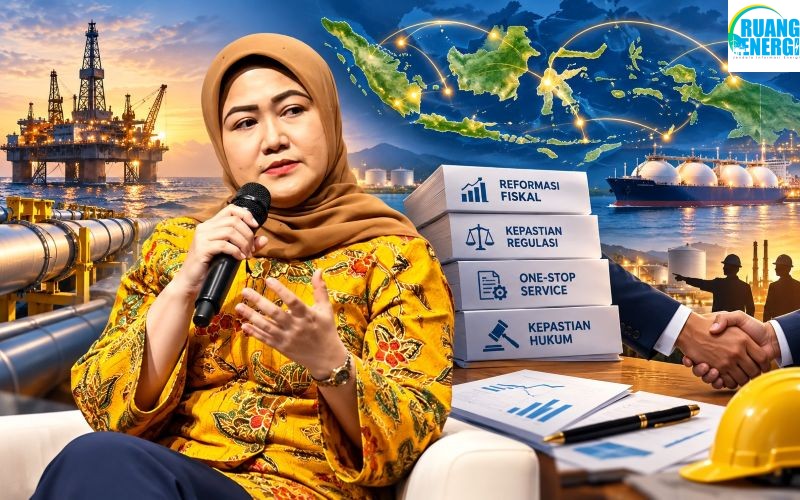
Desti Melanti, Deputy for Finance and Commercialisation at the Special Task Force for Upstream Oil and Gas Business Activities (SKK Migas), said improving the competitiveness of investment in Indonesia’s upstream oil and gas sector requires comprehensive fiscal reform, regulatory and legal certainty, and clarity over the authority of different institutions.
She delivered the remarks in her closing address at the 2026 Upstream Oil and Gas Economic, Financial and Commercial Forum (FOREK) in Jakarta on Thursday, 29 October 2026. The two-day forum was formally closed by SKK Migas head Djoko Siswanto.
“To reach the target of producing one million barrels of oil per day, certainty is needed not only in regulations and contracts, but also in the clarity of authority, including the division of roles and responsibilities among each party,” Desti said.
Indonesia also needs an integrated one-stop licensing service to help upstream oil and gas projects proceed more quickly, she said.
Desti warned that the challenge facing the upstream oil and gas industry is not simply attracting investors to Indonesia. The bigger challenge is ensuring that the investment actually results in production.
The upstream sector requires substantial capital and long development times, and carries significant exploration and production risks. Policy certainty is therefore one of the main factors investors consider before making investment decisions.
Discussions over the two days at FOREK 2026 produced four concrete steps to strengthen the national upstream oil and gas sector’s appeal to investors: comprehensive “radical fiscal reform”; stronger cross-sector coordination; an integrated one-stop licensing service; and stronger legal certainty.
The four measures are expected to lay the groundwork for faster investment decisions and help bring upstream oil and gas projects to fruition.
Despite the challenges, Desti said Indonesia has substantial assets that could strengthen its position in the global energy industry.
The country’s oil and gas resources and reserves, particularly gas and condensate, are considered highly promising. Several discoveries in recent years have raised hopes for the development of Indonesia’s upstream sector.
One notable find is Geng North in the Kutai Basin, East Kalimantan. Desti said the discovery gives Indonesia a strategic asset with which to strengthen its position in the global gas industry.
“These discoveries put Indonesia in a very promising position compared with several of the world’s major exploration regions, such as Brazil, Norway and Guyana,” she said.
However, this considerable potential must be matched by an appropriate commercialisation strategy. Indonesia needs to build domestic demand for gas so that discovered resources can be developed economically and deliver tangible benefits to the national economy.
Desti stressed that the next challenge is turning “discovery into delivery”. Finding oil and gas reserves must be followed by the ability to develop fields, build infrastructure and deliver production to consumers.
These efforts are increasingly important to support national energy security and affordability.
In this context, partnerships between the upstream oil and gas industry and the financial sector are a decisive factor. The closing panel at FOREK 2026 concluded that banks do more than provide financing for oil and gas businesses: they also contribute directly to economic growth, job creation and regional development.
Co-operation between the government, businesses, financial institutions and other stakeholders is therefore needed to ensure oil and gas projects progress from discovery to production.
The strong interest in upstream investment was reflected in attendance at FOREK 2026. The forum, initially expected to attract 1,100 people, drew 2,006 participants — nearly twice the original estimate. This year’s event was hosted by Pertamina Hulu Energi (PHE), the upstream subholding of PT Pertamina.
SKK Migas said it hoped the forum would be more than a platform for exchanging ideas. Its recommendations will be followed up on an ongoing basis to strengthen the investment climate and competitiveness of the national upstream oil and gas sector.
Indonesia’s task is now not only to find new oil and gas reserves, but also to ensure every discovery can be developed promptly into production that benefits the country.
Fiscal reform, legal certainty and simpler licensing are central to that effort. Without improvements to the investment climate, abundant oil and gas resources risk remaining figures on paper even as national energy demand continues to rise.
Source: jawawa.id (https://jawawa.id/newsitem/desti-melanti-reveals-four-keys-to-boosting-indonesias-upstream-oil-and-gas-investment-1793508636)
Originally published by ruangenergi.com (https://www.ruangenergi.com/desti-melanti-buka-bukaan-ini-4-kunci-dongkrak-investasi-hulu-migas-indonesia/), translated from Indonesian