
Despite Double Capacity, Inmates at Kerobokan Women's Prison Continue to Create
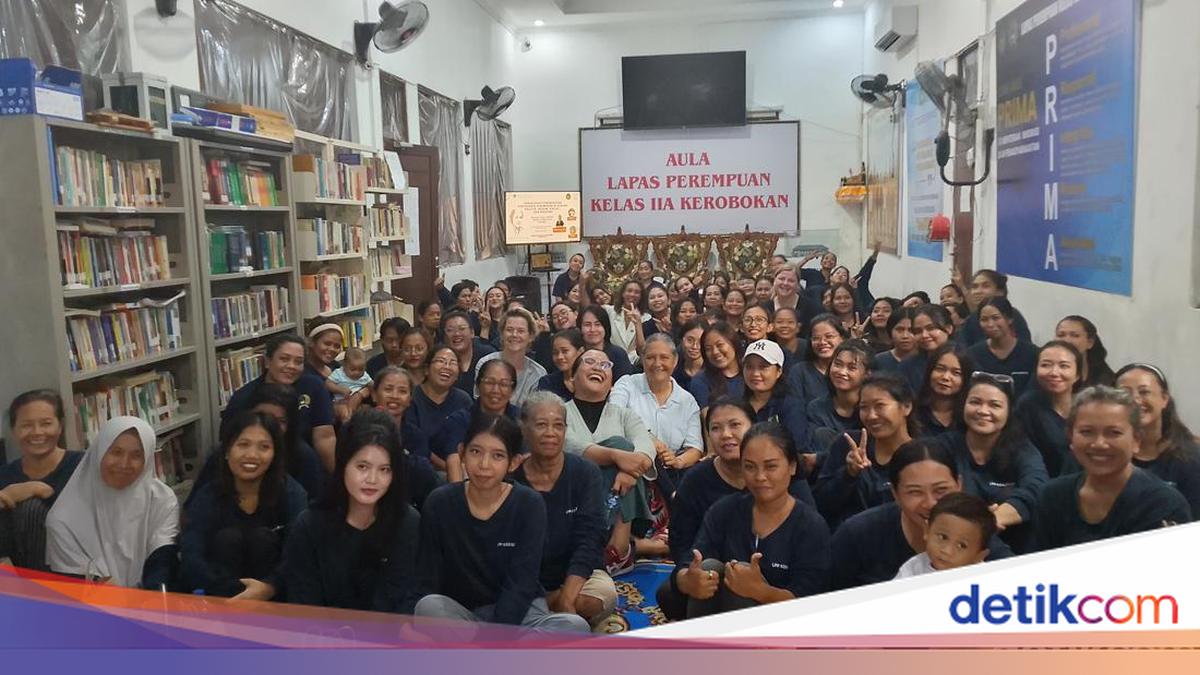
Amid conditions of overcrowding nearly double its capacity, the inmates at Kerobokan Class IIA Women’s Prison continue to demonstrate a spirit of creativity while celebrating Kartini Day. Through various works and performances, they prove that limitations in space do not hinder productivity.
When visited by officials from the Social Services, Women’s Empowerment, and Child Protection Agency (Dinsos P3A) and the Public Participation Forum for Women’s Welfare (Puspa) in Bali, the inmates displayed a range of skills. From makeup artistry, bag crafts, various foods, paintings, to a fashion show.
“The inmates at Kerobokan Women’s Prison are very enthusiastic about this Kartini Day event, including the foreign nationals inside,” said the Head of Kerobokan Women’s Prison, Ni Luh Putu Andiyani, on Tuesday (21/4/2026).
The event was opened by the Head of Dinsos P3A of Bali Province, Anak Agung Sagung Mas Dwipayani, accompanied by the Chair of the Puspa Forum of Bali Province, Ny Seniasih Giri Prasta, and a delegation of participants from the World Congress on Probation and Parole from the Netherlands.
Andiyani stated that this was the first time Kerobokan Women’s Prison held an exhibition of inmate works combined with skills training, such as facial makeup and hair art. In addition, socialisation was held on increasing women’s participation in social, economic, political, and legal fields.
Enthusiasm was evident in various performances, from dances to fashion shows featuring their own creations, such as bags, shawls, and knitting. These works serve as proof that creativity continues to flourish even behind bars.
According to Andiyani, every training provided is not temporary. Inmates also receive skills certificates as provisions for when they return to society.
“Each training comes with a certificate stored in their respective files. When they are released, the certificate and equipment will be given as provisions,” she explained.
In addition to salon training, various empowerment programmes continue to be developed inside the prison, such as making tempeh chips, cakes, handicrafts, to agricultural and livestock activities, like raising chickens, catfish, melons, and grapes.
The results of the inmates’ works have even penetrated markets outside the area. Their products have been used as souvenirs in international events and are often exhibited in various district- to provincial-level events in Bali.
Currently, the number of inmates at Kerobokan Women’s Prison reaches 258 people, including five babies, far exceeding the ideal capacity of 120 people. Among them, there are 12 foreign nationals also undergoing guidance.
Amid these conditions, empowerment programmes become an important space to rebuild the inmates’ confidence.
One of them is felt by Kasarin Khamkao, who has served seven years of a 16-year sentence in a narcotics case.
“This is the first time I have participated in training like this. I want to change and not repeat the same mistakes,” she said.
Prison staff hope that the inmates can return to society better prepared.
“We are moved to see these women here so strong in undergoing their trials. May they soon go home, reunite with their families, and not feel inferior when returning to society,” said the Chair of the Puspa Forum of Bali Province, Ny Seniasih Giri Prasta.
The commemoration of Kartini Day at Kerobokan Prison serves as a reminder that women’s empowerment knows no spatial boundaries. Behind bars, these women continue to learn, create, and ignite hope for a better future.