
Deputy Social Affairs Minister Urges Centres to Improve Services and Support Sekolah Rakyat
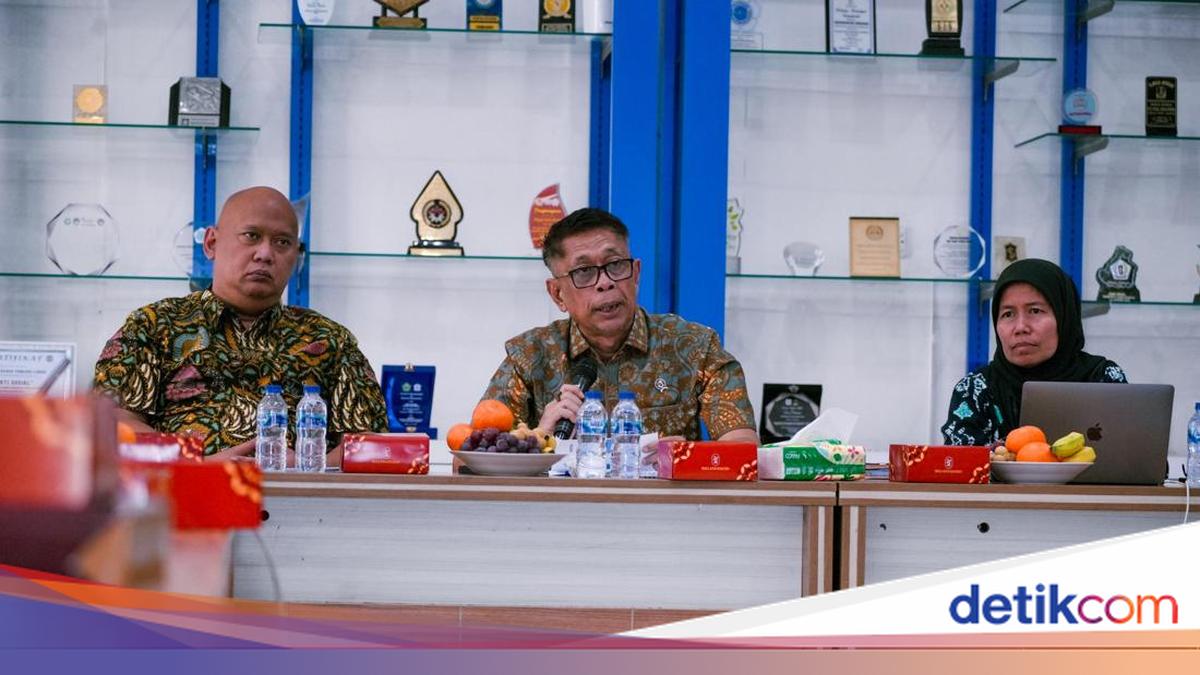
Deputy Social Affairs Minister Agus Jabo Priyono said the Ministry of Social Affairs’ centres and integrated centres, which are technical implementation units (UPTs), must not focus solely on providing services to the 12 groups requiring social assistance (PAS). They are also obliged to give full support to the President’s priority programme, Sekolah Rakyat (People’s School).
He made the remarks while addressing the heads of centres and integrated centres at a performance-monitoring meeting for implementation units under the Directorate General of Social Rehabilitation. The event was held at Pangudi Luhur Centre in Bekasi, West Java, on Thursday (15 October 2026).
“We also have to understand the President’s programmes,” he said in a written statement on Friday (16 October 2026).
He cited the Directorate General of Social Rehabilitation’s initiative to establish Community Learning Activity Centres (SKBs), which serve as a bridge to support children who have not yet been able to enter Sekolah Rakyat. In his view, more such innovative programmes should be developed in the future.
“We will continue to implement strategic programmes in line with our duties and functions, as set out in the law. But we will also implement mandatory programmes such as Sekolah Rakyat. This means that, alongside carrying out our service duties in both qualitative and quantitative terms, the Social Rehabilitation Directorate must be actively involved in programmes mandated by the President,” he said.
“There is a mandate under the law, and there is a mandate from the President that we must respond to and address. We also need to start planning what this will look like going forward,” he added.
Agus Jabo stressed that future social rehabilitation programmes and policies should be based on two main priorities: focusing on the core duty of serving the 12 PAS groups, and supporting the President’s priority programmes.
“That, I think, should be the approach going forward. Services for the 12 vulnerable groups, yes, but we must also support the President’s priority programmes entrusted to us. The Minister has translated this into the concept of ‘making the centres prosper’,” he said.
He said this meant turning the centres into centres of excellence in social services, with three key components: serving as the primary referral centres for social rehabilitation; acting as role models and examples of best practice; and becoming social rehabilitation learning centres that meet high quality standards.
Agus Jabo explained that the 12 PAS groups fall into two broad categories. The first comprises people facing economic hardship, or the poor, who come under the remit of the Directorate of Social Protection and Security and the Directorate of Social Empowerment.
The second category includes people facing social problems whose social functioning needs to be restored so that they can become self-reliant again. This includes older people, children, people affected by narcotics, psychotropic substances and other addictive substances (Napza), people with mental health conditions (ODGJ), and others.
“Social Rehabilitation has 11 areas of responsibility. The 12th falls under Social Protection and Security and Social Empowerment. We need to maximise services in those 11 areas. If we can do that, the centres will prosper,” he said.
“Once again, making the centres prosper does not simply mean having them busy; it means filling them with social rehabilitation services,” he added.
Although the analogy may sound simple, Agus Jabo acknowledged that achieving it would be difficult. It would require support for human resources, facilities and infrastructure; specialisation in social rehabilitation services; service standardisation; improved governance of the rehabilitation centres; better flagship services; higher-quality services and financial management; and greater productivity.
Nevertheless, he said he was confident that the centres and integrated centres, as the front line of the Directorate General of Social Rehabilitation, could achieve this, given their extensive experience in social rehabilitation. The Ministry’s work in the field, he added, had also been recognised by many parties.
“We all know that external institutions greatly appreciate the Ministry of Social Affairs, particularly its work in rehabilitation and deradicalisation. The National Counterterrorism Agency (BNPT) and the police’s Special Detachment 88 (Densus 88) appreciate our work and consider us Indonesia’s leading force in rehabilitation. If we are good at deradicalisation, then we can also deliver rehabilitation services and processes in other sectors,” he said.
Agus Jabo also expressed confidence that budget support for the centres’ development as centres of excellence in social services would be secured, as the President continued to provide and increase support for social programmes.
“If we want to make the centres prosper, we must be consistent. That starts with supporting facilities and infrastructure, human resources and funding. The President is committed to supporting social programmes for the people,” he said.
He urged the centres to strengthen social rehabilitation programmes and maximise services through collaboration with various parties, particularly local governments. Cooperation with local social affairs offices, he said, had not been optimal.
“On the ground, I sometimes see that we are not working collaboratively with the social affairs offices. We go our separate ways. When they meet us, they ask the Ministry for support with facilities, halfway houses, and complain about people with mental health conditions—sometimes two truckloads arrive at midnight. From the time I first became Deputy Minister until now, those have always been the complaints from local governments,” he said.
Meanwhile, Rabiah, acting Secretary of the Directorate General of Social Rehabilitation, said the meeting was intended to assess UPT performance, review achievements, identify obstacles and strengthen follow-up measures for social rehabilitation services.
The meeting was expected to enable all UPTs—the centres and integrated centres—to present objective accounts of their conditions and progress. This would provide an overall picture of performance to inform future evaluations and policy decisions.
“The meeting is an indicator of where we are, because going forward we want integrated centres and centres to become referral hubs for social rehabilitation. This will involve institutional specialisation in the services provided by each centre, as well as developing staff capacity and the rehabilitation services delivered at the centres,” she said.
Source: jawawa.id (https://jawawa.id/newsitem/deputy-social-affairs-minister-urges-centres-to-improve-services-and-support-sekolah-rakyat-1792119111)
Originally published by detikcom (https://news.detik.com/berita/d-8709448/wamensos-minta-sentra-optimalkan-layanan-dan-dukung-sekolah-rakyat), translated from Indonesian