
Deputy Police Chief Shifts Forest Fire Strategy from Reactive to Multi-Approach Policing
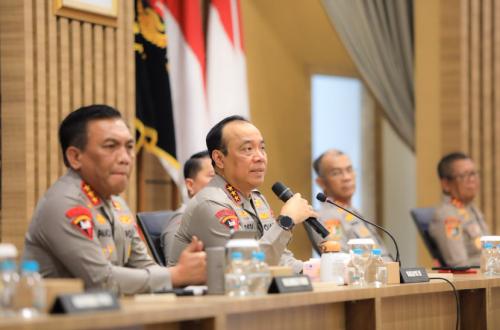
JAKARTA – The handling of forest and land fires (Karhutla) can no longer rely on a reactive pattern of extinguishing blazes only after they break out. Deputy National Police Chief Commissioner General Dedi Prasetyo is pushing a shift towards multi-approach policing that combines prediction, prevention, technology, community engagement, ecology, emergency response, law enforcement and crisis communication.
The strategy was one of the key points in the Deputy Police Chief’s briefing to 322 personnel of the second wave of the Karhutla Education, Outreach and Prevention Task Force at the Bhara Daksa Field of the PTIK Police Education and Training Institute in Jakarta on Monday (7/9/2026).
The 322 personnel comprise 64 Sespimti participants, 207 Sespimmen participants, 29 SPPK participants and 22 escorts. They are being deployed for 10 days to South Sumatra, West Kalimantan, Central Kalimantan and East Kalimantan.
Previously, 189 trainees had already been dispatched, making this second-wave deployment part of continuity and cross-rotation of assignments in the regions.
The Deputy Police Chief stressed that participants must both learn from and audit the management of Karhutla handling in the field.
“Do not merely come to give outreach. You are middle and top managers. Observe how the organisation works, the condition of the region, how policies are implemented and what is still lacking,” he asserted.
Karhutla Must Be Predicted Before It Occurs
The Deputy Police Chief is promoting predictive policing by integrating hotspot data, weather, groundwater table conditions, peat, fire history and technologies such as drones, satellites and artificial intelligence.
This data must form the basis for determining priority areas and mobilising resources before fires spread.
As of 6 September 2026, 113,616 hotspots had been recorded, with burnt land covering 202,010 hectares across 38 provinces.
The highest number of hotspots was recorded in August at 58,243 points and in September at 38,237 points.
Of all the hotspots, 23,228 points (20.4 per cent) have been verified as fire points, 26,302 points (23.1 per cent) remain unverified and 64,086 points (56.4 per cent) were declared not to be fire points. Extinguishing operations have been carried out on 18,085 points.
Ecology Becomes Part of Policing
The Karhutla approach must also take account of ecological conditions, particularly peatland. Data from the Environment and Forestry Ministry’s SiTMAT as of 6 September shows groundwater tables at critically vulnerable levels in several regions, including Central Kalimantan at -143 cm, West Kalimantan at -163 cm, South Sumatra at -231.1 cm, East Kalimantan at -142.6 cm, Riau at -209 cm and North Kalimantan at -137 cm.
The Deputy Police Chief judged that these conditions show that firefighting alone is insufficient. Water management through canal blocking, retention ponds, boreholes and hydrological restoration must become part of the strategy.
“Do not simply chase the fire. If the root of the problem is dry peat, we must fix the water management,” he said.
Collaborative Policing
All of these approaches must operate through collaborative policing. Collaboration is built from the national level, involving the Ministry of Forestry, the Ministry of Environment, BNPB, BMKG, BRIN, the National Police and the TNI, down to regional and site levels.
At the regional level it involves regional police forces, district police, regional disaster agencies, forest management units and regional governments, while at the site level it involves community police officers, territorial army officers, village fire brigades, village heads, customary leaders, communities and corporations. In emergency conditions, regional governments serve as the leading sector with the support of all stakeholders according to their respective duties and authorities.
Law Enforcement: Individuals and Corporations
The Deputy Police Chief also asked that law enforcement view the problem holistically. As of 6 September 2026 there have been 200 police reports, comprising 192 individual cases and 8 corporate cases, with 138 suspects and a total case area of 8,637.35 hectares.
“If facts and evidence of corporate responsibility are found, do not stop at the actors in the field. Examine the entire chain of accountability,” he asserted.
Karhutla handling also takes place in the digital sphere. Between 1 August and 6 September 2026, there were 117,022 mentions with a reach of 1.67 billion views. Sentiment comprised 83.2 per cent neutral, 13 per cent negative and 3.8 per cent positive.
The highest volume occurred on 2 September with 7,466 mentions, while the highest negative sentiment reached 27.7 per cent on 21 August alongside the hashtag #PrayForKalimantan.
The conversation was distributed across online media at 47.4 per cent, Instagram and TikTok at 30.2 per cent, and X and Facebook at 20.5 per cent. Meanwhile, institutional voice accounted for only 2.48 per cent.
The Deputy Police Chief asked that crisis communication become part of the handling strategy.
“Intensive field work must be accompanied by good communication so that the presence of the state can be perceived by the public,” he said.
Three Fundamental Changes
The Deputy Police Chief stressed that the transformation of Karhutla handling must be directed at three changes. First, from reactive to anticipatory. Second, from individual to individual and corporate. Third, from sectoral to multi-stakeholder.
“Do not only look at how the fire is extinguished. Audit the management. See what has been done, what is lacking and how to improve it. Concrete recommendations must emerge from this,” the Deputy Police Chief concluded.
Through the deployment of these 322 personnel, the National Police is strengthening the transformation of Karhutla handling from merely extinguishing fires to building a system capable of predicting risk, preventing fires, engaging communities, protecting ecosystems, integrating resources, prosecuting violations and managing public communication.
Source: jawawa.id (https://jawawa.id/newsitem/deputy-police-chief-shifts-forest-fire-strategy-from-reactive-to-multi-approach-policing-1788774985)
Originally published by Republika (https://news.republika.co.id/berita/tkzlee490/wakapolri-ubah-strategi-hadapi-karhutla-dari-reaktif-ke-multiapproach-policing), translated from Indonesian