
Deputy MSME Minister Urges Cross-Sector Collaboration to Foster New Entrepreneurs
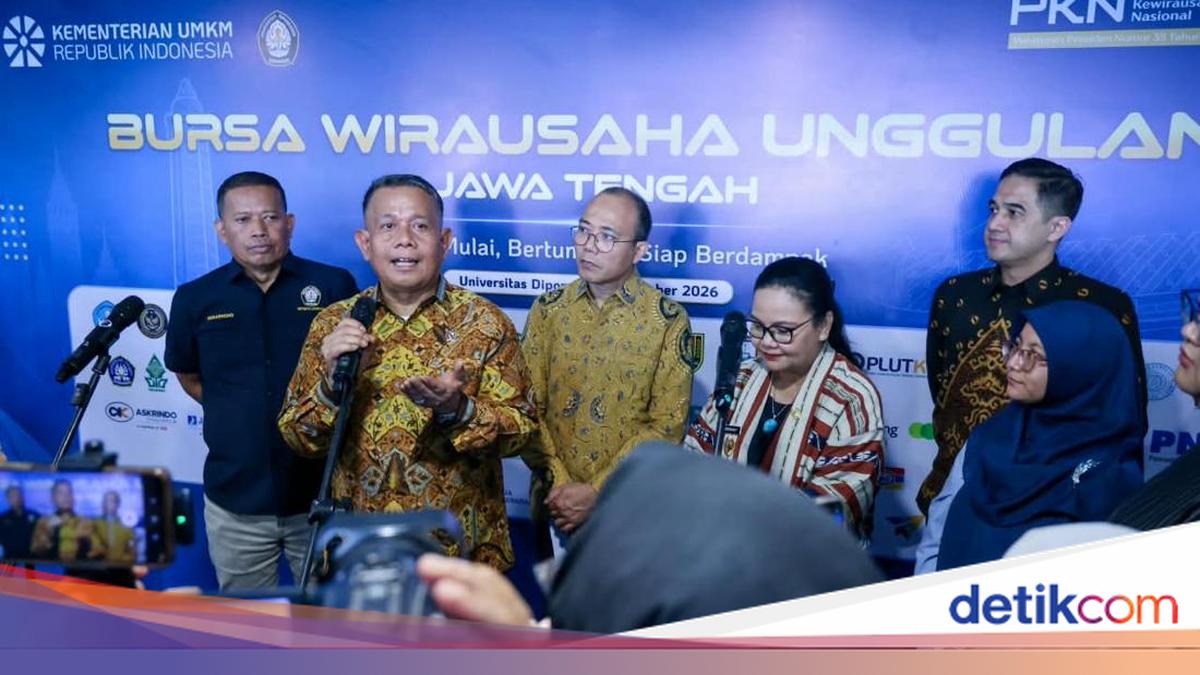
The Deputy Minister of Micro, Small, and Medium Enterprises (MSMEs), Helvi Moraza, is encouraging collaboration between the central government, local governments, universities, the business world, and various stakeholders to produce more productive entrepreneurs while helping existing MSMEs scale up.
This was stated during the ‘Bursa Wirausaha Unggulan’ (Leading Entrepreneurship Exchange) event held at Diponegoro University (Undip) in Semarang, Central Java, on Wednesday (7/10). Helvi noted that the event, themed ‘Dare to Start, Grow, and Impact’, is one of the Ministry of MSMEs’ efforts to address employment challenges and create more opportunities for the birth of productive entrepreneurs, particularly among the younger generation.
“Developing MSMEs is inseparable from how we produce new entrepreneurs, then providing facilitation so they can grow through financing, marketing, and mentoring, until they finally provide an impact on society and the regional economy,” Helvi said in a written statement.
According to her, the challenges faced by MSMEs are becoming increasingly complex due to rising competition in domestic, regional, and global markets. Therefore, efforts to elevate MSMEs cannot rely solely on conventional methods but must be supported by the utilisation of technology and innovation.
“If we want MSMEs to scale up, we certainly need a touch of technology. Universities are the kitchens of technology and innovation, while local governments understand the potential and wealth of their regions. These three forces must be united,” said Helvi.
She assessed that Central Java has great potential to produce new entrepreneurs. From approximately 678,000 active students across 241 universities, there are about 105,000 new graduates every year who need space and opportunities to become job creators rather than just job seekers.
“We must not let this surplus of great talent merely become job seekers. We must encourage them to take on roles as productive entrepreneurs so they can create new economic chains,” she added.
Strengthening the entrepreneurship ecosystem aligns with Presidential Regulation Number 3 and 8 of 2026 concerning National Entrepreneurship Development, which serves as the umbrella for collaboration between central and local governments, universities, the business world, financing institutions, incubators, and other stakeholders. This collaboration is aimed at accelerating the achievement of an entrepreneurship ratio of 3.6 percent by 2029 and 8 percent by 2045.
Helvi also emphasised the importance of the role of incubators in ensuring that prospective entrepreneurs do not stop after training, but receive mentoring until they are capable of building sustainable businesses. Currently, there are 757 incubator institutions spread across various regions in Indonesia that can serve as links for entrepreneurs to obtain mentoring, build networks, and access financing and markets.
“This ecosystem cannot be built by the government alone. Universities must connect research with market needs, financing institutions must provide schemes suitable for business needs, the business world must open supply chains and partnerships, while incubators ensure entrepreneurs continue to receive guidance,” Helvi asserted.
Helvi reported that as of October 2026, the distribution of People’s Business Credit (KUR) nationally has reached Rp243 trillion to 3.77 million MSMEs. Of that amount, KUR distribution to the production sector reached 66 percent, or approximately Rp159 trillion. Specifically in Central Java, KUR has been distributed amounting to Rp42.8 trillion to approximately 760,000 debtors, with distribution to the production sector reaching Rp25.5 trillion.
According to Helvi, prioritising financing for the production sector is vital because this sector has a significant capacity to create jobs and form new economic activities in the regions.
“Why do we encourage the production sector? Because it is in this sector that job creation is largest. When MSMEs grow in the production sector, the impact is not only on the MSMEs themselves, but also on the community and the regional economy,” Helvi explained.
She hoped that the Leading Entrepreneurship Exchange would serve as a momentum to bring together various forces within the entrepreneurship ecosystem so that more new entrepreneurs can grow, develop, and compete in both domestic and global markets.
Furthermore, the Governor of Central Java, Ahmad Luthfi, emphasised that MSMEs are the lifeblood of Central Java’s economy. Therefore, universities are seen to have an important role as a link between the creativity and innovation of students and the real needs of MSME entrepreneurs, particularly in addressing financing and marketing issues.
“Various creative ideas born from campuses must be able to enter and provide benefits for MSMEs, including addressing issues of capital access and marketing,” said Luthfi.
He also reaffirmed the commitment of the Central Java Provincial Government to open access to affordable financing for MSMEs and provide promotional spaces so that local products become more widely known and gain broader market access.
In line with this, the Rector of Diponegoro University, Suharnomo, stated that Undip has been appointed as the coordinating hub for entrepreneurship guidance and incubation in Central Java. He noted that MSME development requires a continuous mentoring process. Therefore, the existence of various incubators in universities needs to be optimised and connected within a network capable of meeting entrepreneurial needs.
Source: jawawa.id (https://jawawa.id/newsitem/deputy-msme-minister-urges-cross-sector-collaboration-to-foster-new-entrepreneurs-1791381671)
Originally published by detikcom (https://news.detik.com/berita/d-8697064/wamen-umkm-dorong-kolaborasi-lintas-sektor-cetak-wirausaha-baru), translated from Indonesian