
Deputy MPR Chairman Reveals Indonesia's Readiness to Become Asia-Pacific CCS Hub
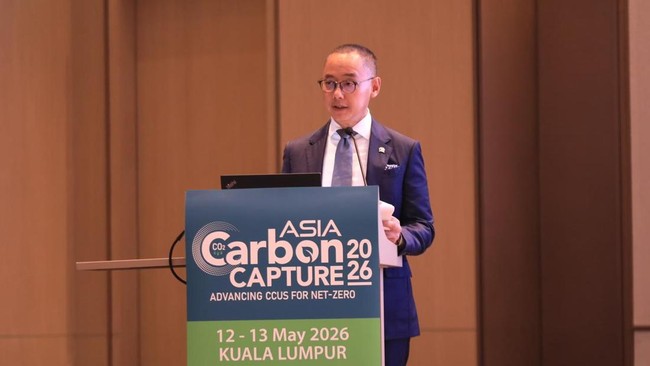
Jakarta, CNBC Indonesia - Deputy Chairman of the People’s Consultative Assembly of the Republic of Indonesia, Eddy Soeparno, was one of the key speakers at the Asia Carbon Capture 2026 forum held at the Crowne Plaza Kuala Lumpur City Centre, Malaysia, on Tuesday (12/5/2026).
In that opportunity, Eddy affirmed that Indonesia’s energy transition is not merely an environmental agenda but also a national economic strategy and a strengthening of energy resilience.
According to him, Indonesia is entering a crucial phase of economic transformation with a growth target towards 8 percent. To achieve that target, Indonesia requires substantial investments alongside a more sustainable energy system transformation.
“Indonesia faces great challenges as well as opportunities. On one hand, we have abundant fossil energy resources, but on the other hand, we still face dependence on energy imports, particularly fuels and LPG. Therefore, the energy transition must be part of the national economic resilience strategy,” he stated, as quoted from a press release on Wednesday (13/5/2026).
In addition to the renewable energy potential reaching around 3,600 GW, Eddy also spotlighted Indonesia’s strategic position in the development of Carbon Capture and Storage (CCS). Indonesia is estimated to have a carbon storage capacity of up to around 600 gigatonnes of CO₂, making it one of the most potential countries in the Asia-Pacific region for CCS development.
“Indonesia has a great opportunity to become a regional CCS hub. The large carbon storage capacity, strategic geographical position, and increasing decarbonisation needs in Asia make Indonesia highly competitive for cross-border CCS cooperation,” he explained.
The MPR leader also emphasised the importance of regulatory certainty to accelerate low-carbon investments. He appreciated the government’s steps through various strategic regulations related to CCS, the carbon economy, and waste-to-energy, which are deemed to strengthen the green investment ecosystem in Indonesia.
At the forum, Eddy mentioned that Indonesia’s carbon economy potential in 2030 could reach US$21 billion, derived from sectors such as forestry, renewable energy, waste management into energy, and CCS/CCUS.
“This great potential must be accompanied by strong governance, cross-sector coordination, and close collaboration between the government, industry, and financial sectors to translate it into real investments,” he added.
Concluding his remarks, Eddy affirmed that Indonesia is ready to take a central role in driving the energy transition and low-carbon economic development in the Asia-Pacific region.
“Indonesia wants to be part of the global solution to climate change, while ensuring that the energy transition provides economic benefits, creates jobs, and strengthens national resilience,” said Eddy, who is also a member of Commission XII of the House of Representatives (DPR RI).