
Deputy Minister: Teacher Competence Key to Boosting Lampung's Higher Education Participation Rate
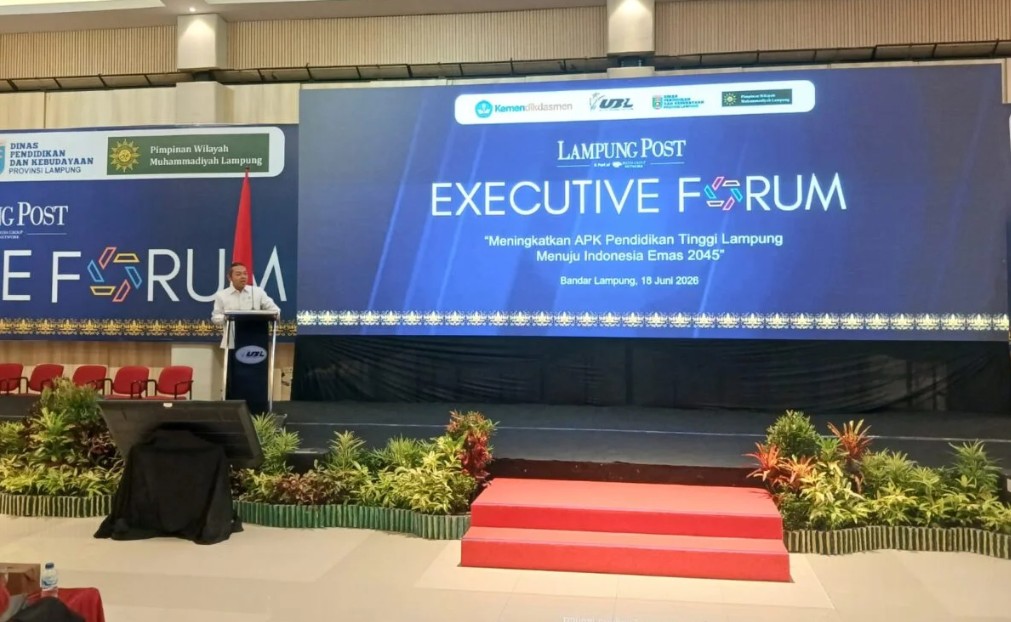
Deputy Minister of Basic and Secondary Education (Wamendikdasmen) Fajar Riza Ul Haq has asserted that improving teacher quality is a strategic step to encourage more students to continue their education to university level. According to him, educator competence and learning quality have a significant influence on increasing the Gross Participation Rate (APK) for higher education, including in Lampung Province.
The statement was made by Fajar at the Lampung Post Executive Forum themed ‘Increasing Lampung’s Higher Education APK Towards Golden Indonesia 2045’, held at the Mahligai Agung Postgraduate Building of Bandar Lampung University (UBL) on Thursday (18/6). On that occasion, he appreciated the role of Lampung Post in consistently presenting discussion forums on human resource development and educational progress.
‘This shows that the press is not only focused on the world of information, but also has a moral responsibility in improving the quality of education,’ he said. According to Fajar, collaboration between various parties, including the mass media, is crucial to strengthening the educational ecosystem capable of producing excellent human resources in the regions.
Fajar revealed that Lampung’s higher education APK currently stands at around 24 percent. This achievement is still below the national average, which has reached 32.89 percent. Nevertheless, he views this condition as a challenge that can be overcome through comprehensive improvements in education quality, particularly in the aspect of school learning. ‘Indeed, hard work is still needed so that Lampung’s APK can approach or even surpass the national average,’ he said.
He also reminded that educational progress is not always determined by a region’s economic strength or natural resource wealth. ‘The key point is that natural resource wealth and regional economic strength do not automatically produce high-quality education,’ he stated. Therefore, improving human resource quality must be the main focus to accelerate educational progress in Lampung.
In his presentation, Fajar mentioned three important factors influencing the increase in higher education APK. These three factors include access to education and information, the readiness of high school, vocational school, and Islamic senior high school graduates to continue their studies, and the school culture built during the learning process. He assessed that many students have the potential to continue their studies to university but still need stronger support from the school environment and quality learning processes.
Additionally, students’ critical thinking skills are a concern for the government. This is because the current university entrance selection patterns increasingly demand analytical and problem-solving abilities. ‘The current UTBK and SNBT question patterns are based on higher-order thinking skills. If learning still focuses on memorisation, students will find it difficult to compete,’ Fajar said. According to him, schools need to continuously adapt so that teaching methods can shape students who are more critical, creative, and ready to face academic challenges in higher education.
To support the improvement of education quality, the Ministry of Basic and Secondary Education is implementing the Academic Ability Test (TKA) as an instrument to strengthen students’ literacy and numeracy. The programme is expected to help students improve the basic skills needed for further education. ‘TKA is one of the efforts to sharpen children’s numeracy and literacy skills. The hope is that the transition from secondary school to university will become smoother,’ he said.
Fajar explained that TKA results not only reflect students’ abilities but can also serve as an indicator of the quality of the learning process taking place in schools. According to Fajar, when student learning outcomes have not reached the expected standards, the main attention should be directed at improving teacher quality and the teaching methods used. ‘If children’s TKA results are still below standard, then what needs to be fixed is the teacher’s competence and teaching methods, not blaming the students,’ Fajar stressed.
Therefore, the government is currently encouraging teachers from early childhood education to senior secondary levels to master deep learning approaches. This method is considered capable of helping students understand material more comprehensively while improving critical thinking skills and creativity. Fajar is optimistic that strengthening teacher competence will become an important foundation in improving the quality of education in Lampung. With increasingly better learning, students’ opportunities to continue their education to higher education are also believed to be greater. ‘As well as strengthening the quality of human resources towards Golden Indonesia 2045,’ he concluded.