
Deputy Minister: Strengthening Science Literacy is President Prabowo's Focus
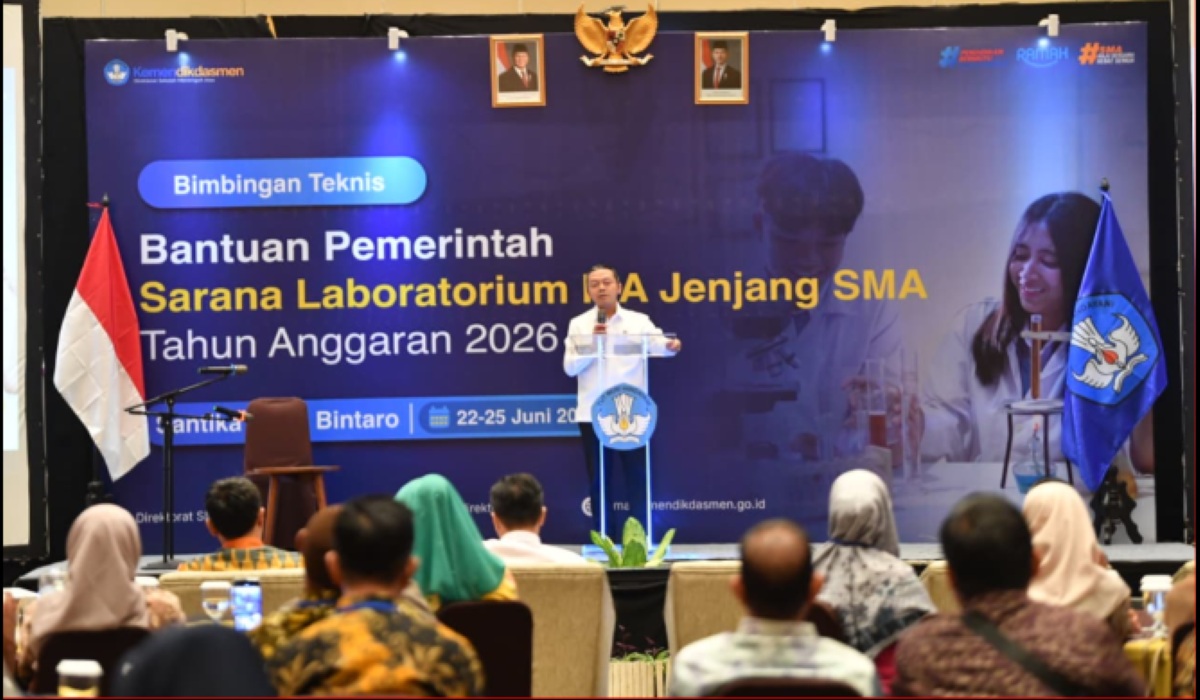
Deputy Minister of Primary and Secondary Education (Wamendikdasmen) Fajar Riza Ul Haq has affirmed that strengthening science literacy is a crucial part of President Prabowo Subianto’s focus on bolstering science, technology, engineering, and mathematics (STEM) education from the school level.
He made the statement while providing direction and opening the Technical Guidance for Government Assistance for Science Laboratory Facilities for Senior High Schools for the 2026 fiscal year at Hotel Santika Premiere Bintaro, South Tangerang, on Monday (22/6).
“A school without a laboratory is merely an ordinary place of learning, but not yet a complete learning ecosystem. Science laboratories are highly strategic because that is where theory meets reality, knowledge is tested, and students learn how scientific knowledge works,” Fajar said.
Fajar stated that strengthening science laboratories is crucial amidst the torrent of information received by children. According to him, schools need to enhance students’ ability to select, understand, and test information correctly.
“Science literacy is not just about physics, chemistry, or biology. Science literacy is the ability to observe phenomena around us, ask critical questions, test the truth, and draw conclusions based on evidence,” he explained.
Fajar emphasised that the Digitalisation of Learning Programme through Interactive Digital Boards (PID) and the science laboratory assistance are two important instruments that complement each other in strengthening deep learning.
According to him, deep learning must ensure that students not only know theory but are also able to connect concepts with real phenomena. Science laboratories provide a concrete space to carry out project-based learning, experimental practice, and direct experiential learning.
“The laboratory is the practice of deep learning. There, students learn that scientific knowledge must be tested, that no knowledge is final, everything is a process,” he said.
He also stressed the importance of a questioning culture within the education ecosystem. Students, Fajar said, should not only be trained to answer questions but also need to be accustomed to asking critical and high-quality questions.
“In deep learning, we want to build a culture of questioning. Scientific knowledge must be challenged, it must be tested,” he stated.
Fajar asked head teachers and teachers not only to teach the technical use of laboratory equipment. Students also need to understand the philosophy of how the tools work, the workings of theories, and the scientific process behind experiments.
“Do not just teach the technical use of tools. Our children must know the philosophy of how the tools work. They must experience learning, have engagement, and cultivate curiosity,” he said.
Fajar added that President Prabowo’s push to strengthen STEM needs to be translated from early childhood education through a STEAM culture that is close to students’ lives.
“This is the basic argument for the government’s push to strengthen the STEAM culture from an early age. Without curiosity, our children will only become consumers of theories and knowledge,” Fajar remarked.
According to Fajar, although the literacy achievements of Indonesian children remain a significant challenge, they possess strong potential for imagination and creativity. The task of schools is to bridge this potential with scientific culture, disciplinary knowledge, and honesty towards data.
In his report, Director of Senior High Schools Yuli Haryanto stated that the science laboratory facilities assistance programme was carried out transparently through an open application system. Out of 1,384 schools that submitted proposals, 100 schools were selected as recipients.
Yuli explained that the proposals were submitted by schools, with the knowledge of the local education offices, and underwent a verification and validation process to ensure the assistance was given to educational units that met the criteria and needed strengthening of their science laboratory facilities.
Fajar congratulated the 100 selected schools. He stressed that this assistance is a significant mandate that must be managed accountably and have a direct impact on the quality of learning.
“The measure of success for this assistance is not just that the equipment arrives, is recorded, and stored. The measure of success is whether the equipment is used, whether teachers become more confident in designing practical sessions, whether students experiment more often, and whether science learning becomes more joyful,” he said.
In closing, Fajar reminded that a living laboratory will ignite students’ curiosity. If curiosity is alive, scientific reasoning and a culture of science will grow naturally.
“If a scientific culture continues to grow as hoped by President Prabowo, we have great hope of producing a generation of solution creators, not just technology users,” he concluded.