
Deputy Minister Proposes Forensic Audit of Hajj Funds; BPKH Responds
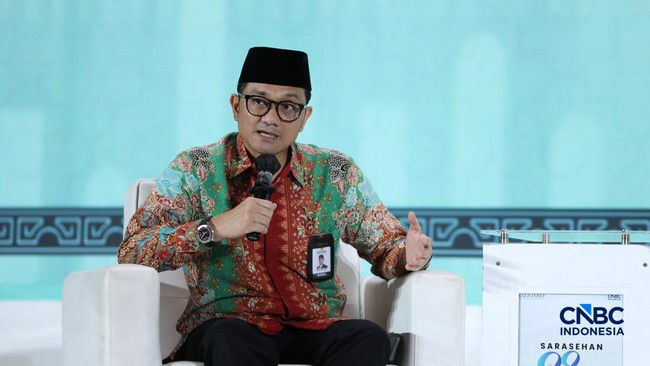
The Hajj Financial Management Agency (BPKH) has stated it is prepared to support the plan for a forensic audit of Hajj fund governance and will provide all necessary data, documents, and information in accordance with prevailing laws and regulations.
Fadllul Imansyah, Head of the BPKH Executive Body, stated that the BPKH is open to inspections conducted by authorised institutions. “An inspection is a vital part of ensuring that Hajj funds are managed transparently, accountably, prudently, and in accordance with Sharia principles,” Imansyah said in a BPKH press release on Thursday.
BPKH emphasised that Hajj fund management has long been subject to audit and supervision mechanisms. BPKH financial reports are routinely audited by the Audit Board of Indonesia (BPK), and the agency has achieved an Unqualified Opinion (WTP) for eight consecutive fiscal years up to 2025. The consolidated financial reports for BPKH and its subsidiaries for 2025 have also been published through BPKH’s official channels.
BPKH maintains that a forensic audit must be conducted under clear governance prerequisites, including a firm mandate and authority for the inspection, the independence and objectivity of the auditors, documented scope and methodology, secure data access trails, protection of information confidentiality, and quality control mechanisms. Any findings must be supported by valid, documented, and traceable evidence, and communicated through accountable reporting and follow-up mechanisms.
Amri Yusuf, a member of the BPKH Executive Body for Finance and Accounting, noted that a forensic audit could strengthen the understanding of data integrity, the effectiveness of benefits, and the sustainability of Hajj funds. “The inspection needs to reconcile SISKOHAT data, portion numbers, initial deposits, settlements, benefit values in virtual accounts, quotas, departure status, cancellations, refunds, and pilgrim departure data,” said Yusuf.
This data must be cross-referenced with BPKH records, BPS Bipih data, bank accounts, and actual departure figures to ensure there are no duplicate entries, discrepancies, or unauthorised data changes. The inspection also needs to test the appropriateness of benefits for departing pilgrims based on the BPIH-Bipih formula, the number of pilgrims, embarkation points, and services received, including flights, accommodation, consumption, transport, living costs, and services in Arafah, Muzdalifah, and Mina.
“The audit results should also serve as the basis for calculating the sustainability of Hajj funds, considering assets, liabilities, cash flows, investment returns, benefit values, liquidity needs, the number of pilgrims in the waiting list, Hajj costs, and various risk scenarios,” Yusuf added.
In exercising its mandate under Law Number 34 of 2014, BPKH is committed to managing Hajj funds transparently, accountably, safely, and sustainably. BPKH is also open to evidence-based recommendations for improvement, including in internal controls, risk management, transparency, and investment governance.
“We also hope that the terminology used in public discourse remains precise. The trust of over five million pilgrims has been built over many years and can be easily shaken by terms that cause anxiety without any findings. If there are indications of issues, let us open them with data. If there are none, the public deserves to hear that clearly,” said Imans, adding that the ultimate goal is to ensure funds are managed for the pilgrims’ interests.
Previously, the plan for a forensic audit of Hajj fund governance was announced by the Deputy Minister of Hajj and Umrah, Dahnil Anzar Simanjuntak, following a meeting with President Prabowo Subianto on 28 September 2026. The government will coordinate with the Financial and Development Supervisory Agency (BPKP) regarding its implementation.
Simanjuntak also mentioned that the effort is intended to clean up ‘Hajj/Umrah cartels’. According to him, during the meeting, the President gave special attention to the reconstruction of Hajj fund management to improve it for pilgrims.
“The President encouraged that the Hajj funds, which are currently managed by BPKH, undergo a forensic audit immediately,” Simanjuntak said after the meeting. He explained that the forensic audit is being conducted because the President wants to know the actual facts regarding the condition of the Hajj funds, specifically to prevent ‘financial engineering’ similar to recent high-profile cases in Malaysia.
Source: jawawa.id (https://jawawa.id/newsitem/deputy-minister-proposes-forensic-audit-of-hajj-funds-bpkh-responds-1790826737)
Originally published by CNBC Indonesia (https://www.cnbcindonesia.com/news/20261001095054-4-772391/wamenhaj-tiba-tiba-bicara-audit-forensik-keuangan-haji-ini-jawab-bpkh), translated from Indonesian