
Deputy Minister of Law at MK: Police Cannot Be Equated with Ministries
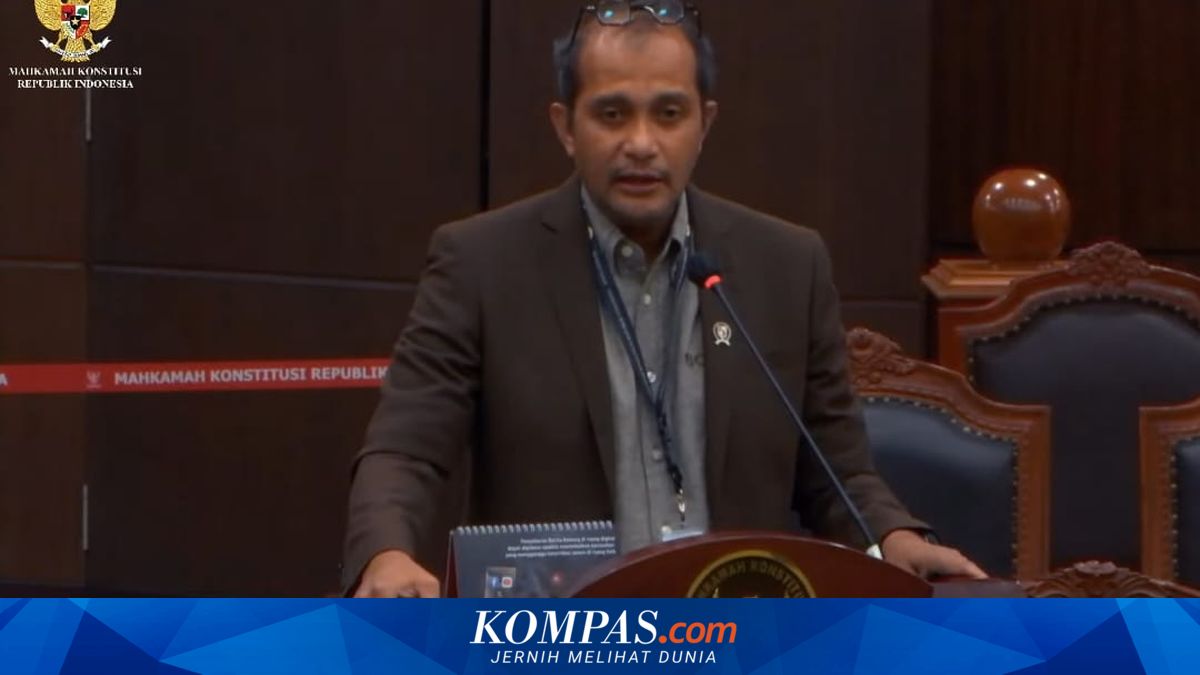
JAKARTA - Deputy Minister of Law Edward Omar Sharif Hiariej, or Eddy, emphasised that the Indonesian National Police (Polri) institution cannot be equated with ministries.
In Article 8 paragraphs (1) and (2) of Law No. 2 of 2002 on Polri, legal certainty has been provided regarding Polri’s position as a state instrument under the President.
“In this case, Polri cannot be equated with ministries because it has specific characteristics and functions as a state instrument in the fields of security and law enforcement,” said Eddy during the government’s testimony session for Case No. 63/PUU-XXIV/2026 at the Constitutional Court (MK) building in Jakarta, quoted from the MKRI YouTube broadcast, Wednesday (13/5/2026).
Clarity on Polri’s position is necessary to ensure clear lines of coordination, command, and accountability in carrying out governmental functions in security and law enforcement.
“Its direct placement under the President is a rational and constitutional legal policy choice to maintain effectiveness, responsiveness, and unity of command in performing its duties,” said Eddy.
“The principle of good governance itself is not solely determined by the form or institutional position, but by transparency, accountability, effectiveness, efficiency, and compliance with the law in government administration,” said Eddy.
“In this regard, oversight of Polri is still carried out through various mechanisms, both internal and external, so the principle of accountability remains upheld,” he added.
Article 8 paragraph (1) of the Polri Law states, “The Indonesian National Police is under the President.” Then, Article 8 paragraph (2) of the Polri Law states, “The Indonesian National Police is led by the Chief of Police who, in carrying out his duties, is responsible to the President in accordance with statutory regulations.” Meanwhile, Article 17 paragraph (1) of the Polri Law states, “The President is assisted by state ministers.”
The three petitioners assess that Polri’s position under the President creates potential discrimination, particularly regarding advocates defending the opposition or parties opposing the government.
The direct placement of the Police under the President without oversight and limitation mechanisms has the potential to cause abuse of power that contradicts the rule of law principle.
In their petitum, the three request that the MK declare Article 8 paragraph (1) of the Polri Law contrary to the 1945 Constitution of the Republic of Indonesia and has no binding legal force unless interpreted as, “That the Indonesian National Police is under the President through the Minister in charge of domestic government affairs.” They also request that the Court declare Article 8 paragraph (2) of the Polri Law contrary to the 1945 Constitution and has no binding legal force unless interpreted as, “The Indonesian National Police is led by the Chief of Police who, in carrying out his duties, is responsible to the Minister in charge of domestic government affairs in accordance with statutory regulations.”
Source: jawawa.id (https://jawawa.id/newsitem/deputy-minister-of-law-at-mk-police-cannot-be-equated-with-ministries-1778680459)
Originally published by Kompas (https://nasional.kompas.com/read/2026/05/13/18094761/wamenkum-di-mk-polri-tidak-bisa-disamakan-dengan-kementerian?utm_source=ABC&utm_medium=rss), translated from Indonesian