
Deputy Minister of Investment Stresses Strengthening of the National Bioethanol Industry
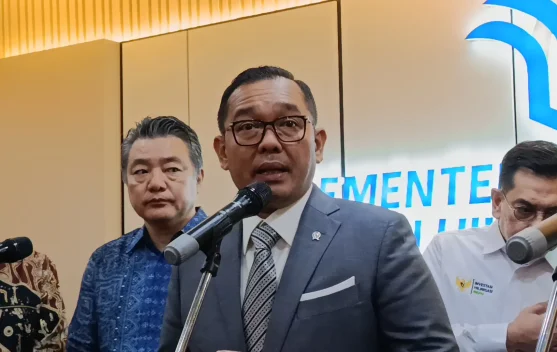
Deputy Minister of Investment and Downstreaming/Deputy Head of BKPM, Todotua Pasaribu, has said that bioethanol development is important for strengthening national energy security. This comes amid rising energy demand and plans to increase the bioethanol blend in petrol to E20.
He made the remarks while inaugurating the Bioethanol Development Centre in Tegineneng Sub-district, Pesawaran Regency, Lampung, on Monday, 14 September 2026. The facility was developed through a partnership between PT Pertamina New & Renewable Energy and PT Toyota Motor Manufacturing Indonesia.
“Our journey — the Ministry of Investment and Downstreaming/BKPM collaborating with PNRE and Toyota (TMMIN) — is an important milestone. After several rounds of coordination, we have reached the launch stage; the next focus is maintaining momentum so that investment is realised and the project runs according to plan,” said Todotua.
The need for bioethanol development is rising in line with projections that national petrol consumption will reach 39.7 million kilolitres by 2029. Meanwhile, domestic fuel-grade bioethanol production capacity remains limited, so additional capacity and certainty of raw material supply are required.
“This bioethanol development is linked to four main agendas: energy security, downstreaming, the energy transition and economic resilience. Indonesia has various raw material sources, including sugarcane, cassava and sorghum, which can be further processed to generate added value domestically,” he said.
According to Todotua, bioethanol is also part of efforts to increase the added value of agricultural commodities through processing them into energy products. Its use in the transport sector is expected to broaden the choice of renewable energy sources while complementing the use of biodiesel for diesel fuel.
“The development of bioethanol for petrol complements the use of biodiesel for diesel fuel. The involvement of the automotive industry is important to support the connection between fuel development and the vehicle technology that uses it,” he said.
The Bioethanol Development Centre in Tegineneng has been developed using a multi-feedstock concept, utilising molasses, sorghum and biomass waste. The facility is intended to test production economics before capacity is scaled up.
“We are building this development centre to measure its commercial viability — how competitive a production cost we can achieve,” said Todotua.
In its initial phase, the facility has a capacity of 60 kilolitres to calculate the production economics of bioethanol. Todotua is targeting the facility to start producing bioethanol by December 2026 at the latest, with capacity increasing to 60,000 kilolitres in 2027.
The development of the bioethanol industry is also directed at strengthening the link between the agricultural sector and processing industries. Communities can participate by growing raw materials, while cooperatives serve as collection centres before the facility absorbs the output as off-taker.
“So communities can also take part in planting, and the cooperative concept can be implemented. Cooperatives will later become raw material collection centres, while the facility here will act as the absorber or off-taker,” he said.
The development is expected to open up alternative markets for agricultural produce while strengthening the involvement of farmers and cooperatives in the industrial supply chain. This step forms part of efforts to build a national bioethanol ecosystem supporting energy and economic security.
Source: jawawa.id (https://jawawa.id/newsitem/deputy-minister-of-investment-stresses-strengthening-of-the-national-bioethanol-industry-1789465834)
Originally published by rri.co.id (https://rri.co.id/nasional/2730808/wamen-investasi-tekankan-penguatan-industri-bioetanol-nasional), translated from Indonesian