
Deputy Minister of Human Rights urges Papua development rooted in local ethnoscience
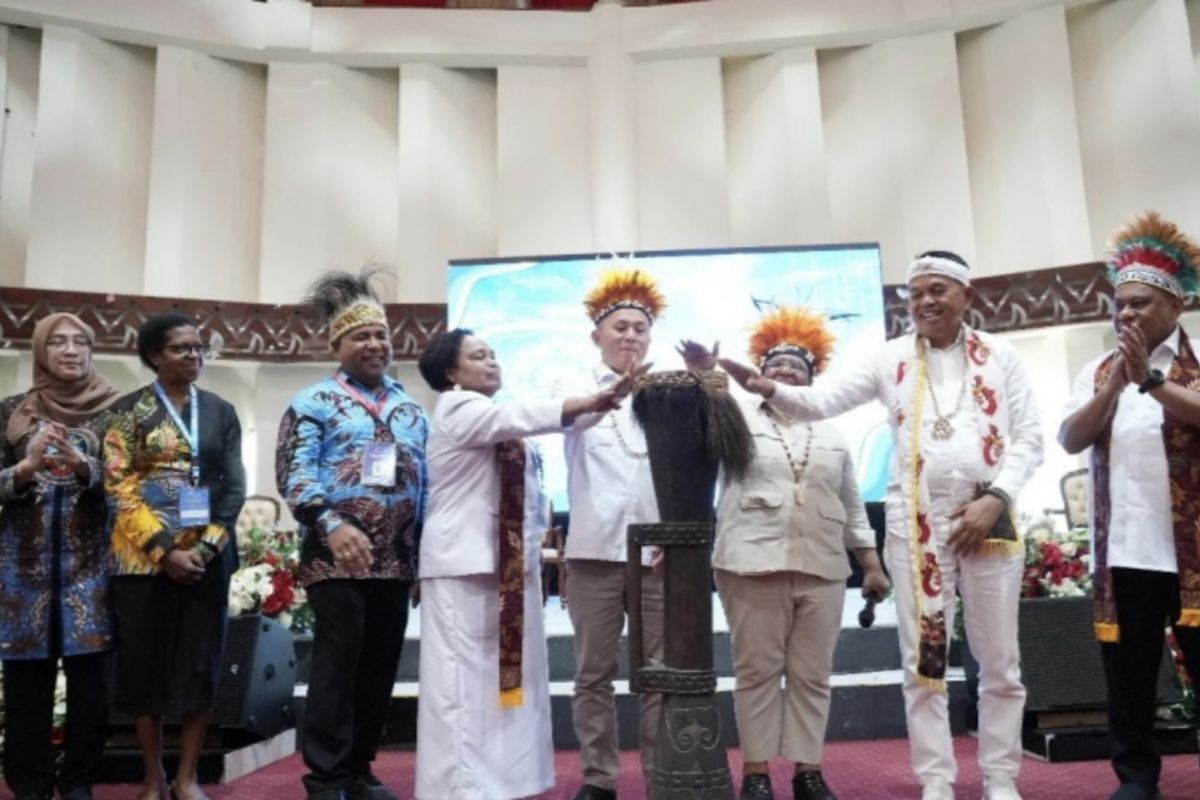
Jakarta (ANTARA) - Deputy Minister of Human Rights Mugiyanto has urged that Papua’s development be approached through ethnoscience and human rights frameworks to ensure policies better align with the needs of local indigenous communities.
‘This means we are talking about building Papua without severing it from itself. Papua is not empty land, nor merely a territory. It is a living space for hundreds of civilisations,’ Mugiyanto stated in Jakarta on Friday.
Speaking at the third APS Conference at the Papua Youth Creative Hub (PYCH) in Jayapura on 29 May, he noted that Papua possesses rich local knowledge that has proven to sustain communities across various sectors, including agriculture, healthcare, natural resource management, and disaster mitigation.
Mugiyanto assessed that many development programmes in Papua have been ineffective due to approaches that fail to consider local social and cultural contexts.
He cited examples such as infrastructure projects impacting productive land, and healthcare facilities underutilised because communities prefer traditional medicine aligned with their culture.
‘Papua’s ethnoscience has already been proven. There is the Dani tribe’s ukluk irrigation system, Asmat and Marin tribe’s sago management, and Biak tribe’s Manarmeri customary law regulating fishing to prevent overexploitation,’ he said.
He added that such local knowledge is empirically tested and can offer more effective and community-accepted development solutions.
From a human rights perspective, Mugiyanto stressed that ethnoscience-based development is part of fulfilling cultural rights and community participation as stipulated in the 1945 Constitution.
‘Development that disregards ethnoscience risks violating human rights principles. Embracing it strengthens social cohesion and public trust,’ he stated firmly.
He hopes the conference will produce concrete recommendations for local governments to implement in their Medium-Term Regional Development Plans (RPJMD).
‘Let us build Papua not by enforcing uniformity, but by celebrating diversity through grounded innovations from Papua’s land, forests, and seas,’ Mugiyanto said.