
Deputy Minister of Home Affairs Urges Regional Councils to Oversee Regional Budgets for Greater Productivity
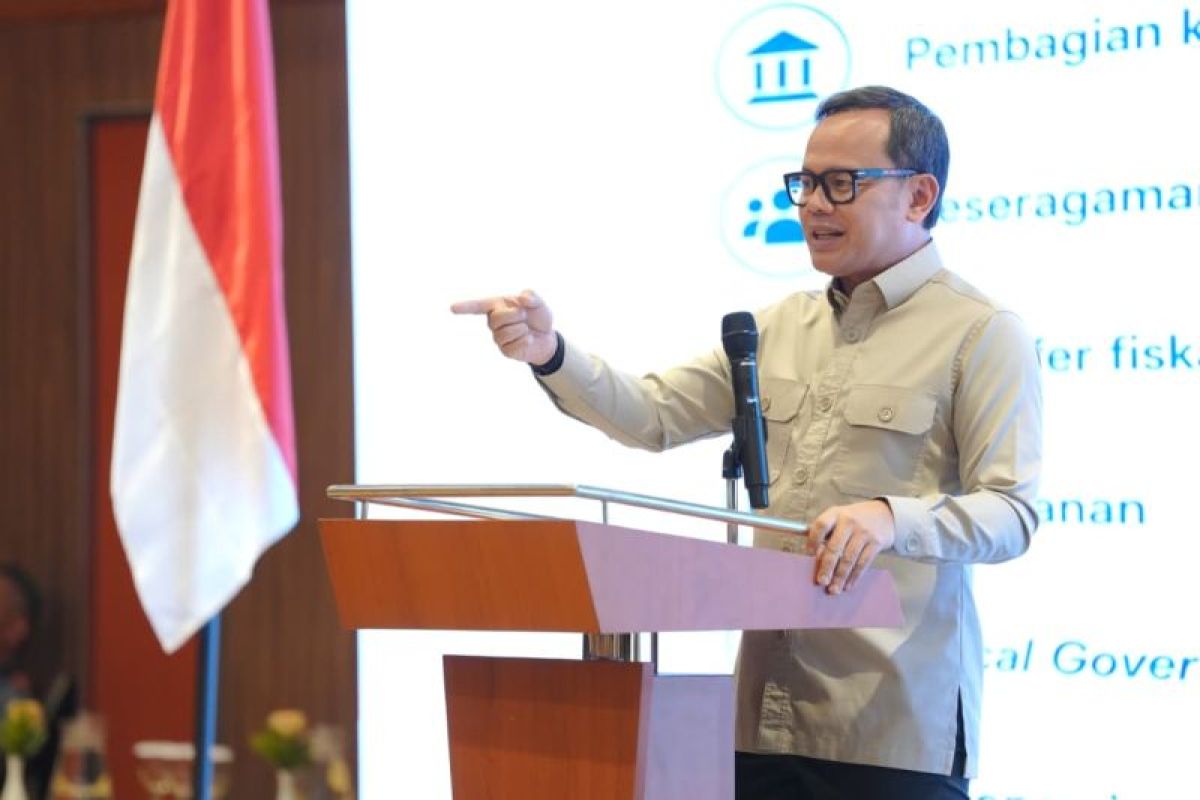
Jakarta (ANTARA) - The Deputy Minister of Home Affairs, Bima Arya Sugiarto, is encouraging the Regional House of Representatives (DPRD) throughout Indonesia to continuously increase their capacity and strengthen their role in overseeing regional development.
According to him, the DPRD plays a vital role in empowering regions. This is particularly important as local governments currently face complex challenges ranging from digitalisation and territorial boundary issues to disparities in fiscal capacity between regions.
“The essence is not just autonomy, but empowered regions. An empowered region is impossible if the DPRD is powerless or fails to play its part,” Bima stated in a briefing in Jakarta on Sunday.
These remarks were made during his attendance at the Seminar and National Working Meeting (Rakernas) of the Association of Regency-level Regional House of Representatives of All Indonesia (ADKASI) in Jakarta.
He assessed that after more than two decades of decentralisation, an evaluation of the effectiveness of regional authority and its impact on the community is urgently needed. Furthermore, as times have changed, the role of oversight regarding local government can no longer be applied uniformly.
Additionally, Bima highlighted the significant ongoing dependence of some local governments on transfers from the central government. He noted that decentralisation must be applied not only to the distribution of authority but also to the strengthening of regional economic and fiscal capacity.
“Regional autonomy has existed for 30 years, yet the fiscal capacity of local governments has not strengthened significantly. Most are still dependent on transfers from the central government to the regions. Therefore, the decentralisation of authority does not automatically result in strengthened fiscal capacity,” he said.
In this context, Bima reminded that the success of Regional Budget (APBD) management should not be measured solely by the scale of budget absorption or low budget execution surpluses (SiLPA). He argued that budget discussions must become increasingly oriented towards results and the impact felt by the community.
The DPRD, alongside regional heads, must ensure that the budget is capable of driving investment, strengthening infrastructure, reducing transaction costs, improving the quality of human resources, and creating job opportunities. Furthermore, the DPRD needs to shift the focus of budget discussions from mere budget amounts to the actual impact generated by those funds.
“Therefore, the APBD must serve as a trigger for productivity, investment, employment, and so on,” said Bima.
Furthermore, Bima encouraged the DPRD to strengthen their oversight function regarding the performance of the regional executive. He noted that strong oversight is necessary to ensure that policies and budget usage truly produce measurable development performance.
“Other matters we are entrusting, the Minister (of Home Affairs) also entrusts, is for the DPRD to consider how they must always upgrade their approaches and developments,” he concluded.