
Deputy Minister of Home Affairs Bima Urges West Sumatra to Strengthen Regional Resilience
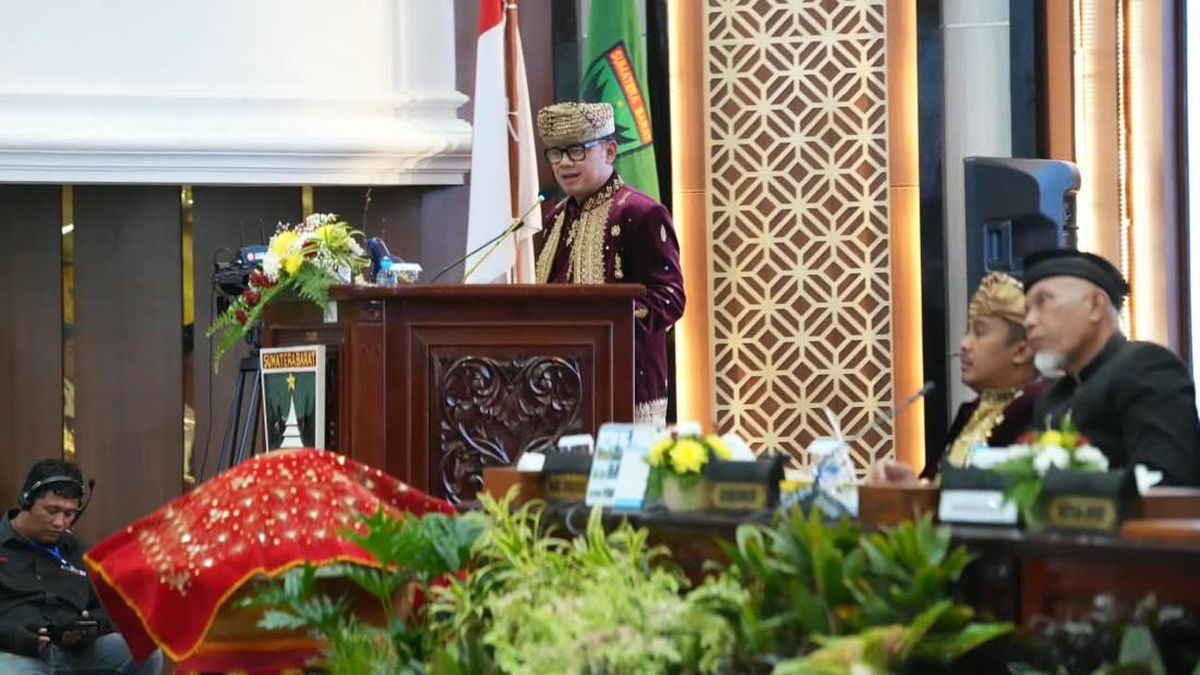
The Deputy Minister of Home Affairs, Bima Arya Sugiarto, has encouraged the West Sumatra Provincial Government to strengthen regional resilience in facing various risks, including disasters. According to him, such steps are vital to ensure that the developmental achievements attained by West Sumatra can continue and provide benefits for future generations.
Bima made these remarks while attending the Plenary Session of the West Sumatra Regional House of Representatives (DPRD) to commemorate the 81st Anniversary of West Sumatra at the DPRD Provincial Office in Padang on Thursday (1/10/2026).
“81 years of West Sumatra is a story, a tale of how the people of West Sumatra have transformed every trial, every challenge, and every opportunity into resilience, ultimately leading to progress,” said Bima.
Bima noted that West Sumatra’s progress is reflected in several development indicators that stand above the national average, including the Human Development Index (HDI) and economic growth. He stated that these achievements serve as essential capital for West Sumatra to continue development across various sectors.
However, he cautioned that regional progress is not solely determined by infrastructure development and the improvement of basic services. Regional resilience is also determined by the ability of the government and the community to protect lives and ensure that development continues when facing various risks.
“A resilient region is not just one that is prepared for disasters, but a resilient region is one that never allows disasters to rob its future,” he emphasised.
Bima also expressed his appreciation for West Sumatra’s initiative to incorporate disaster dimensions into the 2025-2029 Regional Medium-Term Development Plan (RPJMD). In his view, this policy demonstrates that disaster mitigation and risk anticipation have been placed as part of the regional development agenda.
With this approach, development in West Sumatra is expected to not only meet the current needs of the community but also account for various challenges and risks that may arise in the future.
In addition to disaster resilience, Bima emphasised the importance of strengthening the quality of human resources. He stated that human development must go hand in hand with physical and infrastructural development so that West Sumatra possesses a successor generation capable of sustaining developmental achievements.
According to Bima, West Sumatra possesses strong social capital to realise this goal. This strength is reflected in religious and customary values, the networks of the diaspora and the ‘nagari’ bonds, as well as the resilience and tradition of innovation passed down from generation to generation.
This social capital, he said, needs to be integrated with modern governance, productive investment, and innovation. Strengthening these various aspects is expected to foster the emergence of a new generation from West Sumatra capable of competing and making an impact at both national and global levels.
“There is no reason for Minangkabau not to go global. We wait, we pray, and we hope that it is not just Nasi Padang or the Plate Dance (Tari Piring) that becomes world-renowned, but also the intellectuals, professors, and thinkers from West Sumatra will go global,” he concluded.