
Deputy Minister of Home Affairs Bima: Disaster Mitigation Must Begin with Planning
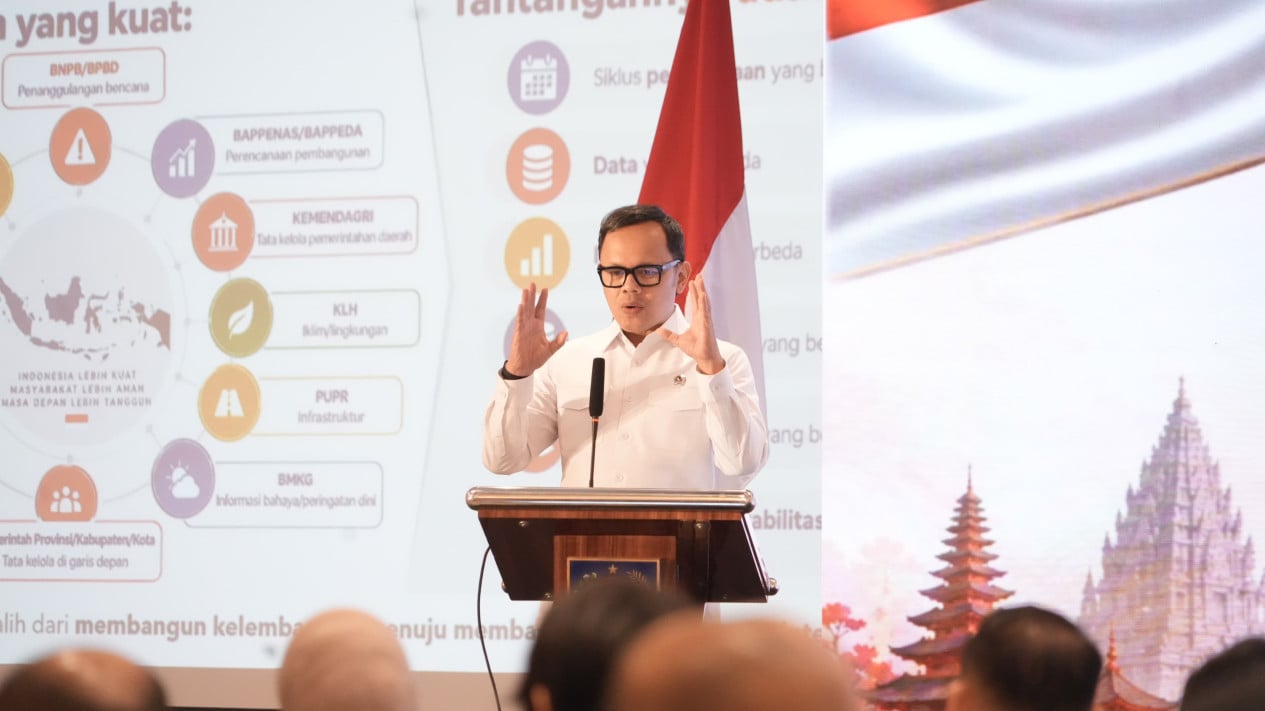
Deputy Minister of Home Affairs Bima Arya Sugiarto has emphasised the importance of incorporating disaster risk mitigation from the very beginning of regional development planning stages. This step must be supported by spatial planning that considers disaster potential, alongside an integrated system involving various stakeholders.
According to Bima, this approach is vital so that regional development is not merely oriented towards achieving development targets, but also accounts for public safety and regional resilience in facing various disaster risks.
“This includes spatial planning that can mitigate various social, community, and force majeure issues,” Bima stated during his keynote address at the 2026 Japan-Indonesia Local Government Administration Seminar, themed “Enhancing Regional Resilience to Disasters: Prevention and Mitigation Efforts by Local Governments” in Jakarta, Wednesday (30/09/26).
Bima explained that strengthening regional resilience is crucial, reflecting on the various challenges Indonesia has faced, ranging from monetary crises to various natural disasters. These experiences serve as lessons for the government to build increasingly robust systems to face disasters and changes.
In this context, the central government continues to formulate policies and development plans implemented at the regional level, taking into account the specific conditions, capabilities, and needs of each area.
“The Ministry of Home Affairs, in this regard, functions to provide guidance, to standardise public services, and to remind and assess every plan undertaken by local governments. We adjust the implementation according to each local capability,” Bemma explained.
Beyond development planning and spatial planning, Bima emphasised the importance of collaboration in building regional resilience. The involvement of the community, local leaders, non-governmental organisations, and universities is a vital part of strengthening mutual cooperation and coordination.
Therefore, Bima encouraged the involvement of various parties from the planning stage, rather than only when a disaster has occurred. The community, academics, researchers, and other stakeholders must sit together from the outset to map risks and prepare mitigation steps.
“It is no longer about accommodating or inviting, but about inviting all parties to sit together starting from the planning stage. Citizens, stakeholders, communities, academics, and researchers must sit together from the beginning. We must not just invite them when a disaster occurs,” he stated.