
Deputy Minister of Communication and Digital Emphasises Human Control as Standard for AI Governance
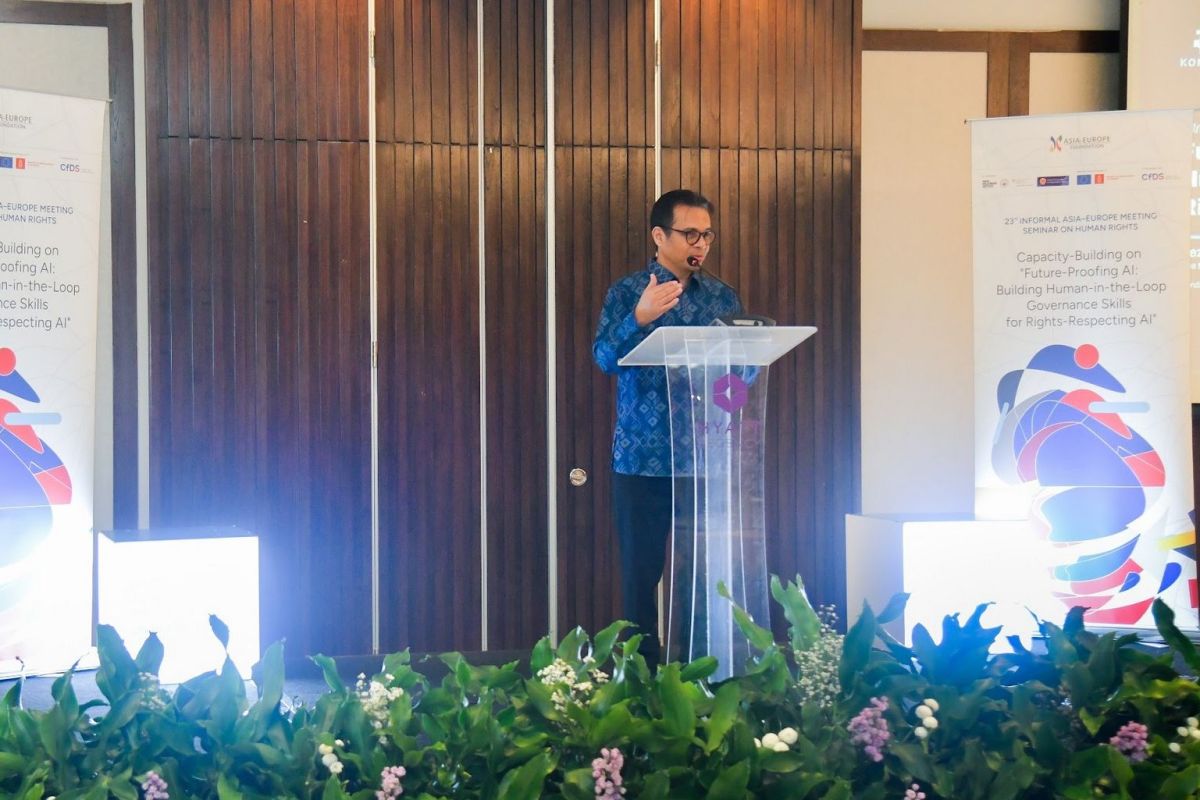
Jakarta (ANTARA) - Deputy Minister of Communication and Digital (Wamenkomdigi) Nezar Patria has affirmed that Indonesia is promoting an AI governance model that places humans as the primary controllers, serving as a concrete solution to confront the acceleration of technology that surpasses regulations.
Nezar emphasised the importance of building systems that ensure humans retain control over every decision generated by technology.
“Our focus is not on concerns, but on designing systems that ensure humans continue to lead the direction of AI use,” said Nezar in a statement confirmed in Jakarta on Tuesday.
Indonesia is advocating for a human-in-the-loop approach as the primary standard. This model ensures that every AI system remains under human supervision, particularly in sectors with significant impacts such as public services, security, and the digital economy.
According to Nezar, this approach provides assurance that innovation continues to progress while maintaining accountability and protecting public rights.
As a concrete step, the government is preparing the National AI Roadmap, which will serve as a guide for technology development in Indonesia. This roadmap outlines directions for research, strengthening digital talent, cross-sector collaboration, and risk mitigation from the early stages of development.
Indonesia has also established ten core principles for AI governance. These principles serve as standards in every technology development, ranging from personal data protection and system transparency to guarantees of fairness and inclusivity.
“We are building agile systems, but with clear controls. This is essential so that innovation does not proceed without direction,” he stated.
At the global level, Indonesia is taking an active role to bring the perspective of developing countries into AI governance discussions. Indonesia is pushing for more equitable cooperation so that every country has equal opportunities in developing technology and formulating regulations.
He emphasised that the success of AI is not solely determined by the technology, but by a country’s ability to manage and direct it appropriately.
“The key to the future of AI is ensuring that humans remain at the centre of decision-making. That is where the benefits of technology can be felt tangibly by society,” he asserted.