
Deputy Minister: Mangrove Protection Delivers Socio-Economic Impact
The programme has created jobs for 64,386 people, supported the issuance of 63 Village Regulations on mangrove ecosystem protection and management, and disbursed community business grants totalling Rp16.29 billion.
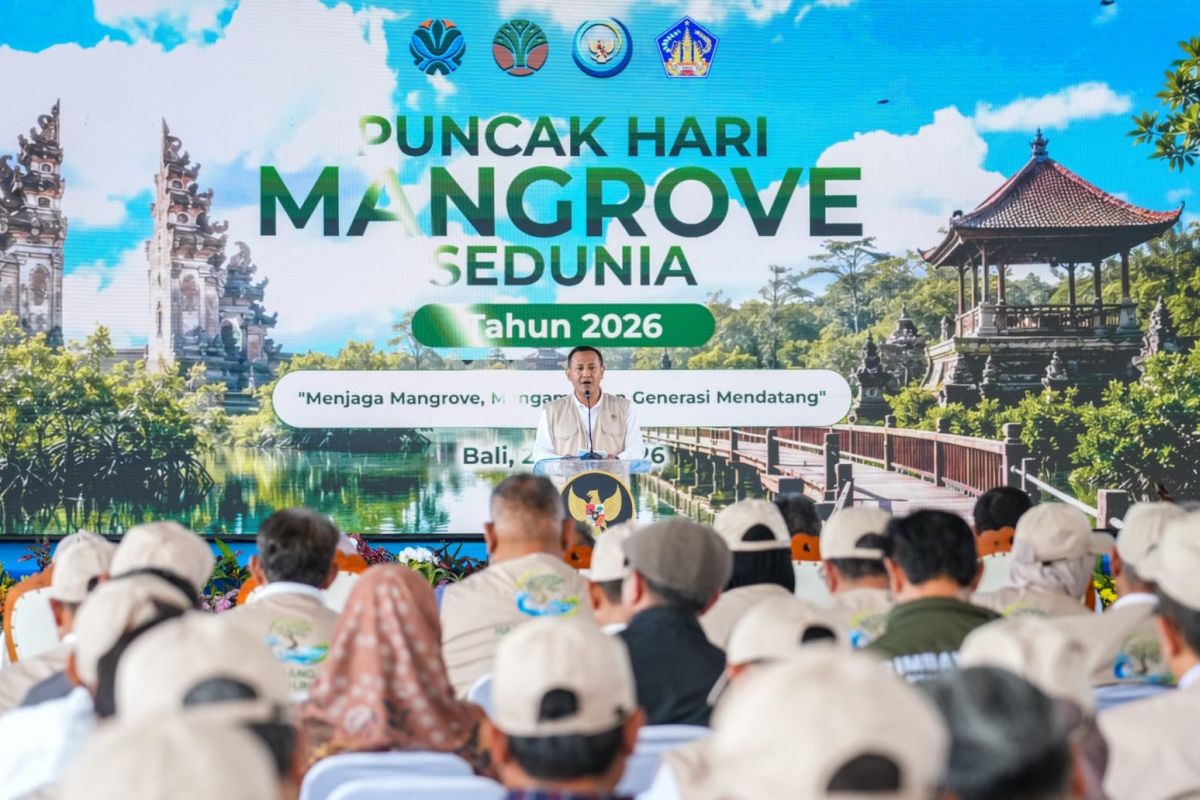
Jakarta (ANTARA) — Deputy Minister of Forestry Rohmat Marzuki has assessed that the rehabilitation and protection programme for mangrove forest areas has proven to deliver real socio-economic benefits for coastal communities whilst having a positive impact on environmental restoration.
“This collaborative support has created jobs for 64,386 people, supported the birth of 63 Village Regulations on the protection and management of mangrove ecosystems, and channelled community business grants of Rp16.29 billion,” the Deputy Minister said, quoted from his statement in Jakarta on Tuesday.
“This shows that mangrove rehabilitation is able to restore ecosystems whilst directly improving community welfare,” he added.
On that basis, the Deputy Minister underlined three main pillars that form the foundation for the future sustainability of mangrove ecosystems.
“Therefore, commitment, collaboration and innovation from all stakeholders are the keys to success in preserving mangrove ecosystems,” he said.
This strategic step by the Ministry of Forestry aligns with the implementation of Government Regulation Number 27 of 2025 and the National Mangrove Ecosystem Protection and Management Plan (RPPEM) 2026-2055.
Moreover, the move also represents a concrete execution of President Prabowo Subianto’s Asta Cita in harmonising life with nature, optimising blue carbon, and driving green economic growth based on coastal communities.
Meanwhile, the Ministry of Forestry continues to affirm its central role in safeguarding the sustainability of Indonesia’s coastal ecosystems.
Of the total 3.45 million hectares of national mangroves — representing around 23 per cent of the world’s mangroves according to the 2025 National Mangrove Map — some 2.73 million hectares, or roughly 80 per cent, lie within Forest Areas under the direct responsibility of the Ministry of Forestry.
The Deputy Minister outlined the Ministry’s track record and concrete steps in ecosystem recovery. By the end of 2025, the Ministry and its partners had successfully rehabilitated 91,678 hectares of mangrove.
Continuing that commitment, in 2026 the Ministry targets rehabilitation of more than 17,000 hectares across various regions of Indonesia through collaboration with development partners.
These include Mangroves for Coastal Resilience (M4CR), Forest Programme VI, the Japan International Cooperation Agency (JICA), and Nature-based Solutions for Climate-Smart Livelihoods in Mangrove Landscapes (Nasclim).
Source: jawawa.id (https://jawawa.id/newsitem/deputy-minister-mangrove-protection-delivers-socio-economic-impact-1785218022)
Originally published by Antara (Indonesian) (https://www.antaranews.com/berita/5668911/wamenhut-perlindungan-hutan-mangrove-beri-dampak-sosial-ekonomi), translated from Indonesian