
Deputy Minister Lays First Stone for TK Aisyiyah Banguntapan as Part of Education Revitalisation
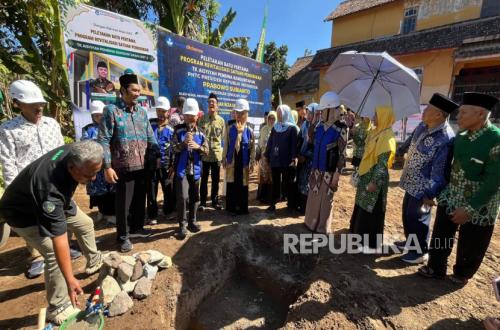
BANTUL – Deputy Minister of Primary and Secondary Education (Wamendikdasmen) Fajar Riza Ul Haq laid the foundation stone for the construction of TK Aisyiyah Pembina Banguntapan on Friday (24/7/2026). The construction is part of the government’s education unit revitalisation programme, which aims to strengthen educational facilities and infrastructure, including those managed by the community.
Fajar said the government’s support for the construction of TK Aisyiyah Pembina Banguntapan does not stop at the foundation stone ceremony. He confirmed that financing has been settled by the Ministry of Primary and Secondary Education, and expressed hope that construction can be completed quickly, improving the quality of the learning environment while expanding community access to decent, high-quality educational services.
“God willing, it will be seen through to completion. Not just the laying of the stone, but until it is finished. Thank God, the financing has already been settled by the Ministry of Education, and hopefully there will be contributions and collective efforts to add to the site. The spirit of Aisyiyah and Muhammadiyah is one of mutual cooperation, of ta’awun,” Fajar said in his remarks on Friday (24/7/2026).
According to him, the construction of TK Aisyiyah Pembina Banguntapan embodies the synergy between the government and community groups that have long provided educational services. He stressed that government attention is given not only to state schools but also to private schools managed by community organisations such as Muhammadiyah, Aisyiyah, Nahdlatul Ulama, Persis, Taman Siswa, PGRI and other foundations.
Fajar noted that the work of Aisyiyah and Muhammadiyah in education has reached various regions to the remotest corners of the country. He recounted a visit to Wakatobi in Southeast Sulawesi, where he found Muhammadiyah schools serving the education of children from the Bajo tribe.
“The reverberations of the Muhammadiyah-Aisyiyah mission are truly felt to the very ends of the country. Not only in Yogyakarta as the home of Muhammadiyah, but all the way to Wakatobi, the home of the Bajo people,” he said.
Therefore, Fajar said the government needs to give equal attention to non-governmental institutions providing educational services. According to him, improving facilities and the quality of educational services will support better learning processes.
He also encouraged Aisyiyah schools to continue improving quality rather than merely pursuing growth in the number of their institutions. With Aisyiyah’s track record spanning more than a century, Fajar hopes more Aisyiyah schools will become outstanding schools and models of education.
“The hope, of course, is that in future more Aisyiyah schools will emerge that excel and serve as models, because we are oriented towards quality, not simply chasing the quantity of institutions. Improving quality is a worthy focus for all of us. When the government pushes the importance of quality, I believe private schools must also run, and not be left behind,” he said.
“And I know that in Yogyakarta there are many excellent Muhammadiyah-Aisyiyah schools. Perhaps even, if I may say, more attractive to parents than state schools. This is a shift, something important for us to observe,” he added.
On that occasion, Fajar also emphasised the importance of strengthening early childhood education and the role of the family. He said the future of education is determined not only by formal and non-formal schooling, but also by the education that takes place within the family environment.
According to him, the concept of education involving family, school and community needs to be strengthened amid the challenges of children’s use of gadgets and social media. He reminded parents of the importance of limiting children’s access to mobile phones to prevent excessive dependency.
“We are also trying to work out how to limit children’s use of the internet. We only allow it at weekends,” Fajar said.
Furthermore, he hopes the construction of TK Aisyiyah Pembina Banguntapan will strengthen early childhood education and become part of the development of a community-based education ecosystem.
“I believe that if the government facilitates the construction of a school for Aisyiyah, God willing, the results will not disappoint. I have travelled to many places and seen that, with or without the government, Aisyiyah keeps moving forward. Working in synergy with the government, it can run even faster,” he said.
Meanwhile, the Chair of the Aisyiyah Central Leadership, Latifah Iskandar, said the construction forms part of efforts to prepare the generation that will enter productive age in 2045. She said education provided from an early age is an essential part of preparing the generation towards a Golden Indonesia 2045.
“What will be built here will add to the pupils educated by Aisyiyah. They will be ready when they turn 19 and enter Golden Indonesia 2045,” she said.
According to her, the construction and revitalisation of Aisyiyah education units is still needed in many regions. Although many schools have already received assistance, a number of educational institutions still require support to improve their facilities and infrastructure.
“Although we understand that many have already been helped, there are also many that need support for the revitalisation programme for kindergartens and other early childhood education units,” she said.
Latifah hopes the construction of TK Aisyiyah Pembina Banguntapan can be completed quickly and begin operating so that it benefits the community. She also hopes support for the development of Aisyiyah education can continue to be expanded to various other locations.
“God willing, it will be built quickly, become operational quickly, and be of benefit to the community, especially in Kotagede and the surrounding area,” she said.