
Deputy Minister: Indonesia Seeks Access for ‘Personalised Products’ in Chinese Market
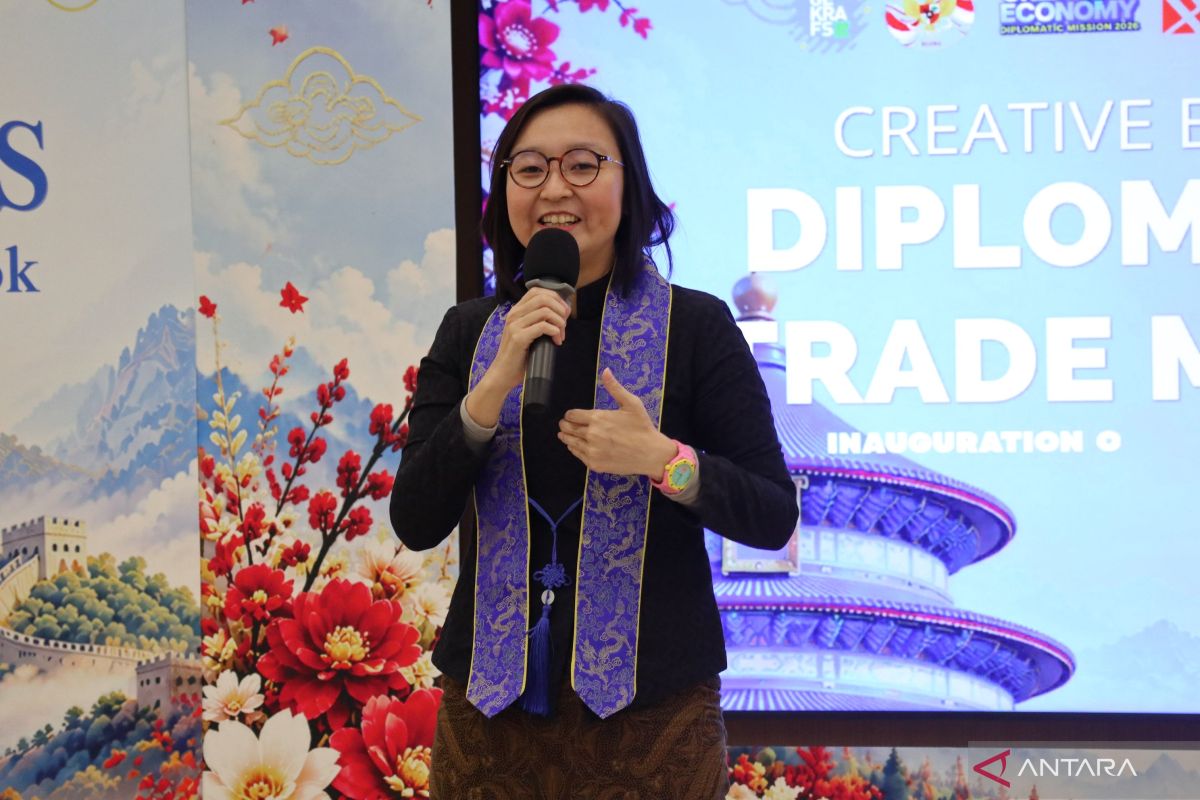
Beijing (ANTARA) – Deputy Minister of Creative Economy and Deputy Head of the Creative Economy Agency Irene Umar said Indonesia had an opportunity to market personalised products with distinctive Indonesian characteristics in China.
“We see a lot of demand in China, particularly for personalised items based on Indonesian culture, of which Indonesia has a great deal,” Irene said in Beijing on Saturday (31 October).
A personalised product is an existing product given a particular appearance or identity, adding personal or emotional value for its user.
Irene made the remarks on the sidelines of the inauguration of the China Overseas Representative Council of the National Creative Economy Movement (Gekrafs), whose representatives cover Beijing, Guangzhou, Shenzhen and Shanghai.
“We see the creative economy as a new engine of growth for the country. From Sabang to Merauke, we are all different. Our faces are different, and so are our stories, which gives us something unique,” Irene said.
She said future markets would look not only at what could be produced well, but also at a product’s added value and connection with consumers.
“Indonesia is the only country that can make personalised products that exist only for its consumers, and we have a very large number of them – 215 million people. This is not something that cannot be traded,” Irene said.
“We should not fight over prices or compete in commodities. We should compete through creativity – why not? The question is how to communicate with the Chinese market, which differs from us in language and culture,” she added.
Irene also urged creative industry players to look to China as an example in innovation and technology.
“Although when it comes to cultural roots Indonesia also has an advantage – for example, they supply fabric to Indonesia, but in Indonesian hands it can be designed in such a way that the margin can reach hundreds of per cent,” she said.
Irene said the Ministry of Creative Economy aimed for the sector to contribute 8 per cent of Indonesia’s gross domestic product (GDP) in 2026.
“We are currently at 7.6 or 7.8 per cent, so we are about to reach the target. But in my view, we have already exceeded it, because we have not yet counted digital assets, such as games like ‘My Lovely Daughter’, which has entered the Chinese market,” she said.
Previously, more Indonesian games had gone to the US market. The former Creative Economy Agency (Bekraf), she explained, had helped translate content into the language used by target markets and open up opportunities for Indonesian talent at both national and international levels.
Indonesia’s Ambassador to China and Mongolia, Djauhari Oratmangun, said in his address that the Ministry of Foreign Affairs supported creative economy businesses by making diplomacy deliver tangible benefits, “all the way to the dinner table”.
“At the Indonesian Embassy in Beijing, we changed the name of the Information and Socio-Cultural Affairs function to Tourism, Creative Economy and Public Diplomacy (PEKDP), making us one of the first Indonesian embassies to do so,” Djauhari said.
He said China’s government and businesses worked together to support the creative industries, from promotion and market activities to sharing information about trends, technology and financing.
“If China has Chinese dramas, what about Indonesia having Indonesian dramas? Indonesia is good at storytelling. In gaming, in the first half of this year, sales of Indonesian games there reached US$26.3 billion, with 680 million users,” Djauhari said.
He said producing dramas or games rooted in Indonesian stories in collaboration with China’s production capabilities could be one example of cooperation.
Data from the Ministry of Creative Economy and the Creative Economy Agency show that the creative economy contributed Rp1,757 trillion, or 6.86 per cent, to national GDP in 2025. The largest subsector was culinary, at Rp721.8 trillion.
In the same year, the sector employed 27.40 million people, or 18.8 per cent of the national workforce.
The total value of creative economy goods exports from January to April 2026 was US$9.99 billion. Fashion goods accounted for US$5.85 billion, or 58.55 per cent of total creative economy goods exports.
The creative economy subsectors under Bekraf include culinary, fashion, television and radio, crafts, publishing, applications and games, architecture, advertising, film, animation and video, music, photography, fine arts, product design, performing arts, interior design and visual communication design.
Source: jawawa.id (https://jawawa.id/newsitem/deputy-minister-indonesia-seeks-access-for-personalised-products-in-chinese-market-1793451190)
Originally published by Antara (Indonesian) (https://www.antaranews.com/berita/5823843/wamenkraf-indonesia-cari-akses-personalized-product-di-pasar-china), translated from Indonesian