
Deputy Minister Hanif: Unbeknownst to Us, Indonesia is Still Colonised by Other Nations in the Food Sector
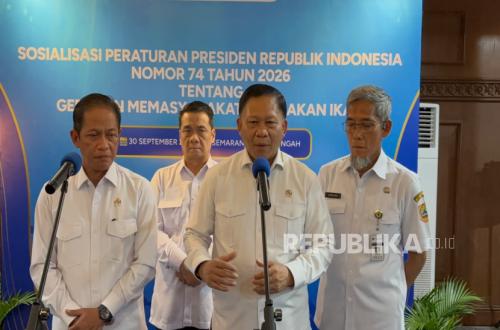
The Deputy Coordinating Minister for Food, Hanif Faisol Nurofiq, stated that Indonesia is still being colonised by other nations in the food sector. He encouraged the public to utilise local food sources, particularly the fisheries sector, to reduce dependence on food imports.
Hanif explained that to meet protein requirements, the public still tends to consume beef and cow’s milk. However, approximately 50 per cent of the national supply or availability of beef still relies on imports.
The same applies to cow’s milk. Hanif noted that the national requirement for cow’s milk reaches 5 million tonnes per year, while domestic production capacity is only 800,000 tonnes.
“Without us realising it, we are spending more on buying imported protein rather than utilising our domestic protein,” said Hanif while attending a socialisation event for Presidential Regulation Number 74 of 2026 regarding the Movement to Popularise Fish Consumption (Gemarikan) at the Gradhika Bhakti Praja Building, Semarang, Central Java, on Wednesday (30/09/2026).
According to Hanif, the protein needs of citizens can be met through domestic fishery products, which currently have a very low absorption rate. “We are still trapped by proteins that we import from other countries. The demand for beef, namely beef and buffalo meat, reaches almost 800,000 tonnes per year, and half of it is imported. Meanwhile, we have a fish production of almost 56 million tonnes per year, yet our consumption is only 7.5 million tonnes,” he said.
He added that, at a more affordable price, the protein intake obtained by the public from fish is no inferior to beef. Hanif noted that the price range for fish is between Rp 15,000 and Rp 24,000 per kilogram, whereas beef can reach Rp 150,000 to Rp 240,000 per kilogram.
“Imagine, just for our protein fulfilment, in the name of our tastes, we neglect how long we have been colonised by other nations in the food sector,” said Hanif.