
Deputy Minister: From Tempe Innovation to Exports, a Model for Impactful Research
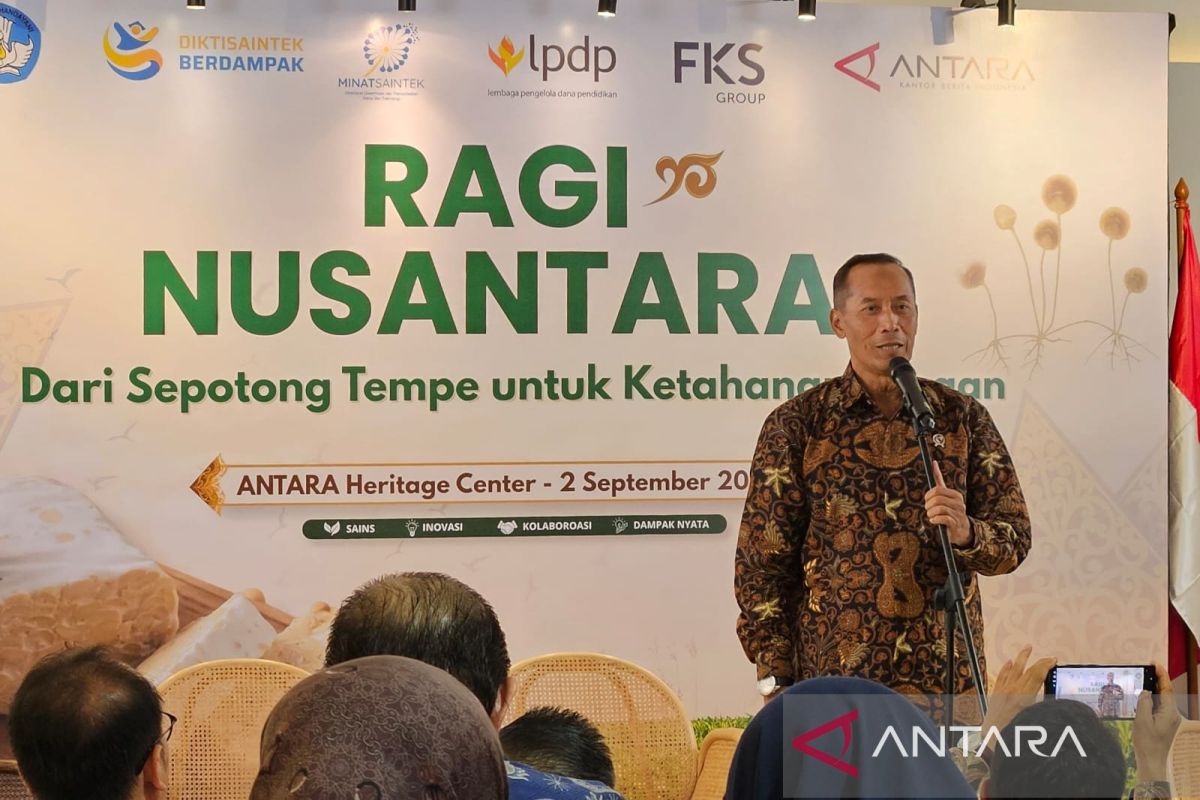
Jakarta (ANTARA) - The Deputy Minister of Higher Education, Science, and Technology, Fauzan, stated that innovations ranging from tempeh to export capabilities serve as examples of strengthening the utility of research for society and the national economy to achieve development targets.
A research team from the University of Indonesia (UI) has developed an innovation in tempeh starter through the Science and Technology-Based Living Ecosystem Program (Bestari Saintek) under the Ministry of Higher Education, Science, and Technology, with funding from the Indonesia Endowment Fund for Education (LPDP).
Speaking at the Ragi Nusantara event at the Antara Heritage Center, Jakarta, on Wednesday, Fauzan noted that the development of tempeh could serve as a prime example of how university research delivers tangible impacts. According to him, existing research must be followed up with product innovation and industrial development.
He highlighted the limited variety of tempeh products currently available, which are mostly found in the form of chips or ‘botok’. Therefore, breakthroughs are necessary to ensure tempeh can penetrate export markets and generate economic impact.
Furthermore, he noted that President Prabowo Subiandum has targeted 8 per cent economic growth by 2029 and the ‘Indonesia Emas’ (Golden Indonesia) vision for 2045. Fauzan assessed that these are not easy goals to achieve and require a paradigm shift in the governance of higher education.
Fauzan emphasised that impactful research is not enough to merely produce knowledge; it must also provide benefits that can be felt by the community, including through increased economic value.
He explained that the tempeh innovation aligns with the efforts of the Ministry of Higher Education, Science, and Technology (Kemendiktisaintek) to shift the higher education paradigm so that it does not merely serve as a site for the production of scientific knowledge.
“We just need to find industrial off-takers capable of producing export-grade tempeh, which could be named ‘Tempe Bestari Saintek’. This is what constitutes impactful research. We must define impact by whether it possesses the value to enhance economic dignity or not,” he said.
In his view, universities must be able to contribute to economic growth and prosperity. Consequently, innovation in the tempeh sector needs to be directed so that a product traditionally known as a local food can evolve into a global commodity.
He expressed hope that activities and research conducted by universities would not stop at academic exercises or ceremonies, but would offer practical benefits, particularly in addressing economic needs and business development.
Source: jawawa.id (https://jawawa.id/newsitem/deputy-minister-from-tempe-innovation-to-exports-a-model-for-impactful-research-1788354538)
Originally published by Antara (Indonesian) (https://www.antaranews.com/berita/5722896/wamendikti-inovasi-tempe-hingga-ekspor-jadi-contoh-riset-berdampak), translated from Indonesian