
Deputy Minister for Energy Inspects Saguling Hydropower Plant, Guarantees Secure Electricity Supply for Eid Al-Fitr
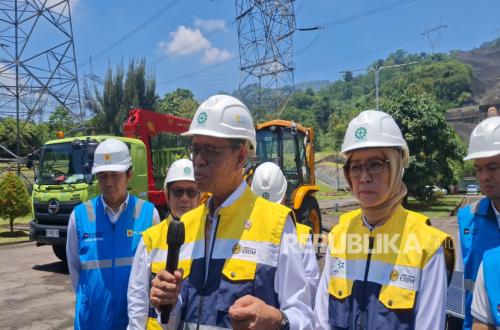
BANDUNG BARAT — Deputy Minister for Energy and Mineral Resources (Wamen ESDM), Yuliot Tanjung, conducted an inspection of the Saguling Hydroelectric Power Plant (PLTA) in West Bandung Regency, West Java, on Monday, 16 March 2026.
Following the inspection, he assured that electricity supplies would remain secure ahead of Eid Al-Fitr 1447 Hijriah. “We have reviewed the comprehensive preparations at PLTA Saguling, and I can confirm that our electricity supplies for Eid are secure,” Yuliot told journalists.
He reported that current national power generation capacity (DMP) reached 51,967 megawatts (MW).
Projections for electricity supply to the national system throughout the Ramadan and Eid Al-Fitr 1447 Hijriah period indicate safe conditions, with peak demand at 35,017 MW, providing a reserve of 16,950 MW or 48.4 per cent.
“Our peak demand is already at 35,000 MW, which means our reserve is quite substantial, well above average,” said Yuliot. National electricity requirements during Ramadan and Eid are partly supplied by PLTA Saguling, operated by PT PLN Indonesia Power UBP Saguling.
The PLTA, located in Rajamandala Kulon Village, Cipatat District, West Bandung, has an installed capacity of 4×175 MW. PLTA Saguling operates to support peak demand in the Java-Bali system and functions as a frequency regulator using load frequency control (LFC).
“Saguling power plant maintenance was conducted well in advance, so the potential for future disruptions is minimal,” said Yuliot.
Beyond national electricity supply, PLN has mobilised personnel and equipment to facilitate the smooth 2026 Eid exodus. Some 72,056 personnel have been placed on standby to ensure electricity supply remains safe and reliable. A total of 3,790 emergency posts and 437 exodus assistance posts have been established nationwide.
PLN has also prepared 2,005 generators, 1,349 mobile substations (UGB), 773 uninterruptible power supply (UPS) units, 4,901 vehicles, 4,594 motorcycles, 429 crane trucks, and 4,769 public electric vehicle charging stations (SPKLU) nationwide.
“With the establishment of the National Emergency Post for the Energy Sector and posts at each unit, energy preparedness can be coordinated and responsive to potential disruptions,” said Yuliot.