
Deputy Minister Fajar: Pancasila Must Be Felt in Classrooms and Public Services
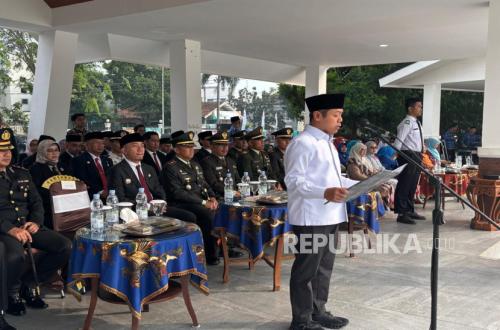
Lebak – The commemoration of Pancasila’s Birth on 1 June 2026 serves as a moment to reaffirm the importance of embedding Pancasila values in national life and governance, according to Deputy Minister of Basic and Secondary Education Fajar Riza Ul Haq, who presided over the ceremony in Lebak Regency, Banten, today.
He stressed that the government must embody Pancasila values through policies and public services that prioritise humanity, social justice, and equitable access to education.
He highlighted Lebak as the venue for this solemn ceremony, noting the region’s historical, cultural, and moral legacy centred on human dignity and respect.
‘Commemorating Pancasila’s birth in Lebak means reading Pancasila from its deepest moral source: that humanity must be honoured, the people served, and the state present as protector and guardian for all,’ Deputy Minister Fajar said in a written statement on Monday (1/6/2026).
He explained that quality education for all is a tangible manifestation of Pancasila, particularly the second and fifth principles. Therefore, the government continues to expand educational access for communities facing various limitations.
He added that this aligns with President Prabowo Subianto’s directives, implemented by Basic and Secondary Education Minister Abdul Mu’ti, with ongoing efforts to ensure all Indonesian children have equal educational opportunities.
Deputy Minister Fajar’s activities in Lebak began with a visit to SMA 34 Lebak, a People’s School, the night before the Pancasila commemoration. During the visit, he engaged with students, teachers, and education staff to hear their aspirations regarding the school’s operations.
‘Economic background must not determine an Indonesian child’s future. Through education, the state paves the way for every child to have equal opportunities to learn, grow, and achieve their aspirations,’ Deputy Minister Fajar said.
‘As President Prabowo Subianto directed, ‘no Indonesian child should be denied schooling due to economic reasons’, so the state must ensure quality education access for all citizens,’ added the former executive director of the Maarif Institute.
He added that education must serve as a bridge for social mobility and a tool to break intergenerational poverty cycles, requiring cross-sector synergy between government, business, civil society, and other stakeholders.
Following the ceremony, Fajar, accompanied by Lebak Regent Hasbi Asyidiqi, visited the Multatuli Museum, where Commission X DPR RI member Bonnie Triyana guided them through the exhibits and historical records.
During the visit, the ideas of Eduard Douwes Dekker, known for championing human rights and critiquing colonial injustices, were highlighted. For Deputy Minister Fajar, the museum serves as a reminder that the struggle for social justice must continue across all aspects of life, including education.
‘Pancasila must not remain a slogan or ceremony. It must be felt in classrooms, public services, state policies, and the daily lives of Indonesian citizens,’ he said.
‘It is an honour to visit the Multatuli Museum accompanied by the Regent and guided directly by Mr Bonnie, our partner in Commission X of the DPR RI,’ he added.