
Deputy Minister Ensures Legok Nangka Waste-to-Energy Technology is Environmentally Safe
Bandung Regency, West Java (ANTARA) - Deputy Minister of Energy and Mineral Resources Yuliot Tanjung has stated that the Legok Nangka Waste-to-Energy Plant (PSEL) in Bandung Regency uses environmentally friendly incinerator technology that is safe for public health whilst supporting clean energy.
According to Yuliot, all waste from the agglomeration area will be processed, thereby reducing environmental impact, improving public health quality, and generating sustainable new renewable energy for the community’s needs.
“With the incinerator technology used at the Legok Nangka PSEL, the waste processing temperature is around above 800 degrees Celsius. So all materials entering the facility will be processed and burned completely,” Yuliot said in Bandung Regency, West Java, on Wednesday.
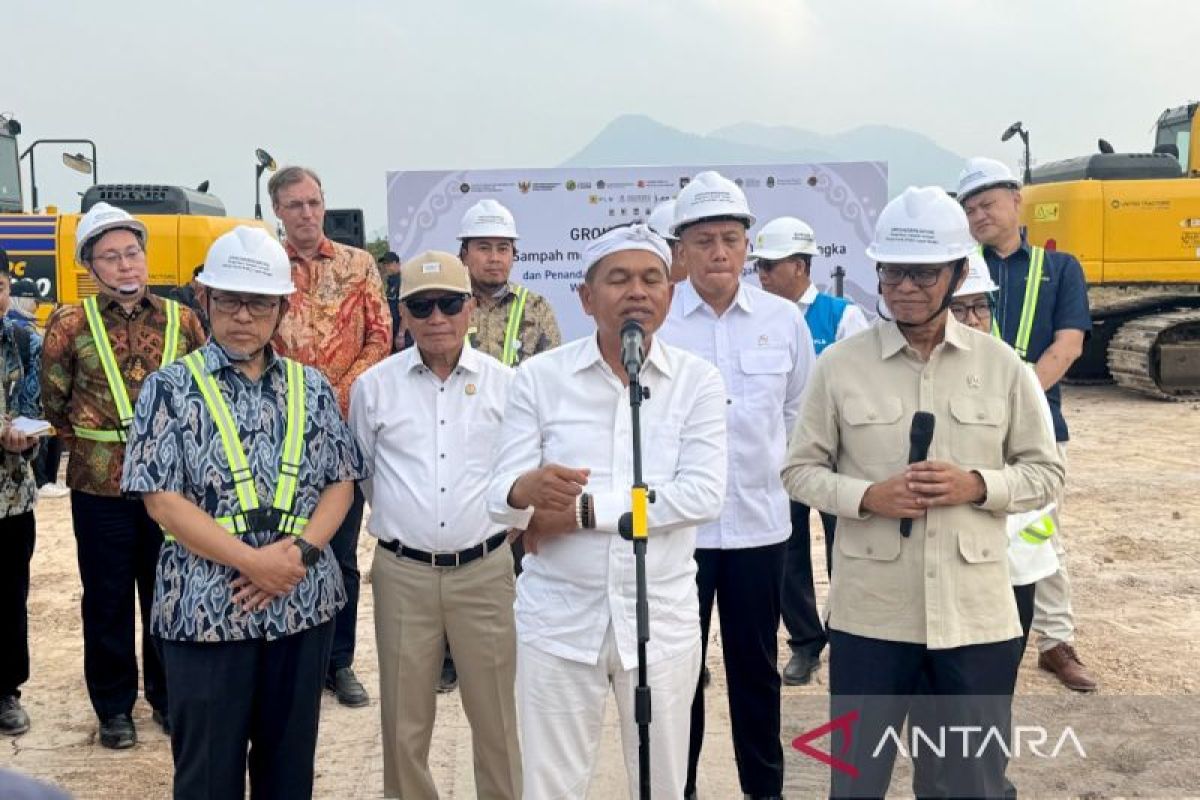
He made the remarks during the groundbreaking ceremony for the Legok Nangka Waste-to-Energy Plant, held together with the West Java Provincial Government.
Under the project, the Legok Nangka PSEL will process up to 2,131 tonnes of waste per day into electricity with a capacity of around 40 megawatts, in order to strengthen the availability of sustainable and reliable energy in West Java Province.
To that end, Yuliot expressed hope for full support from ministries, agencies, the West Java Provincial Government, district and municipal governments, and all levels of society so that the project’s construction proceeds according to the targets set.
He said various facilitation measures for the construction had been carried out by the West Java Provincial Government together with ministries and agencies, so the project is expected to achieve its commercial operation date (COD) on target in 2029.
He further stated that the construction of the Legok Nangka PSEL is also a follow-up to President Prabowo Subianto’s instruction to accelerate the resolution of urban waste problems through the development of integrated waste processing facilities in various regions.
According to him, the priority of building these facilities is expected to resolve West Java’s waste problems whilst increasing energy supply sourced from waste processing as a source of clean energy.
He explained that waste processing also supports the development of a circular economy, as various types of waste can be sorted and reused into value-added products through the application of modern technology.
Plastic waste, he added, can be processed using such technology into renewable fuel, thereby strengthening national energy resilience through the utilisation of resources that were previously waste.
The government will also integrate various processing technologies in order to produce electricity, renewable liquid fuels, and bioenergy as part of sustainably strengthening the national energy mix.
Responding to concerns about emissions, Yuliot explained that the Legok Nangka PSEL uses incinerator technology at temperatures exceeding 800 degrees Celsius, so all materials burn completely without leaving hazardous residue.
He affirmed that the technology can prevent the formation of dioxins, which are potentially harmful to health, and has been proven safe in various countries without causing environmental or public health impacts.
Yuliot added that the construction of the electricity transmission network will be carried out in parallel with PT PLN, so that when the PSEL begins operating, all the energy produced can be immediately channelled to the public.
He said that after construction in the area, the government plans to develop similar facilities in other agglomeration areas, including Bogor Raya, Depok, and Bekasi Raya, in order to expand national waste-to-energy management.
West Java Governor Dedi Mulyadi said the project, targeted to operate in 2029, will deliver three main benefits: resolving waste problems in Greater Bandung, providing electricity for communities and industry, and creating a cleaner environment.
The waste-to-energy project, valued at 400 million US dollars or approximately Rp7.2 trillion, is designed with a capacity of 40.79 megawatts. During the 41-month construction period, the project is estimated to absorb 1,565 workers. The project is also projected to reduce greenhouse gas emissions by 311,874 tonnes of CO2 equivalent.
Source: jawawa.id (https://jawawa.id/newsitem/deputy-minister-ensures-legok-nangka-waste-to-energy-technology-is-environmentally-safe-1785336874)
Originally published by Antara (Indonesian) (https://www.antaranews.com/berita/5671643/wamen-esdm-pastikan-teknologi-psel-legok-nangka-aman-bagi-lingkungan), translated from Indonesian