
Deputy Minister and Teluk Wondama DPRD Discuss Accelerating 'Sekolah Rakyat' Construction
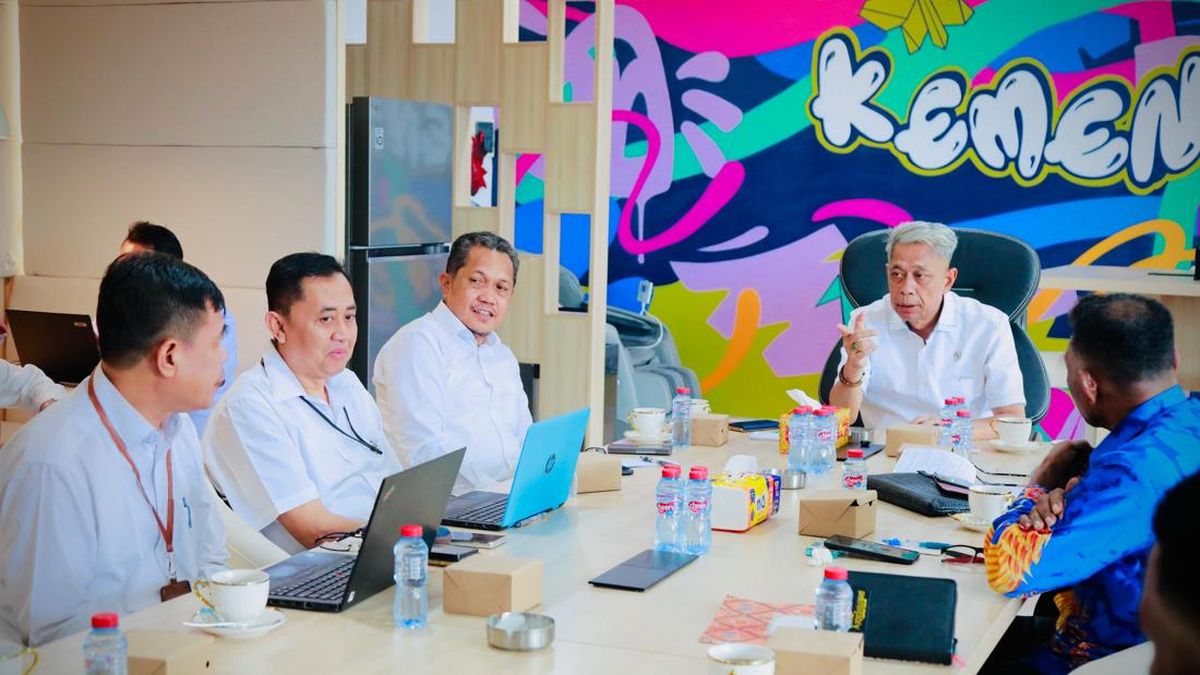
Deputy Minister of Social Affairs Agus Jabo Priyono is encouraging the Teluk Wondama Regency Government in West Papua to immediately submit a proposal for the construction of a Sekolah Rakyat (People’s School) as part of efforts to expand educational access for poor communities in frontier, outermost, and disadvantaged (3T) regions. This was conveyed by Agus Jabo during an audience with the leadership of the Teluk Wondama DPRD at the Ministry of Social Affairs office in Central Jakarta on Monday (6/7). The DPRD delegation included Deputy Chair II Soleman JP Karubui, Deputy Chair III Amos Waropen, and their respective expert staff, Heronimus Gewayanzre Keban and Arie Waropen. Agus Jabo was accompanied by Expert Staff to the Minister of Social Affairs Hendri Kurniawan and Alif Kamal, along with representatives from the Directorate of Social Rehabilitation for Persons with Disabilities, the Directorate of Social Empowerment for Poor and Vulnerable Families, the Centre for Social Welfare Data and Information (Pusdatin Kesos), and the Joint Secretariat for Sekolah Rakyat.
Discussions not only focused on accelerating the construction of Sekolah Rakyat but also on optimising the use of the National Single Socio-Economic Data (DTSEN) as the basis for formulating poverty alleviation programmes. Deputy Chair of the Teluk Wondama DPRD, Soleman JP Karubui, stated that they deliberately sought consultation to obtain direction on steps the local government should take, particularly in accelerating the school’s construction and handling communities in remote indigenous areas (KAT). “We took the initiative from the DPRD. Because we see that if the executive is slow, we must immediately check ourselves. Our people are also waiting,” said Soleman. He noted that many residents of Teluk Wondama still require housing support and basic services, especially those in remote indigenous communities, and the DPRD wants to ensure the local government can promptly prepare proposals in accordance with applicable regulations.
Agus Jabo explained that proposals for the Remote Indigenous Community (KAT) programme and Sekolah Rakyat must be submitted by the local government through the regent and relevant technical agencies. The DPRD can oversee and encourage the executive to map and submit the community’s needs comprehensively. “There must be a proposal, sir. And it must come from the Regency Government. Later, you call the Regent, together with the Social Service and related agencies, to submit what the community needs there,” said Agus Jabo. He stressed that all social interventions must now originate from the DTSEN, which serves as the foundation for central and regional governments in formulating poverty alleviation programmes, including social assistance, PBI-JK, Sekolah Rakyat, empowerment, and KAT. “Now we have the National Single Socio-Economic Data. Development and poverty alleviation programmes from the central to regional levels must be based on this data. If DTSEN is not used, there will be problems later,” he stated.
Agus Jabo explained that the Ministry of Social Affairs has been mandated to assist in updating the DTSEN. For social assistance programmes like PKH and BPNT, updates are conducted every three months, while updates for PBI-JK are done monthly due to the more dynamic nature of the data. During the meeting, Agus Jabo also highlighted that the PBI-JK quota in Teluk Wondama could still be optimised, with a potential quota of around 15,000 participants that could be utilised through DTSEN updates. He requested the DPRD to immediately encourage the local government to coordinate with the Social Service and the Central Statistics Agency (BPS) to correct recipient data, including addressing inclusion and exclusion errors. He noted that optimising this quota could also help reduce the burden on the Regional Budget (APBD) for health insurance financing. “If the quota is still available, please propose it. That can reduce the APBD burden. Please convey this to the Regent and the Social Service so it can be managed,” said Agus Jabo.
Furthermore, Agus Jabo assessed that Papua and West Papua still require more Sekolah Rakyat given the vast area and the many children from poor families who still lack adequate access to education. “If Teluk Wondama can propose one, that would be excellent. We will prioritise it because this is Papua, which we must pay attention to,” he said. He explained that Sekolah Rakyat is built with a boarding school concept, requiring a minimum of 6.8 hectares of land that must be certified under the ownership of the local or provincial government to avoid future disputes. “The land is 6.8 hectares, the certificate must belong to the Regency or Provincial Government. It cannot belong to indigenous communities or individuals. If it belongs to the indigenous community, it must be granted first and the administration processed,” said Agus Jabo. In response, Soleman mentioned that there had been previous discussions regarding land for a Sekolah Rakyat in Teluk Wondama, with around 10 hectares of community-granted land available that could be further prepared by the local government. Agus Jabo welcomed this and requested that the administrative process be completed so that Teluk Wondama could enter the construction proposal stage. “If it can be done this year, that would be extraordinary. I note, with your presence here, that within a month the land can be proposed for the construction of Sekolah Rakyat,” he said.
The audience also discussed that the proposal for the Remote Indigenous Community (KAT) programme for Teluk Wondama has been followed up with an assessment by the Ministry of Social Affairs in two villages, namely Sewar and Yopmeos. The programme is planned for 75 beneficiary families and is being prepared for implementation in 2027. “For KAT, it turns out it has been followed up because the Social Service has submitted a proposal. The total is 75 beneficiary families in two villages. It is currently in process, and hopefully, it will be operational by 2027,” said Agus Jabo. Closing the meeting, Agus Jabo requested the Teluk Wondama DPRD to immediately follow up on the results of the audience with the local government.