
Deputy Minister: 71,000 Schools to Be Revitalised, Urges Aisyiyah to Strengthen Grassroots Education
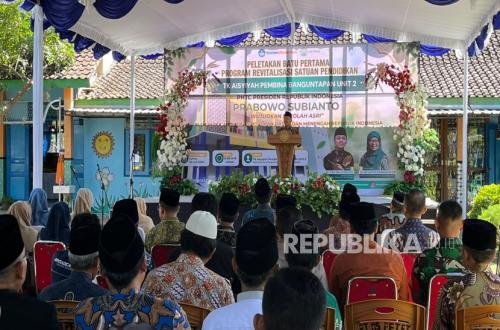
The government has allocated a budget of nearly Rp 90 trillion for a programme to revitalise around 71,000 educational institutions in 2026. The programme forms part of the government’s commitment to improving educational facilities whilst building a safer and more comfortable learning ecosystem.
Deputy Minister of Basic and Secondary Education (Wamendikdasmen) Fajar Riza Ul Haq said the revitalisation programme does not only target state schools, but also educational institutions managed by communities, including Muhammadiyah and Aisyiyah schools.
In the previous year, the revitalisation programme reached around 23 per cent of private schools nationally that received assistance.
“This is a manifestation of our commitment, from the government, to work in synergy with community groups that provide educational services,” said Fajar during the laying of the first stone for the revitalisation of the Aisyiyah Pembina Banguntapan Kindergarten in Bantul, Yogyakarta, on Friday (24/7/2026).
Fajar also stated that the contribution of private schools to national education provision is very significant. Schools managed by communities account for around 60 per cent of all educational institutions in Indonesia. Therefore, improving the quality of national education is considered impossible if it relies solely on state schools.
“Not only for state schools, but also for schools run by community groups. Not only Muhammadiyah, of course, but NU, Persis, Taman Siswa, PGRI, and other foundations that provide educational services have the right to equal access,” he said.
“Without synergising with the private sector, it would be very difficult for us to improve the learning ecosystem nationally,” he added.
It is hoped that the proportion of community-run schools can also be more fairly represented in this year’s revitalisation programme. The programme’s coverage has increased significantly from around 16,000 educational institutions improved under the previous programme. This year, the government is targeting the revitalisation of around 71,000 educational institutions.
The expanded coverage is expected to increase the number of recipient schools in the Special Region of Yogyakarta. However, the final number of recipients still awaits the data collection and technical guidance processes.
“God willing, the revitalisation recipients in Yogyakarta will increase compared to 2025. Last year it was around 16,000 nationally, now it has risen to 71,000,” he said.
Regarding the determination of assistance recipients, Fajar said it would still be based on a priority scale. Schools in severely dilapidated condition, educational institutions in disaster-affected areas, and schools in underdeveloped, frontier and outermost (3T) regions are the main targets. The aim is to complete the programme by December 2026.
The government is also ensuring that revitalisation does not stop at physical construction, but also supports the provision of learning facilities, including digital interactive boards.
Fajar also affirmed that no school buildings will remain in severe disrepair by 2028. For this reason, the revitalisation programme will continue with even greater coverage in the years that follow.
“We hope, ladies and gentlemen, that if the facilities and educational services of these schools are good and of a decent standard, then God willing this will produce quality learning processes as well. And I believe Aisyiyah’s track record has already been proven,” he said.
Urging a Greater Role for Aisyiyah
Amid such substantial government support, Fajar also asked Aisyiyah to take on a greater role in improving the quality of education. Fajar said the government’s support for the construction of the Aisyiyah Pembina Banguntapan Kindergarten does not stop at the laying of the first stone. He confirmed that the financing has been settled by the Ministry of Basic and Secondary Education and expressed hope that the construction can be completed soon so as to improve the quality of the learning environment whilst broadening public access to decent, quality educational services.
“God willing, it will be seen through to completion. Not just the laying of the stone, but right to the finish. Thank God, the financing has been settled by the Ministry of Education, and ideally there will be contributions and collective funding to add more locations. The spirit of Aisyiyah and Muhammadiyah is one of mutual cooperation, of ta’awun,” he said.
According to him, Aisyiyah’s track record over more than a century has proven its contribution to expanding access to education to the farthest corners of the country.
“The reach of the Muhammadiyah-Aisyiyah movement can truly be felt to the very edges of the nation,” he said.
Fajar cited the example of Muhammadiyah schools in Wakatobi, Southeast Sulawesi, located in settlements of the Bajo people. According to him, the existence of these schools shows that educational services managed by community organisations have reached areas far from the centres of government.
He hopes that in the future more Aisyiyah schools will not only grow in quantity, but also become excellent schools and models for improving the quality of education.
“So the hope is that, going forward, Aisyiyah schools will emerge that become flagship institutions, that become models, because we are oriented towards quality, not merely chasing the quantity of our charitable ventures,” he said.
Fajar also reminded that school revitalisation must not be understood as merely building construction. According to him, the government wants to build an educational ecosystem that involves schools, families, communities and the digital environment.
He specifically asked Aisyiyah to strengthen the role of the family in children’s education. According to him, the family is the spearhead of education, especially amid growing use of gadgets and social media by children. “The spearhead of education lies in the family,” he stressed.
According to him, parents need to be actively involved in supporting their children, including limiting the use of gadgets and access to social media. Such measures are important to prevent dependence on technology whilst safeguarding children’s mental health.
In his view, schools managed by Aisyiyah have a strong foundation for strengthening the synergy between educational institutions and families. Parental involvement in the educational process, he said, is one of the key factors in building a quality school.
“When we promote school revitalisation, it is not merely about repairing physical buildings, but about building a more conducive ecosystem, one that is safer and more comfortable for our children,” he said.
Meanwhile, the Chairperson of the Aisyiyah Central Leadership, Latifah Iskandar, welcomed the government’s support for the revitalisation of educational institutions. Aisyiyah affirmed its commitment to making optimal use of the assistance provided and expressed hope that similar support can reach more educational institutions.
She said that education provided from an early age is an important part of preparing the generation that will lead towards Golden Indonesia 2045.
“This is what will be built, so it will add to the number of children educated by Aisyiyah. They will be ready when they reach the age of 19 and enter Golden Indonesia 2045,” she said.
According to her, the construction and revitalisation of Aisyiyah educational institutions are still needed in many regions. Although many schools have already received assistance, a number of educational institutions still require support to improve their educational facilities and infrastructure.
“Although we also understand that a great many have already been helped, there are also many that need support for the revitalisation programme for kindergartens or early childhood educational institutions,” she said.
Latifah expressed hope that the construction of the Aisyiyah Pembina Banguntapan Kindergarten can be completed and begin operating soon so that it can benefit the community. She also hopes that support for the development of Aisyiyah education can continue to be extended to many other locations.
“God willing, it will be completed quickly, become operational quickly, and benefit the community, particularly in Kotagede and the surrounding areas,” she said.
Source: jawawa.id (https://jawawa.id/newsitem/deputy-minister-71-000-schools-to-be-revitalised-urges-aisyiyah-to-strengthen-grassroots-education-1785124311)
Originally published by Republika (https://rejogja.republika.co.id/berita/titdpa291/wamendikdasmen-71-ribu-sekolah-direvitalisasi-dorong-aisyiyah-perkuat-pendidikanakar-rumput), translated from Indonesian