
Deputy Law Minister States Extension of Police Chief's Retirement Is President's Prerogative as Supreme Commander
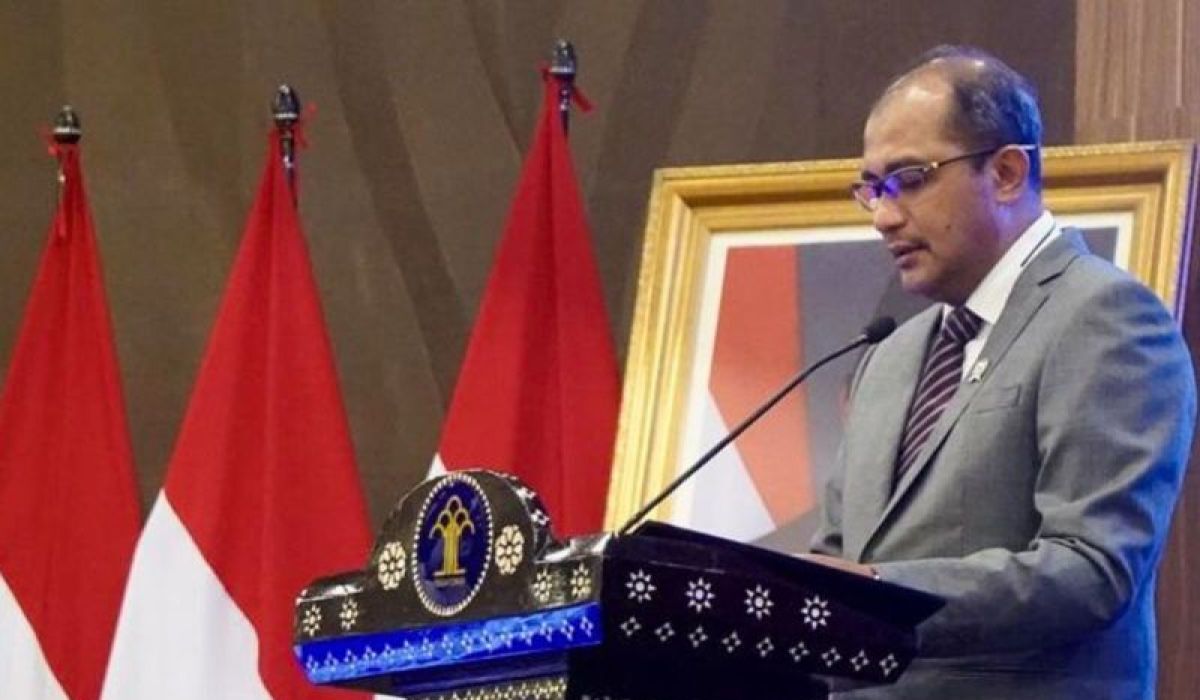
Deputy Law Minister Edward Omar Sharif Hiariej has provided an explanation regarding the emergence of a new rule in the Police Law stating that the extension of the National Police Chief’s retirement period is adjusted according to the ‘President’s needs’. The man familiarly called Eddy asserted that the addition of the phrase is purely based on the President’s constitutional position as the holder of supreme authority over all security and defence branches in Indonesia. ‘So, once again, the President of the Republic of Indonesia is the supreme commander. Thus holding authority over the Navy, Air Force, Army, and also the Police,’ Eddy said when met by journalists at the DPR RI Building, Senayan, Jakarta, Tuesday (9/6/2026).
According to Eddy, the addition of the phrase ‘or according to the President’s needs’ in a crucial article concerning the retirement age limit for high-ranking officers, particularly four-star generals, serves as the legal fulfilment of a Head of State’s prerogative right. Through this rule, the President has the authority to maintain the service period of a high-ranking police officer beyond the normative age limit should the national situation or organisational needs be deemed urgent. ‘So the President can use that prerogative to extend the age. That is the only consideration,’ he said.
Previously, the House of Representatives officially ratified the Bill on the Third Amendment to Law Number 2 of 2002 concerning the Indonesian National Police into law. The decision was led directly by Deputy Speaker of the DPR RI, Sufmi Dasco Ahmad, during a Plenary Session held at the Nusantara II Building, Parliament Complex, Senayan, Jakarta, Tuesday (9/6/2026). ‘The time has come for us to ask for the factions’ approval of the Bill on the Third Amendment to the Law on the Indonesian National Police, whether it can be approved to be passed into law?’ Dasco asked the session forum. The functional question from the session chair was immediately met with a unanimous call by all attending members from various factions. ‘Agreed!’ the council members replied in unison, which was then followed by Dasco’s gavel strike.
The Police Bill was ratified shortly after Commission III held a first-level approval plenary. The newly enacted Police Law contains several amended provisions, including those concerning the retirement age limits for members ranging from enlisted ranks, non-commissioned officers, to commissioned officers. It also addresses the strengthening of the National Police Commission and the placement of police personnel in civilian positions. Regarding the retirement age limit for police members as intended in Article 30 paragraph 5, it applies to members of the Indonesian National Police who are 56 years old when this Law comes into effect. For members who are 57 years old when this Law comes into effect, the retirement age limit is extended until the member reaches 59 years of age. Members who will turn 58 years old this year may be extended until the member reaches 59 years of age, as referred to in Article 30 paragraph 7, effective from the date this Law is promulgated.
The Police Bill also regulates the change in the National Police Chief’s retirement age to 60 years. This provision is stipulated in Article 30 paragraph 5 letter c. It states that the President may extend the term of the National Police Chief as needed. ‘Specifically for four-star high-ranking officers, the maximum retirement age is 60 years and can be extended by 1 year or according to the needs determined by Presidential decision,’ the article reads.
Source: jawawa.id (https://jawawa.id/newsitem/deputy-law-minister-states-extension-of-police-chiefs-retirement-is-presidents-prerogative-as-supreme-1781002368)
Originally published by Media Indonesia (https://mediaindonesia.com/politik-dan-hukum/898576/wamenkum-sebut-perpanjangan-pensiun-kapolri-hak-prerogatif-presiden-sebagai-panglima-tertinggi), translated from Indonesian