
Deputy Law Minister Seeks WIPO Support to Strengthen Cross-Border Royalty Governance
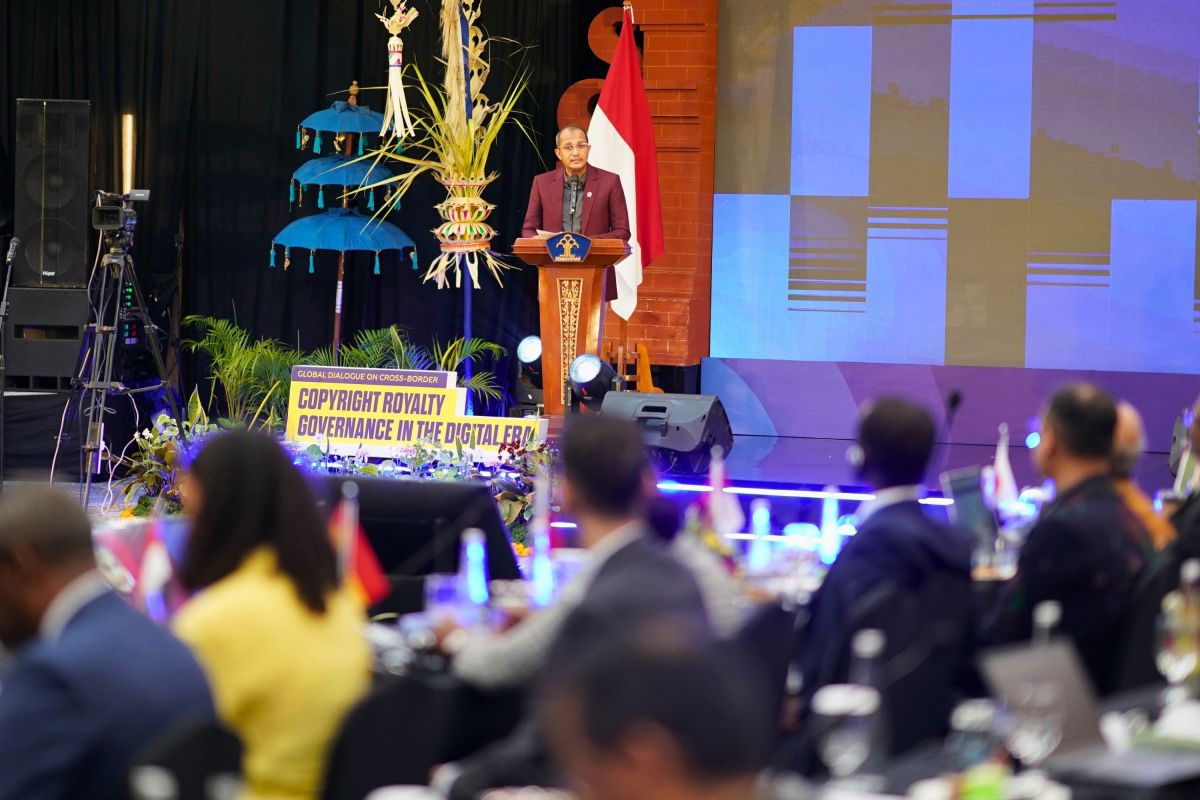
BADUNG, Bali (ANTARA) — Deputy Law Minister Edward Hiariej said the Indonesian Government was seeking support and leadership from the World Intellectual Property Organization (WIPO) to strengthen cross-border royalty governance.
He said technological advances meant creative works could circulate across national borders in seconds, while protection and royalty payment mechanisms had not kept pace.
“Creative works can cross national borders in seconds. Cooperation to protect the people behind those works must be just as strong and operate without barriers,” Eddy, as he is known, said at the Global Dialogue on Cross-Border Copyright Royalty Governance in the Digital Era in Badung, Bali, on Thursday.
He said Indonesia was pushing for stronger cross-border copyright royalty governance that was more transparent and accountable, and supported by interconnected systems. This was needed to ensure creators received fair compensation when their works were used and generated economic value in different countries.
He urged all participants in the global dialogue to continue the discussion, build stronger bridges and turn shared ideas into meaningful action.
The dialogue produced several observations on the main challenges in cross-border royalty governance. On transparency, participants highlighted rights holders’ limited access to information about the use of works, deductions applied and how royalty payments were calculated. “Inaccurate metadata and misuse of identification codes are also issues,” Hermansyah said.
On accountability, participants found that ownership of rights did not always result in creators receiving royalties. Hermansyah said missing contracts, identification-code errors and disconnected systems could break the royalty management chain, from the creation of a work through to payment.
Participants therefore proposed end-to-end royalty tracking and voluntary cross-border pilot projects. One idea was to test around 100 musical works, examining each stage from creation and recording to rights identification, use and payment.
These challenges are becoming more significant as works are used on global digital platforms. Michel Allain of WIPO’s Copyright Management Division acknowledged that negotiating licences and royalties with major companies such as Google and Apple was not easy. “The market is global, so the solutions must be global too,” Allain said.
Indonesia is also calling for royalty governance to go beyond reliance on contractual relationships between industry players. The Government has proposed global parameters that could serve as a shared reference for assessing changes in royalty values.
The proposal will be pursued through WIPO’s Standing Committee on Copyright and Related Rights (SCCR). Its next session is scheduled for late November to early December 2026.
Hermansyah said the Bali dialogue had shown that transparency, accountability and interoperability were mutually reinforcing. Interoperability did not mean that every country had to use the same system, but that different systems should be able to understand one another through shared standards.
“We are ready to continue more technical discussions with all interested partners, in an open and inclusive manner,” he said.
For Indonesia, the dialogue is an initial step towards international cooperation that would enable creators not only to know where their works are being used, but also to track and verify their use and receive the royalties to which they are entitled.
Source: jawawa.id (https://jawawa.id/newsitem/deputy-law-minister-seeks-wipo-support-to-strengthen-cross-border-royalty-governance-1791463969)
Originally published by Antara (Indonesian) (https://www.antaranews.com/berita/5777328/wamenkum-harap-dukungan-wipo-perkuat-tata-kelola-royalti-lintas-negara), translated from Indonesian