
Deputy Law Minister: Mislabeled rice harms the economy and consumers
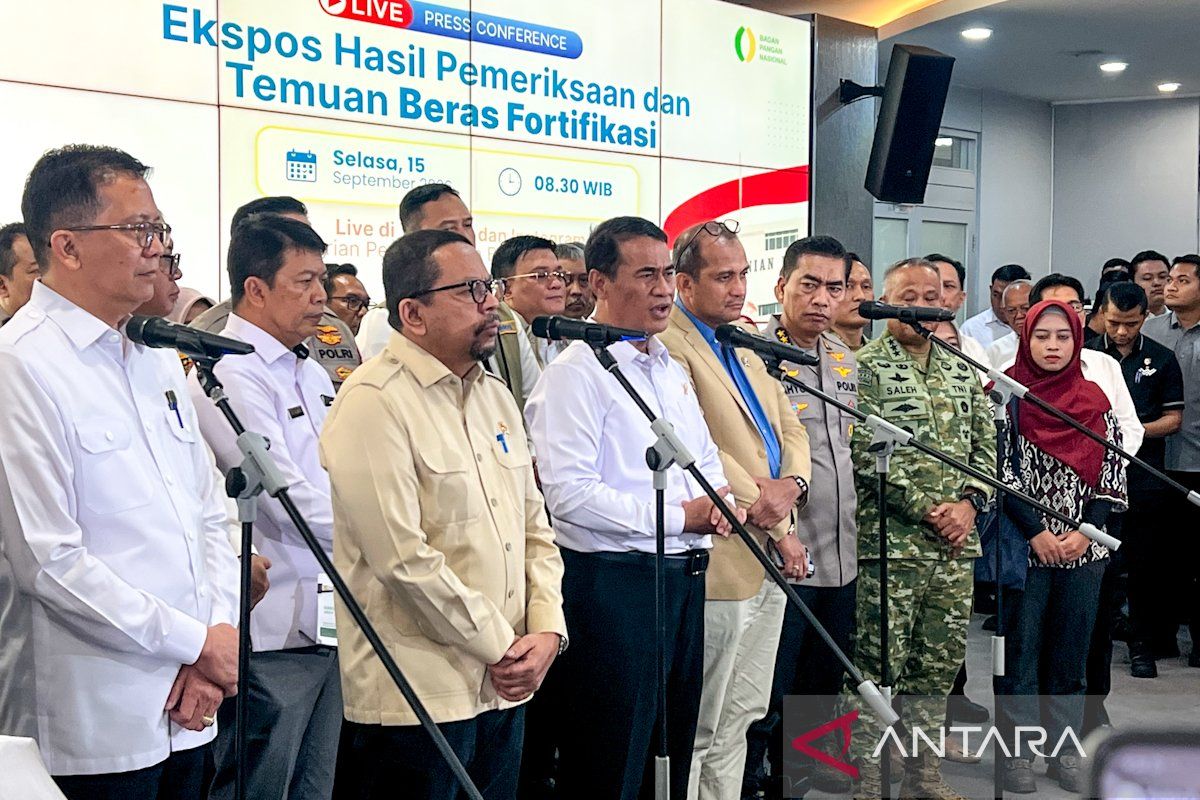
Jakarta (ANTARA) - Deputy Minister of Law (Wamenhum) Edward Omar Sharif Hiariej has stated that rice allegedly failing to match its labels has the potential to cause economic losses for consumers due to discrepancies in price and quality of food products within the national supply chain.
“This is certainly detrimental to consumers, both in terms of quality and economically. As explained earlier by the Minister (Agriculture Minister Andi Amran Sulaiman), products that should have sold at a certain price were being sold at soaring levels, and worse still, the contents did not match what was stated on the label,” Edward said in Jakarta on Tuesday.
He made the remarks during a presentation of the results of inspections and findings on fortified rice by Agriculture Minister and concurrently Head of the National Food Agency Andi Amran Sulaiman at the Agriculture Ministry’s central office in Jakarta.
The event was also attended by Head of the Government Communication Body Muhammad Qodari, the National Police Food Task Force, other law enforcement officials and relevant stakeholders, to discuss findings of suspected violations involving fortified rice.
Edward explained that such practices can economically harm the public because consumers pay high prices for products suspected of failing to meet the nutritional information stated on their packaging.
He said the suspected violations relate to provisions in the Criminal Code and the Consumer Protection Law, which govern the conformity between goods and product information to ensure optimal consumer protection.
The Deputy Minister viewed the issue as having wide-ranging effects on consumers’ finances because substandard quality reduces the value of goods purchased by the public, as a result of unhealthy trading practices.
Edward noted that the law allows for penalties in the form of fines and additional criminal sanctions, in accordance with applicable criminal regulations, for business operators proven to have committed violations.
Those additional sanctions, he continued, can encompass various legal measures up to the revocation of licences, thereby having a deterrent effect on businesses that harm consumer interests and preventing greater economic losses to the public.
“There are indeed specific provisions as set out in Articles 120 and 121 of the Criminal Code, that criminal offences allegedly committed by a corporation carry the threat of a fine plus additional criminal penalties, of which there are 12 items, and which can extend to a revocation (of business licences),” he said.
Nevertheless, Edward stressed that the next steps have been entrusted to law enforcement officials, particularly the Task Force, which will investigate the suspected violations to ensure economic protection for the public as consumers of the national food supply against suspected criminal acts.
“However, we will leave what follows to our friends in law enforcement, especially from the Task Force, which comprises colleagues from National Police Headquarters,” said the Deputy Minister.
Meanwhile, Agriculture Minister and Head of the National Food Agency Andi Amran Sulaiman revealed findings against 25 brands of fortified rice suspected of not conforming to the standards and contents stated on their labels, causing losses to consumers of up to Rp89 trillion.
“First, we have ordered a recall; second, the revocation of their licences; third, they will be processed. The total suspected loss is Rp89 trillion,” Amran said.
He stated that the 25 fortified rice brands failed to meet the nutritional content and quality requirements under SNI 9314:2024 for fortified rice kernels and SNI 9372:2025 for fortified rice.
The rice brands suspected of violations are WFO, TKS, IMF, NUR, TKL, HOK, BRV, IMR, IHJ, IAK, PBK, GNB, DTR, TKR, WJK, PLK, MKY, IMC, PTK, ARP, ARN, SKM, GNM, TAR and CMS.
In response to the findings, the government has taken firm action by ordering the withdrawal of the products from circulation, revoking licences and processing those suspected of involvement in accordance with prevailing law.
Beyond the issue of the rice’s nutritional content, Amran said the government found extremely high price disparities. Products that should have been priced at around Rp13,000–Rp13,500 per kilogram were found being sold for as much as Rp57,000 per kilogram.
According to Amran, such price differences are highly detrimental to the public when the products purchased turn out not to provide the fortification contents as promised.
“The highest was sold at Rp57,000. It should have been around Rp13,500. The difference can reach Rp44,100 per kilogram. This is very harmful to consumers,” Amran said.
Source: jawawa.id (https://jawawa.id/newsitem/deputy-law-minister-mislabeled-rice-harms-the-economy-and-consumers-1789469822)
Originally published by Antara (Indonesian) (https://www.antaranews.com/berita/5742120/wamenhum-beras-tak-sesuai-label-rugikan-ekonomi-dan-konsumen), translated from Indonesian