
Deputy Investment Minister states that providing incentives is a key strategy for downstreaming
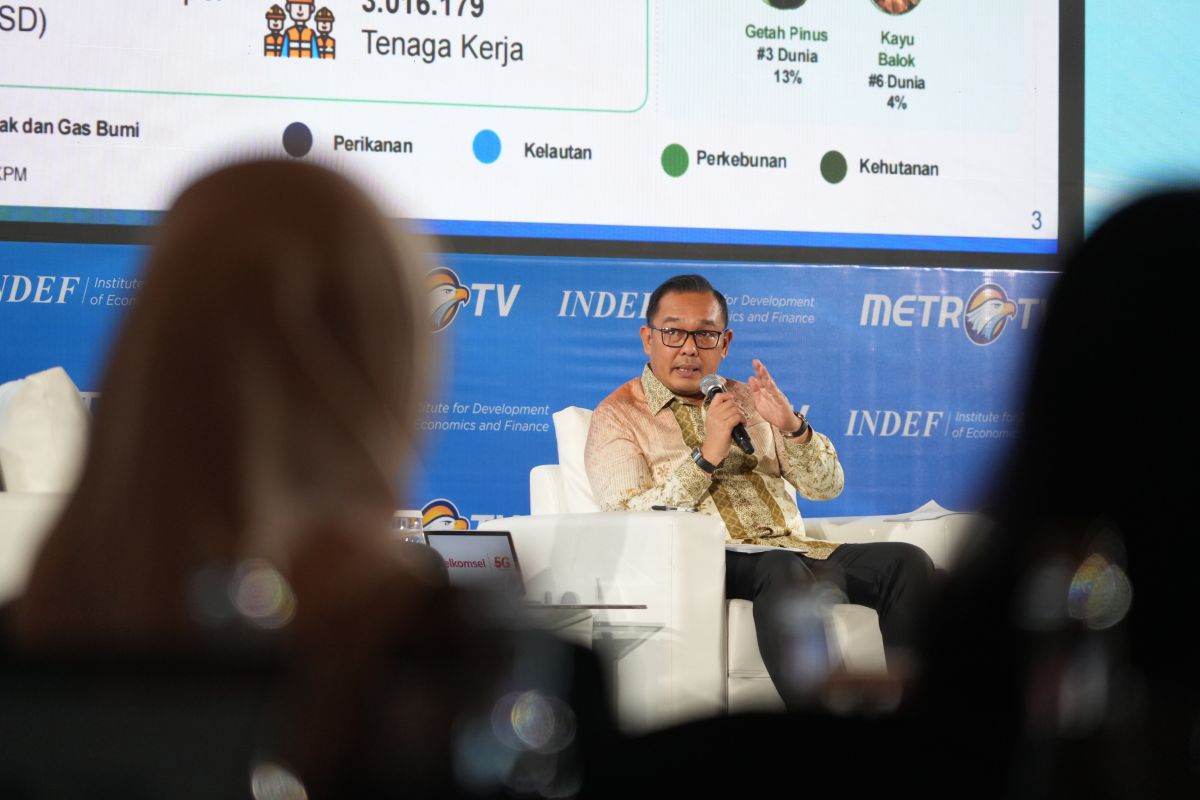
Jakarta (ANTARA) - The Deputy Minister of Investment and Downstreaming/Deputy Head of BKPM, Todotua Pasaribu, stated that planning, execution, and the provision of incentives are the three core strategies for attracting investment and strengthening downstreaming.
“When we discuss the role of the Ministry of Investment and Downstreaming/BKPM, we are talking about strategic planning, how to execute effectively, and also incentives,” Todotua said in an official statement received in Jakarta on Friday.
Todotua explained that the framework for attracting investment focuses on ensuring that incoming capital is both competitive and sustainable.
As part of this strategic planning, the Ministry of Investment and Downstreaming/BKPM has published the Strategic Investment Downstreaming Roadmap for 2022 and 2023. This roadmap details the downstreaming of 28 commodities across eight main sectors, with a total potential investment value of US$618.1 billion and the potential to create 3 million new jobs.
Furthermore, Todotua emphasised that the execution of the downstreaming process in Indonesia must be supported by business certainty and ease of doing business through an improved business climate and the refinement of business licensing policies.
Reforms to improve the business climate are being implemented through risk-based business licensing, the streamlining of licensing authorities, increased business certainty, and the simplification of the licensing issuance process.
Refinements to business licensing policies are ongoing, notably through the issuance of Government Regulation Number 28 of 2025 regarding the Implementation of Risk-Based Business Licensing.
Through these implementations and the integration of licensing via the Online Single Submission (OSS) system, the government hopes to minimise overlapping authorities and create a more systematic and measurable process.
The government, through the Ministry of Investment and Downstreaming/BKPM, is also offering various fiscal incentives to attract value-added investment into downstreaming sectors, using schemes such as tax allowances, tax holidays, masterlists, and super tax deductions.
“Investment entering Indonesia needs to be directed not only towards the construction of production facilities but also towards bringing technology transfer, research and innovation, and the mastery of more complex production processes,” said Todotua.
The implementation of these three strategies is ultimately expected to increase investment realisation, particularly in the downstreaming sector, and expand the contribution of downstreaming to Indonesia’s economic growth.
Throughout the first semester of 2026, total investment realisation in the downstreaming sector reached IDR 300.1 trillion, accounting for 29.7 per cent of total national investment realisation, an increase of 6.9 per cent compared to the same period in the previous year.
Realisation in the downstreaming sector was supported by Foreign Direct Investment (FDI) valued at IDR 212.8 trillion, or approximately 70.9 per cent of the total downstreaming sector realisation, and Domestic Direct Investment (DDI) which recorded a value of IDR 87.3 trillion, or approximately 29.1 per cent of the total downstreaming sector realisation.
Investment in the downstreaming sector has also proven to contribute positively to economic equality in Indonesia, with 75.7 per cent of investment realisation, equivalent to IDR 227.3 trillion, originating from investment projects located outside of Java.