
Deputy Interior Minister Promotes Sectoral Agglomeration to Address Urban Problems
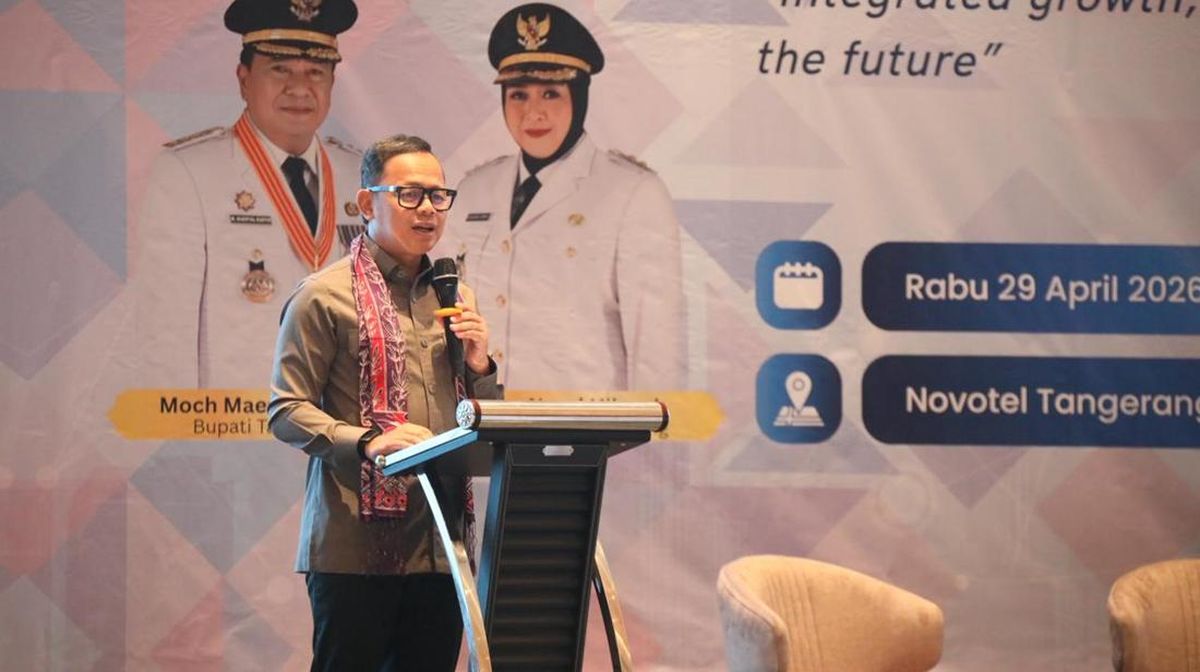
Deputy Interior Minister (Wamendagri) Bima Arya Sugiarto is promoting the strengthening of agglomeration concepts based on a sectoral approach to expedite the resolution of various issues in urban areas.
The statement was delivered at the National Seminar Discussion on Sustainable Agglomeration Aglo-City Summit 2026 at Novotel Tangerang BSD City on Wednesday (29/4).
According to Bima, the agglomeration concept is not new, but its implementation has often been hindered by an excessive focus on institutional aspects.
As a result, a number of cross-regional problems such as flooding, traffic congestion, and waste management have not been addressed optimally. He believes that a more concrete approach is needed to resolve these issues effectively.
“In China, sir, it has progressed like this until now because its agglomeration is working. Regulated by the centre, given models by the centre, so it relies on agglomeration. It can’t be done individually,” said Bima.
Furthermore, he explained that the Ministry of Home Affairs has a mandate to ensure effective synchronisation, synergy, and collaboration among stakeholders. Thus, development policies will no longer run partially but will be integrated within one ecosystem.
For this reason, Bima emphasised the need for a shift in approach from institutional to sectoral. According to him, focusing directly on issues will accelerate problem-solving in the field.
“Focus on issues and directly sectoral,” he stressed.
He cited waste management and transportation as key issues in agglomeration areas that require a sectoral approach.
The Waste Management to Electricity Energy Programme (PSEL) and the Local Service Delivery Improvement Programme (LSDP) were mentioned as forms of direct central government intervention focused on concrete problem-solving.
In addition, cross-regional transportation integration is deemed able to run more effectively if supported by clear authority, financing schemes, and inter-regional coordination within the agglomeration framework.
Bima affirmed that with central government support and regional government commitment, the agglomeration concept based on a sectoral approach has strong prospects as a long-term solution to urban area problems.