
Deputy Human Rights Minister Urges Mandatory Human Rights Due Diligence for Businesses
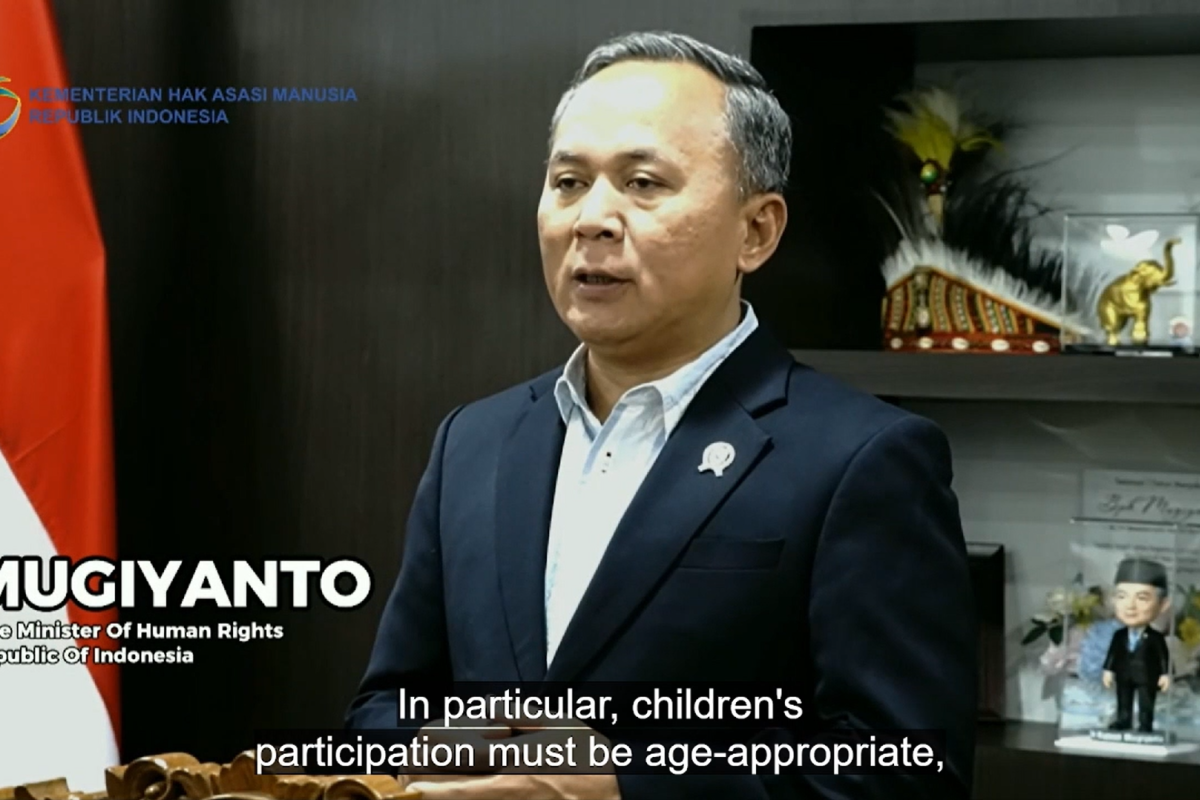
Jakarta (ANTARA) – Deputy Human Rights Minister Mugiyanto is urging stronger human rights due diligence obligations for businesses through regulations that integrate respect for human rights into corporate governance and operations.
The effort is being pursued through a draft presidential regulation on assessing business and human rights compliance by businesses. It forms part of Indonesia’s move from a voluntary approach towards more structured human rights due diligence obligations.
“The most important question is whether businesses can identify risks, prevent or mitigate impacts, assess the effectiveness of their measures, communicate transparently, and address adverse impacts when they occur,” Mugiyanto said in a statement in Jakarta on Thursday.
He made the remarks in a recorded keynote address to the 15th United Nations Business and Human Rights Forum in Geneva, Switzerland, on Tuesday (24 November).
According to Mugiyanto, respect for human rights in business cannot be achieved solely through corporate social responsibility (CSR) programmes or by merely meeting administrative requirements. The principle must be embedded in companies’ business processes and decision-making.
Human rights due diligence comprises six main elements: a human rights policy commitment; identifying and assessing actual and potential impacts; prevention and mitigation; monitoring and evaluation; transparent communication and reporting; and access to remedy for victims.
The Deputy Minister explained that moving towards mandatory human rights due diligence would not mean abandoning voluntary initiatives already undertaken by businesses. Instead, the aim is to reinforce those initiatives through clearer standards and stronger implementation and accountability mechanisms.
The approach is also intended to ensure that strengthening human rights obligations does not undermine the investment climate or business competitiveness. Indonesia is adopting a “smart mix” of policies, combining regulation with voluntary initiatives, incentives, recognition mechanisms, technical assistance and capacity-building for businesses.
Particular attention is being paid to micro, small and medium-sized enterprises (MSMEs) and suppliers in global value chains. Human rights due diligence requirements should be tailored to the size and capacity of businesses so that compliance costs are not unfairly passed on to smaller companies.
Larger companies are also expected to help build suppliers’ capacity and ensure that human rights-respecting business practices are applied throughout supply chains.
“The success of this policy must be measured by its impact on people,” Mugiyanto said.
He stressed that the success of human rights due diligence should not be judged solely by the number of reports submitted by companies. Meaningful participation by workers, local communities, women, children and other affected groups must also be ensured.
This requires safe and accessible grievance mechanisms that protect complainants from threats of retaliation. Indonesia is also developing a National Contact Point (NCP) as part of its commitment to accede to the Organisation for Economic Co-operation and Development (OECD), with the aim of strengthening responsible business conduct and access to remedy.
At the forum, which focused on strengthening the UN Guiding Principles on Business and Human Rights (UNGPs), the Deputy Minister set out three priorities for the Asia-Pacific region: strengthening the implementation of national action plans, developing effective human rights due diligence frameworks, and putting rights-holders at the centre through meaningful participation and access to remedy.
“Economic growth, investment and competitiveness will be sustainable if they go hand in hand with human rights. Respect for human rights builds trust and helps create a more inclusive and resilient business sector and economy,” he said.
The 15th UN Business and Human Rights Forum is being held from 23 to 25 November 2026 at the Palais des Nations in Geneva, Switzerland. The Indonesian delegation is also attending in person, represented by the Ministry of Human Rights, the Ministry of Foreign Affairs and the Permanent Mission of the Republic of Indonesia in Geneva.
Source: jawawa.id (https://jawawa.id/newsitem/deputy-human-rights-minister-urges-mandatory-human-rights-due-diligence-for-businesses-1795665193)
Originally published by Antara (Indonesian) (https://www.antaranews.com/berita/5879371/wamen-ham-dorong-kewajiban-uji-tuntas-ham-bagi-pelaku-usaha), translated from Indonesian