
Deputy Home Minister Ribka Calls for '5T' Principles in Papua Special Autonomy Fund Distribution
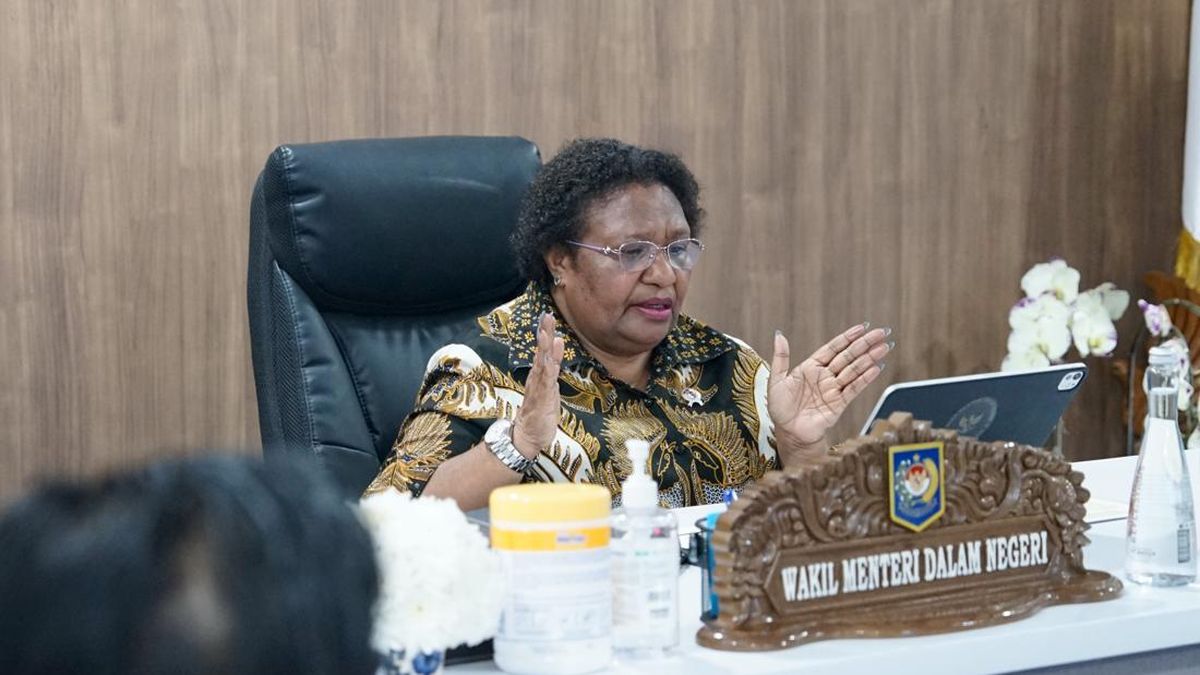
Deputy Home Minister (Wamendagri) Ribka Haluk has asserted that the success of Papua’s Special Autonomy (Otsus) Fund management cannot be measured solely by high budget absorption. According to her, the primary measure of success is the extent to which it delivers tangible impact for the welfare of the Papuan people.
This affirmation was delivered by Ribka while chairing the Meeting on the Acceleration of the Second Phase of the 2026 Fiscal Year (FY) Special Autonomy Fund Distribution in the Papua Region, held at the Ministry of Home Affairs (Kemendagri) office in Jakarta on Thursday (23/7).
During the meeting, Ribka explained that the government continues to strengthen the governance of the Special Autonomy Fund through cross-ministerial and institutional synergy, the development of an interoperability system, and more accountable oversight. These steps are being taken to accelerate the distribution of the Second Phase Special Autonomy Fund while ensuring its use is precisely targeted.
According to Ribka, these efforts have received full support from the Corruption Eradication Commission (KPK) through joint mentoring and supervision with the government. This collaboration is expected to strengthen transparency and prevent irregularities in the management of the Special Autonomy Fund.
‘The management of this Special Autonomy Fund is an important instrument. Therefore, together with the KPK, we are going directly to Papua, inviting all stakeholders to build a shared commitment so that its governance becomes increasingly better and more accountable,’ said Ribka.
She added that the collaboration between the Ministry of Home Affairs, the Ministry of Finance, the Ministry of National Development Planning/Bappenas, regional governments (Pemda), and the KPK has produced an interoperability system that strengthens oversight of the Special Autonomy Fund management. She noted that the system is beginning to show results with improved absorption of the Special Autonomy Fund compared to previous years. However, she stressed that the success of managing the Special Autonomy Fund must be measured by the benefits genuinely received by the Papuan people.
Ribka also highlighted the still significant amount of the remaining budget calculation surplus (SiLPA) from the Special Autonomy Fund in several regions, which has the potential to be used outside its intended purpose. She urged regional governments to be more disciplined in maintaining consistency between budget planning and execution, and to apply the ‘5T’ principles: tepat waktu (timely), tepat sasaran (accurate targeting), tepat jumlah (correct amount), tepat penerima (right recipient), and tepat penggunaan (proper use).
According to her, these steps are crucial to ensure that every rupiah of the Special Autonomy Fund provides optimal benefits for the community. ‘It is not only our systems that must be integrated, but our thinking must also be integrated. We are undergoing a transformation so that the governance of the Special Autonomy Fund becomes more transparent, accountable, and directly impactful for the Papuan people,’ she stressed.
Furthermore, Ribka stated that the Ministry of Home Affairs will continue to assist regional governments in strengthening the capacity of Special Autonomy Fund management apparatus, optimising the use of population data to ensure the accuracy of beneficiary targeting, and refining the interoperability system as a control and evaluation instrument. She expressed hope that these measures would realise transparent, accountable, sustainable, and results-oriented governance of the Special Autonomy Fund, so that the benefits of Special Autonomy can be genuinely felt by the people of Papua.